— Cinema tells stories. It invents a world, constructs an experience that people could not have lived through without watching the film. © David Lynch
1. VISUAL RESEARCH CONCEPT
«We view the world through a prism where everything is interpreted for us. And this prism infects our brains—we transform into it. It’s like a virus.» (Film «I Think About How to End It,» directed by Charlie Kaufman, 2020)
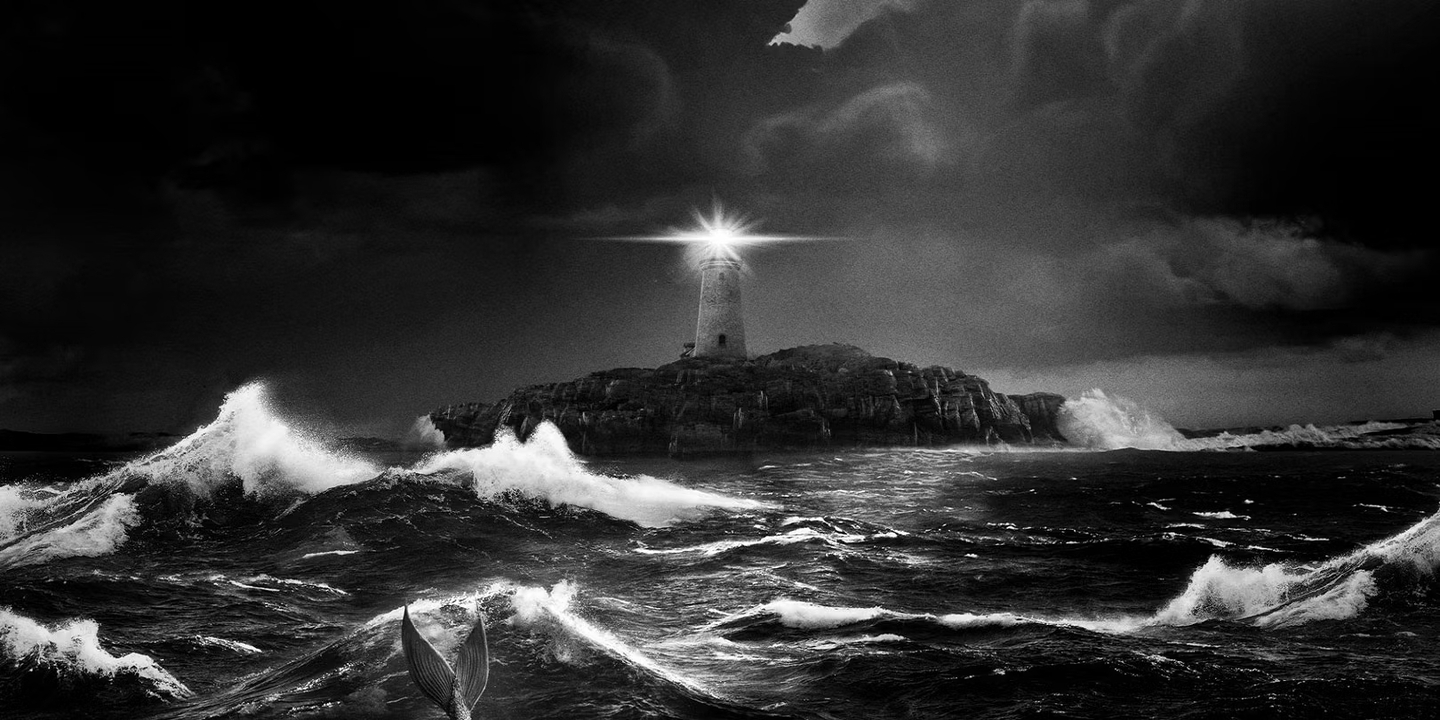
A frame from the film «The Lighthouse» (directed by Robert Eggers, 2019)
Surrealism in art—a movement founded on aesthetics, rules, space, and the worlds of dreams—is regarded as one of the most mystical, enigmatic, ambiguously interpreted, metaphorical, and symbolic movements of the 20th century.
It should be noted that surrealism, as an artistic movement, has not only profoundly influenced literature and painting but has also found its reflection in world cinema: the visual techniques developed within this movement allow artists, creators, and authors to construct unconventional and mysterious visual imagery, transporting the viewer into a world of fantasy and the subconscious, and creating metaphors and symbols whose meaning is illuminated through the lens of Freudian psychoanalytic theories and the interpretation of dreams accompanying a person’s life throughout time.
V.O. Petrov states the following: «This embodiment of surrealism is particularly evident in the field of cinema. We can cite films such as M. Ray’s A Trip to the Moon (1923), M. Duchamp’s Anemic Cinema (1926), and Luis Buñuel’s The Andalusian Dog (1929). A viewer who watches these films is entitled to ask, „Is there meaning in them?“ or to assert, „What deep meaning is embedded within them!”—it all depended on the viewer’s capacity for perception. The films are filled with abstract imagery and often lack a continuous narrative, being resolved as a sequence of disjointed frames or scenes. What is the reality within them? Rather, it is this: a confluence of the reality of the mundane and the reality of dreams.“ [3]
Film Stills: 1 — «Return to Sanity» (Dir. M. Ray, 1923), 2 — «Anemic Cinema» (Dir. M. Duchamp, 1926), 3 — «The Andalusian Dog» (Dir. L. Buñuel, 1929)
However, while 20th-century cinema, spurred by socio-cultural and political turbulence, allowed for the creation of completely «abstract» films—the decryption of which depended solely on the viewer’s intellectual capacity and the author’s willingness to build a tunnel toward the work’s resolution—contemporary cinema, existing within the rigid, and at times restrictive, confines of the commercial field and a highly competitive environment, is compelled to transform its developed cinematic aesthetic experience to suit the modern industrial and market landscape.
As a result, there is a noticeable trend toward a decline in both viewer and directorial interest in authentic surrealist aesthetics—those so-called «Almanacs of Abstract Images,» such as The Andalusian Dog (1929), The Poet’s Blood (1931), Holy Mountain (1973), The Eraserhead (1977), Pi (1998), and others. Contemporary cinema increasingly uses only isolated surrealist elements as material to reconstruct worlds and the logic of their narratives, rather than striving for a true metaphorical visual kaleidoscope.
The plots of such films become more logical, more structured, and more understandable, allowing surrealism as a medium of cinematic language and art to make the commercial more artistic, and the artistic—multi-layered.
Surrealist cinema in the 2010s and 2020s continues to evolve, offering viewers unique visual experiences and pushing the boundaries of what is possible in filmmaking. Every director and artist employs established rules for creating and manipulating surreal imagery in their own distinctive way, introducing their own alterations and interpretations. The incorporation of mirrors, erotic and religious symbolism, unconventional camera angles and in-frame compositions, visual patterns, dreams and visions, body horror elements, a focus on the unreality of the events, the symbiosis of the subconscious and the actual, and the compression and stretching of cinematic time continue to integrate into the narrative fabric, preserving the core concepts of surrealism. All these techniques help create a visual expression of people’s subconscious and fantastical thoughts and experiences. Directors, in turn, continue their experiments with film form and structure, sometimes deliberately breaking traditional cinematic conventions.
It has already been mentioned that surrealism, as a cinematic movement, does not exist in its concentrated form as it did 30–40 years ago; however, it remains a relevant and interesting genre that combines diverse visual characteristics.
Furthermore, the visual effects and animation in contemporary surrealist films allow for the creation of highly fantastical and astonishing images that impact the viewer through their uniqueness and the stunning beauty of the action, imagery, and visual metaphors.
In this research paper, we will examine the traditions of visual and narrative techniques that contemporary cinema inherits. How it integrates past cinematic experiences and abstract imagery into the fabric of a narrative—a narrative that is sometimes aimed at how the average viewer perceives themselves and their symbols. Or how modern production technologies and the contemporary cinematic language transform the existing surrealist cinematic experience into distinct narrative tracks.
2. SURREALISM — IT IS…
«The concept of surrealism is the uncontrollability of the mind, the unintended expression of a particular image» — Petrov V.O. [3].
Surrealism in cinema is a movement characterized by unusual and mystical plots, the play of imagination, and unconventional filming techniques. The defining features of surrealist film include the use of symbols, metaphors, and allegories to convey ideas and emotions, as well as a departure from linear narrative logic in favor of associative logic, all in service of engaging the viewer’s perception—eliciting surprise, shock, and bewilderment.
«The primary motifs and methods of conveying surrealism—the theme of dreams, the image of time, naturalistic details, unreality, the irrationality and irrational nature of events, as well as various phobias rooted in Freudian psychology» [3].
Surrealist films can resemble psychological dreams, where logic and the conventional rules of the world are absent. Sets may be absurd and unnatural, and objects might appear altered or distorted. The viewer senses they are watching a world where anything is possible—where reality merges with fantasy.
3. MIRRORS
The use of mirrors in cinema is a crucial technique for crafting diverse visual metaphors and moods in surrealist films. With their aid, filmmakers can achieve optical effects that distort the visual characteristics of the image, thereby lending new semantic contexts and expanding the spatial boundaries of the reality existing within the frame.
A reflection in a mirror can convey the emotional or physical dimension of a scene. For instance, by displaying the protagonist’s face in a mirror, one can reveal their inner turmoil and mood, or hint to the viewer at a subjective relationship to the unfolding events. This is achieved, for example, when characters are shown exclusively through their reflections, as Charlie Kaufman does in the film Anomalisa. In that work, characters are periodically displayed either through a broken mirror—which carries a negative semantic weight—or new characters are introduced through their mirrored reflections, suggesting that their existence is confined solely to this Looking-Glass world.
Still from the film «I Think About How to Finish It» (dir. Charlie Kaufman, 2020)
Another example of mirror use is the creation of various planes and their reflections within the frame to add depth to a space or to give it a fictitious visual expansion. Furthermore, individual mirrors or entire mirror labyrinths can be employed to generate a specific visual and narrative atmosphere inherent to the surrealist movement in cinema—an atmosphere of tension. Here, the mirror as a symbol is capable of conveying the idea of a blurring boundary between reality and fantasy, or the notion of the subjectivity of what is happening or what surrounds us.
Stills from the film «Suspiria» (dir. Luca Guadagnino, 2018)
4. GEOMETRIC PATTERN IN SETTING
Stills from the film «The Lighthouse» (directed by Robert Eggers, 2019)
Noticeable use of geometric patterns in the styling of films that claim surreal narrative motifs. Why? Such visual patterns play an important role in conveying a tense mood of a scene or unfolding events on a subconscious level, in focusing the viewer’s attention on specific elements of that scene, and in creating an aesthetic, artistic impression of «high art.»
Geometric patterns are also frequently used in cinema to create associations and moods. For instance, the use of horizontal lines and patterns evokes a sense of stability and tranquility, whereas vertical lines create a feeling of strength and overcoming obstacles. Circular shapes emphasize harmony and integrity, while sharp angles suggest anxiety and drama—which is characteristic of the films I highlighted with their surreal contextual landscape.
Geometric patterns can also be employed to underscore contrasts and interactions within a scene. For instance, scenes utilizing irregular or asymmetrical forms and patterns can convey chaos or conflict, especially when juxtaposed against more ordered or symmetrical elements.
Stills from the film «Suspiria» (directed by Luca Guadagnino, 2018)
In the 2018 film Suspiria, the geometric pattern of the setting is used to build increasing narrative tension surrounding both individual characters and the consequences of their actions. The mystery of the dance academy, the oppressive ballet studio, and the postwar Berlin exteriors—the presented visuals gradually begin to drive the viewer mad or hint that something equally crazy will happen within them sooner or later. What is fascinating here is that familiar, correct geometric shapes are intended to dismantle subconscious tranquility, not support it.
5. SYMMETRY
Stills from the film «Holy Mountain» (dir. Alejandro Jodorowsky, 1973)
In surrealist films, symmetry becomes a symbol of strangeness, detachment, unreality, allegorical depth, and metaphorical resonance in the imagery on screen, plot twists, and the world and space of the narrative.
Symmetrical compositions can be achieved by arranging objects, characters, and set elements symmetrically relative to the frame’s central vertical or horizontal axis. This technique allows for the conveyance of a sense of balance and harmony while simultaneously emphasizing the illogicality and unreality of scenes, individual figures, or even the characters themselves, because symmetry, as an outcome, does not conform to our accustomed laws of nature or reality. Symmetry is a hallmark of the artificial. The artificial symbolizes the nonexistent. And the nonexistent is the authentic metaphor for the surrealist cinematic movement.
Stills from the film «Suspiria» (dir. Luca Guadagnino, 2018)