Concept
Faith has always been a form of social control, and in the early Middle Ages, the church was unwilling to relinquish its power over people. We are accustomed to discussing frescoes and icons found in churches and cathedrals as a bible for the illiterate, but we should also remember that images can evoke diverse emotions and prompt contemplation. For people who could neither read nor write, frescoes and icons played a significant role, as they dictated to the illiterate what was right and what was wrong in this world. At first glance, frescoes and icons seem to be mere depictions of saints, but upon closer inspection, one can discern the common techniques that masters employed in creating their masterpieces. When examining religious imagery, one can observe not only how artists skillfully manipulate the viewer’s gaze, but also how they compel a person to experience specific emotions and to subconsciously internalize the rules established by the church.
Painting played a vital role in shaping people’s relationship with God: it dictated the rules by visually illustrating examples of good and evil, and it emphasized the fate of those who choose to stray from the path of faith.
My central research question is: what emotions was Romanesque and Gothic painting intended to evoke in people, and through what techniques did the masters manage to convey them?
I surmise that the work of artists influenced society differently across various periods. For instance, during the Romanesque period, the emphasis was on instilling fear of God, whereas the Gothic period required hope, love, and support for the people. Therefore, I expect to see more severe depictions in the works of XI–XII century artists, and in the XIII–XIV century imagery, I anticipate noticing a diversity of emotion conveyed by the author, as well as more fluid poses.
For my research, I selected religious imagery that clearly featured specific characteristics influencing how people perceived these works. I paid special attention to the composition, the expression of emotion, the postures, and the gestures of the characters, as well as their interactions. This allowed me to trace how artists conveyed religious ideas and shaped the human relationship with the divine through painting.
This division allows one to trace how the image of God and humanity’s relationship with it have changed over time. Within each block, I have also highlighted thematic subpoints that helped me present the material more structurally and group the works by common themes. This provides a clearer view of the differences between the two periods and illustrates how the artistic techniques and the emotional impact of religious painting on the viewer have evolved.
Romanesque Period (11th–12th Centuries)
During the Romanesque period, the Church sought to maintain control over people; consequently, art needed not only to guide individuals toward the true path but also to instill fear of God.
Because of this, popular subject matters for depiction have become the «Last Judgment, ” apocalyptic themes, and so on.
God as the Supreme Judge
During the Romanesque period, God was depicted as a stern judge wielding authority over the entire world. His image was intended to intimidate people, reminding them of their sinfulness and the impossibility of concealing anything from God.
Fresco «Christ in Glory» (San Angelo in Formis, Capua), 11th century
To see the fresco, you must lift your head to the figure of Christ, whose gaze is directed downward, toward the mortal. Thanks to its unique composition, the influence of this fresco on the viewer is amplified, creating a sense of God’s personal presence.
Fresco «The Last Judgment» (West Wall, San Angelo in Formis, Capua), 11th Century
At the entrance, a fresco titled «The Last Judgment» greets visitors, seemingly implying to everyone before they leave that a person must abide by God’s law not only in church but also in daily life, as the Last Judgment will come for everyone.
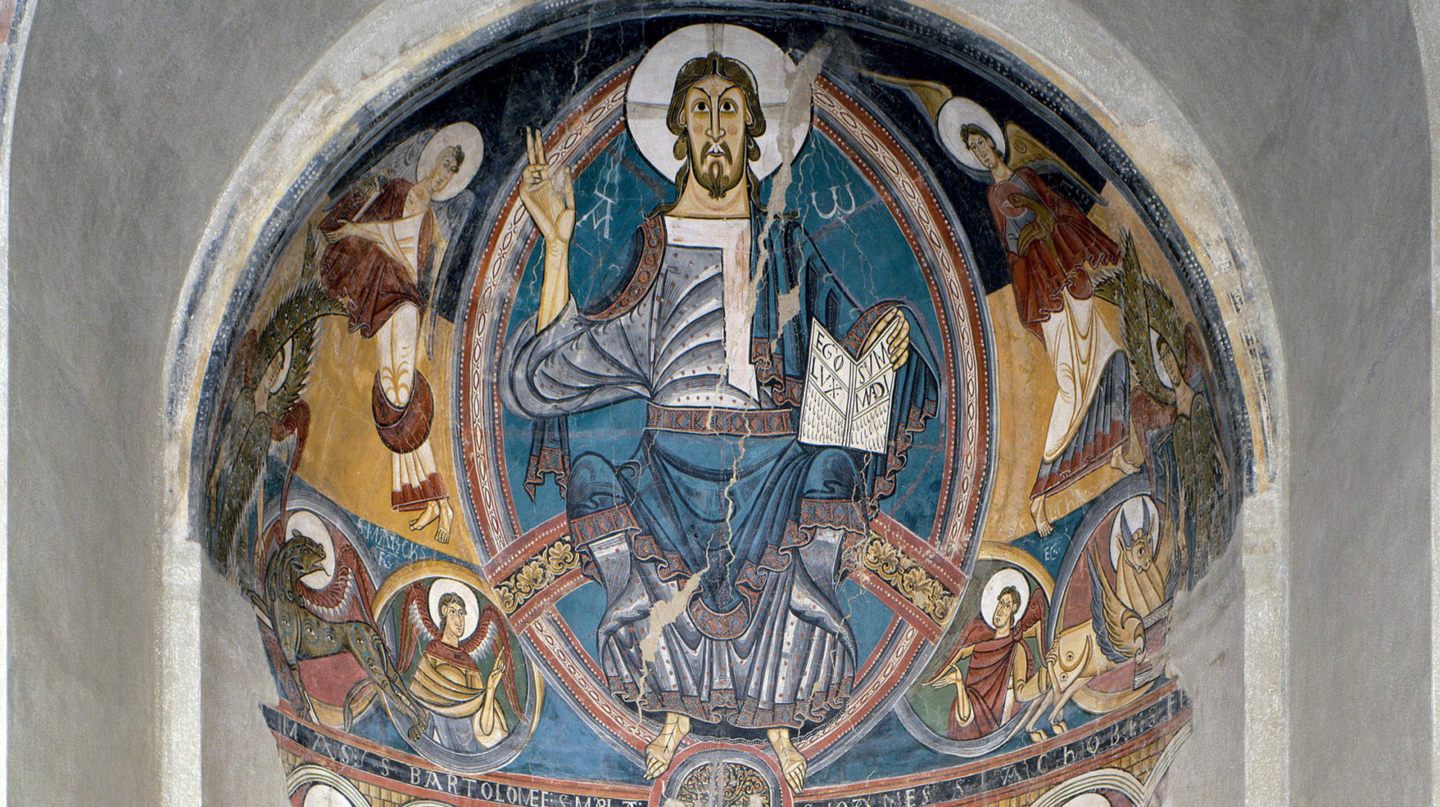
Apse of the Saint-Clément-de-Taul Church, circa 1123
In this fresco, the figure of Christ is the largest. He is also positioned high up, but now with a stern gaze, reminding people that they must obey God’s laws.
Fragment of the apse of the Saint-Clément-de-Taule church, circa 1123
The apostles, depicted below the Son of God, bear witness to the divine power of Christ.
Madonna on the Throne Fresco, circa 1123
The artist emphasizes the divine status of the Madonna and Child by portraying them at the center of the composition and significantly larger than the other figures.
Fragments of the fresco «Madonna on the Throne,» circa 1123
The insignificance of earthly rulers is reflected by the author in their humble postures, making them resemble servants more than sovereigns.
Fragment of the fresco «Christ in Glory,» circa 1180.
The figure of Christ is the largest element in the composition. The artist emphasizes the power of the Son of God by placing him at the center of the composition, reminding humanity of the necessity of humility before God.
Fragments of the fresco «Christ in Glory,» circa 1180.
The Ineffability of the Divine
The grandeur and ineffability of the divine world are also achieved through the depiction of fantastic creatures that do not exist in nature. They evoke in humanity an awareness of its own powerlessness before the Almighty.