Navigator
- Concept
- Roger II and Byzantine Tradition in the Mosaics of Mantua
- The Image of William II in the Mosaics of Monreale
- Comparison of Royal Figures in Mantua and Monreale
- Conclusion
Concept
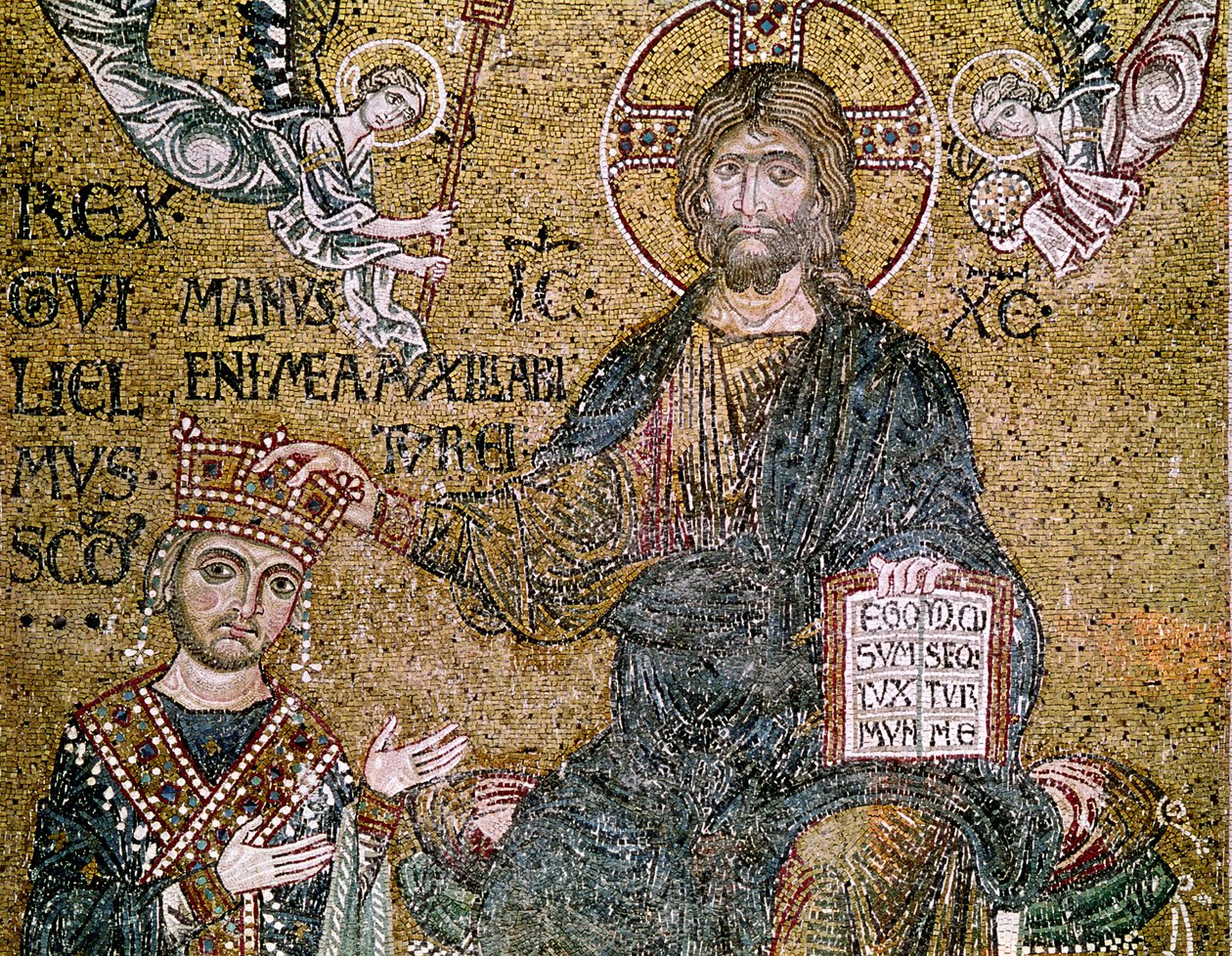
In the Martorana church in Palermo, there remains a mosaic depicting Christ placing a crown on the head of the Sicilian King Roger II. A similar scene can be found in the Monreale Cathedral, although there, a different ruler receives the crown from Christ: William II. This same cathedral also features an image of William holding a model of the church. The king stands before the Virgin Mary, presenting her with the cathedral built at his request.
All three mosaics were created in the 12th century and help us understand how the Norman rulers wished to present themselves and why they turned to Byzantine art to do so.
The Normans came to Sicily from Western Europe, but the island for a long time was influenced by other cultures. Under Roger II in Palermo, artisans worked who were familiar with Byzantine mosaic techniques. This was particularly noticeable in the royal depictions: the rulers wore clothing reminiscent of Byzantine emperors' vestments and were also shown alongside Christ or the Virgin Mary. I became interested in precisely which details were adapted from existing models and what the artists changed when depicting the Sicilian kings. It is also important to examine how distinct these images from the two different churches were.
The foundation of the research will be the mosaics of Mantuan, created in the mid-12th century, as well as later compositions from the Monreale Cathedral.
For a detailed analysis, I have selected the coronation of Roger II, the coronation of William II, and the presentation of the Mother of God’s cathedral. In Martorana, I am also examining depictions of George of Antioch, the founder of this church. This serves as a point of comparison: George served the king, but his relationship with the Mother of God is depicted entirely differently in the mosaic itself. An additional example will be a 10th-century Byzantine relief of the coronation of Emperor Constantine VII. This will demonstrate that the motif of Christ placing a crown existed long before the creation of the Sicilian works.
The images will be organized by two monuments and then compared against each other. First, I will present the complete images so that the characters can be seen. After that, I will examine the images in more detail—the crowns, the robes, the hands, and the inscriptions. In these details, significant differences can be noticed; for instance, in Martorana, Christ stands next to Roger, while in Monreale, he is seated on a throne. In the presentation scene, it will be important to examine the model of the building itself and the king’s posture. The images will be chosen as the analysis progresses; for every major fragment, I will specify exactly which details to focus on.
The work is divided into three main sections. The first is dedicated to Mortara—the circumstances of its creation, the mosaic of Roger II, and the depiction of George of Antioch. The second section examines two royal compositions in Monreale. Here, it is important not only to describe the figures but also their placement near the main altar. In the third section, I will compare the works already studied.
This structure helps avoid retelling the history of the Norman kingdom in isolation from the imagery, instead referring to it only when it aids in explaining a specific artistic detail.For this work, I will utilize scholarly publications on Sicilian mosaics and medieval royal portraiture. Ernst Kitzinger’s research assists in understanding the structure and artistic program of Monreale. Don Mario Hayes’s works examine the attire of Roger II, while Mirko Vianoni analyzes the depictions of William II and their placement within the cathedral. Furthermore, the researchers' interpretations do not always align. For instance, the coronation scenes can be understood as an expression of the ruler’s political ambitions, but their location within the church necessitates considering their religious function as well. I will correlate these explanations with what is genuinely visible in the mosaics, separating verifiable facts from potential interpretations.
Key research question: How did Norman rulers use monumental mosaics to assert their political and religious standing?
Research Hypothesis: The depictions of kings in imperial regalia, scenes of coronation by Christ, and offerings to the Virgin Mary linked royal power to divine patronage and the traditions of Byzantine imperial art.To test this hypothesis, I first turn to the artworks themselves: their composition, gestures, attire, and inscriptions. I then compare the images of two rulers to determine precisely which techniques were preserved throughout the entire 12th century. This will require considering who commissioned the mosaics and who could view them in the original church interior. This approach will help draw conclusions about the royal image without attributing intentions to the artists that cannot be confirmed by visual material or historical sources.
Roger II and the Byzantine Tradition in the Mosaics of Mantua
In 1130, Roger II received the royal title and became the first ruler of the Kingdom of Sicily. His domains included the island and parts of Southern Italy. The new state united lands with diverse customs, languages, and artistic traditions. In Palermo, one could encounter Byzantine mosaics, and the influence of Islamic art persisted in court culture. When creating royal portraits, masters could draw upon models that differed from conventional Western European monarch portraits.One such image is located in the Church of Santa Maria del Ammiraglio, commonly known as Mortara. It was founded by George of Antioch, who held the high office of Grand Admiral under Roger II. The church is also mentioned in a 1143 document, and its early mosaics are generally dated to the mid-12th century, before the founder’s death in 1151.The initial structure of the building was later altered. Two compositions from the western section are particularly significant for this theme: Christ crowning Roger II and the Virgin Mary accepting the prayer of George of Antioch. Currently, these mosaics are not in their original positions, which is an important consideration when interpreting the patron’s intent.
Interior of the Church of Santa Maria del Ammiraglio (Martorana). Mosaic decoration from the mid-12th century. Palermo.
The coronation mosaic is composed quite clearly and simply. Two figures stand on a gold background: Roger II is depicted on the left, and Christ on the right. Behind them, there is no palace, cathedral, or other people who might typically participate in a royal ceremony. The artist focuses the viewer’s attention on Christ’s action, whose hand rests upon the ruler’s crown. Christ is slightly taller than Roger, and the king himself bows his head and raises his hands toward his chest.Roger’s coronation took place on December 25, 1130, but the mosaic itself appeared later. It does not depict the actual ceremony; instead, it illustrates a symbolic scene where Christ himself bestows the crown upon the ruler, even though in real political life, obtaining a royal title was tied to the relationship between the Normans and the Papacy. The absence of clergy and other noticeable background details here is significant. On the mosaic, the viewer sees only the king and the one to whom Christian tradition attributes the highest authority. This choice of subject matter was particularly important for the new kingdom, which needed to establish its place among other European states.
Mosaic «Christ Crowning Roger II.» Circa 1143–1151. Cattedrale di Martorana, Palermo.
If one examines the figures more closely, it becomes apparent that they behave differently. Christ stands upright, having turned his head slightly toward Roger. In one hand, he holds a scroll, while the other is extended toward the crown. Roger’s shoulders are slightly turned, his head is bowed, and his palms are directed toward Christ. The king does not touch the crown nor attempt to hold it; his gesture more closely resembles prayer. Moreover, Roger stands on his feet, and his face is directed toward the viewer. The artist shows reverence toward Christ without reducing the monarch to a completely subservient figure.
The similarity of the two characters’ faces is also interesting. Roger has long hair and a beard, so some of his features resemble the depiction of Christ on the right. However, the artist does not make them equal or alike. Christ is noticeably larger, and a cruciform halo encircles his head, which the king lacks. This similarity can be linked to the Byzantine tradition of equating an earthly ruler with a heavenly archetype. Nevertheless, based on the mosaic alone, one cannot assert that Roger was intended to be represented as Christ. On the contrary, the difference in scale and gestures maintains the distance between them.
Mosaic «Christ Crowning Roger II.» Fragment depicting the crowning gesture. Circa 1143–1151.
Particular attention is paid to the clothing of Roger II. He wears a long blue tunic, over which elaborate fabric decorations featuring golden botanical patterns are visible. A wide sash with a geometric ornament crosses his chest and torso. The loros is part of the ceremonial attire of Byzantine emperors; in the mosaic, it stands out with light and red inlays resembling precious stones and pearls. If you obscure the characters' faces and focus solely on the king’s costume, his connection to the Byzantine imperial image remains noticeable.By the mid-12th century, the form of the loros depicted on Roger already appeared outdated by the standards of the Byzantine court. Researchers offer various explanations for this. Ernst Kitzinger linked the mosaic’s characteristics to the use of earlier artistic models. Don Marie Hays considers the choice of such a costume in relation to Roger’s political claims and the significance of imperial regalia. These explanations do not necessarily exclude one another—the masters might have worked from familiar patterns, and the type of clothing was suitable for representing the high status of the Norman king. It is impossible to definitively determine the motive behind the choice from a single image.
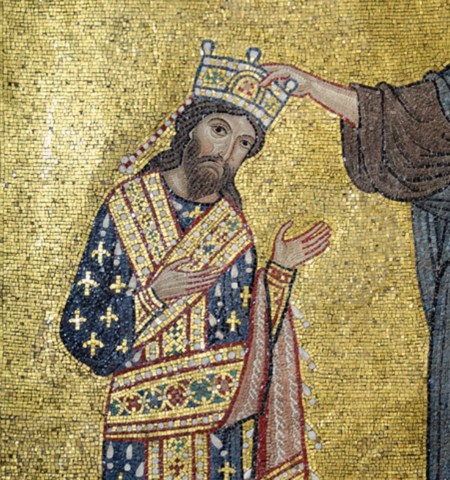
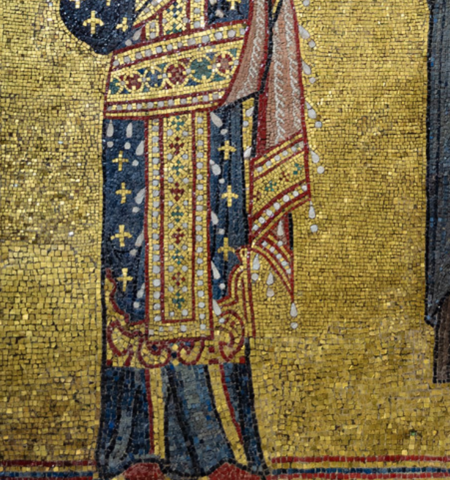
Mosaic: «Christ Crowns Roger II.» Fragment depicting the king’s ceremonial vestments. Circa 1143–1151.
The crown complements this costume. It is open-faced, relatively tall, and features side pendants adorned with pearls. Such details appear in Byzantine depictions of emperors. Here, the crown is significant for two reasons: it denotes Roger’s status, and simultaneously, it becomes the focal point of the main action. Christ’s hand is pointed directly at it, so the viewer’s gaze returns to the moment of coronation even after examining the other details.
Above Roger’s head is a Greek inscription. The name is rendered as «Rogerios, ” and the title „king“ is written in Greek letters as „rix, ” derived from the Latin rex. This is an interesting detail: the language of the image is linked to Byzantine tradition, yet the title remains Western. Roger is dressed like an emperor, but he is inscribed specifically as a king. The artists employed the conventional method of representing supreme authority, preserving Roger’s official title.
Mosaic «Christ Crowning Roger II.» Fragment featuring the crown and Greek inscription. Circa 1143–1151.
The mosaic can be compared to a 10th-century Byzantine relief depicting Christ crowning Emperor Constantine VII Bagranoi. In both works, Christ stands beside the ruler and touches his crown. The emperor, like Roger, bows his head and raises his hands. The ceremonial robes and the overall arrangement of the figures are also similar.This parallel suggests that the Sicilian masters did not invent a new coronation scene, but rather referenced an image already well-established in Byzantine art.
Ivory relief: «Christ crowns Constantine VII Porphyrogenitus.» Mid-10th century.
Furthermore, the differences are clearly visible. In the relief, Constantine turns more toward Christ, whereas Roger faces the viewer almost directly. Additionally, the relief depicts a Byzantine emperor, while the Martorana features a Norman king. The crucial point is the possibility of this alteration—that the recognizable scheme of imperial representation is employed to depict a ruler from another state. This does not prove that one master saw this specific relief. Rather, it serves as a vivid example of an earlier artistic tradition.
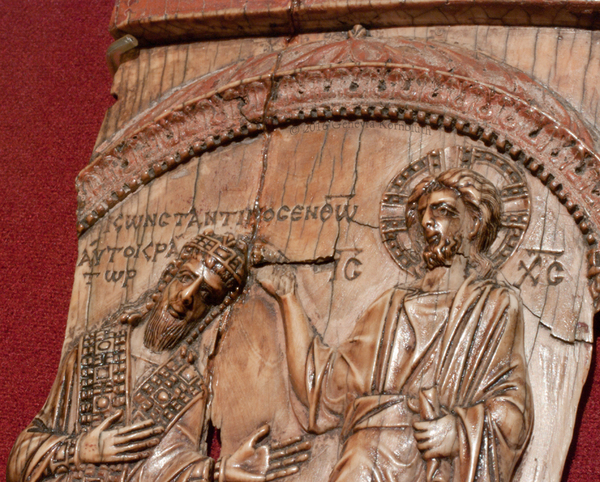
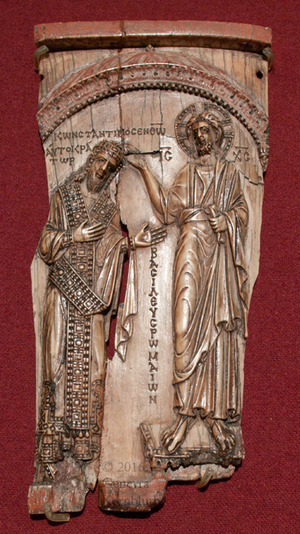
Ivory relief «Christ Crowning Constantine VII Porphyrogenitus.» Mid-10th century.
In Martoran, there is another mosaic that was dedicated to a historical figure. On it, George of Antioch is depicted at the feet of the Mother of God. She is shown almost full-length, with her head slightly turned and holding a long scroll. In the upper corner, inside a blue circle, is Christ. George is very small compared to the Mother of God, and his figure is positioned along the lower edge of the entire image. His attire suggests he was a man of high standing, but his posture conveys his prayerful supplication.
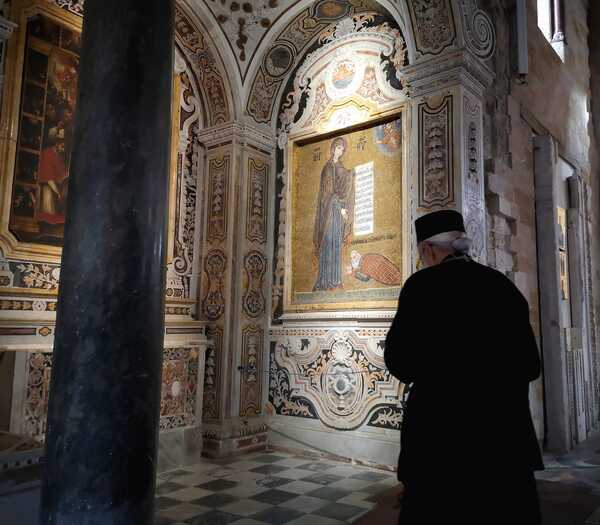
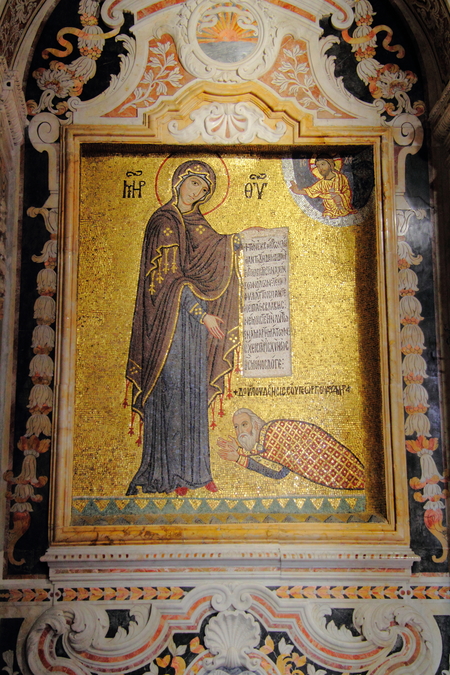
Mosaic of «George of Antioch before the Theotokos.» Circa 1143–1151. Martorana Church, Palermo.
The scroll held by the Mother of God helps reveal the narrative. The Greek text contains her plea to Christ for the protection of George and the forgiveness of his sins. The inscription also mentions the temple he founded. The subject revolves around the prayer for the man who established the church. George addresses the Mother of God, and she intercedes before Christ. The direction of the gestures and the arrangement of the figures correspond to the meaning of the narrative. It must be noted that the mosaic underwent restorations, so not every detail of George’s figure can be considered completely preserved from the 12th century.
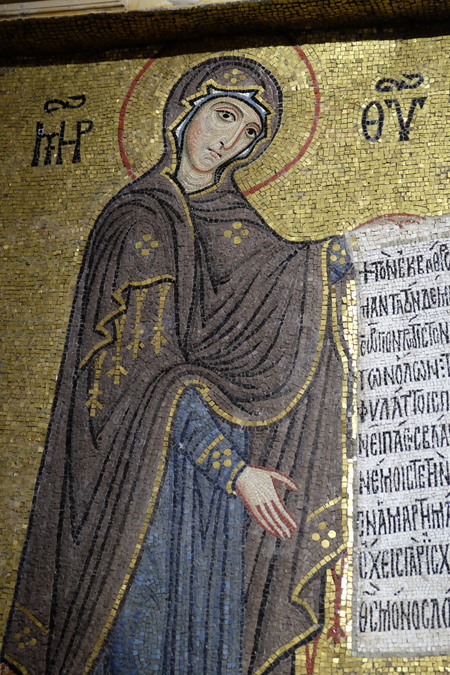
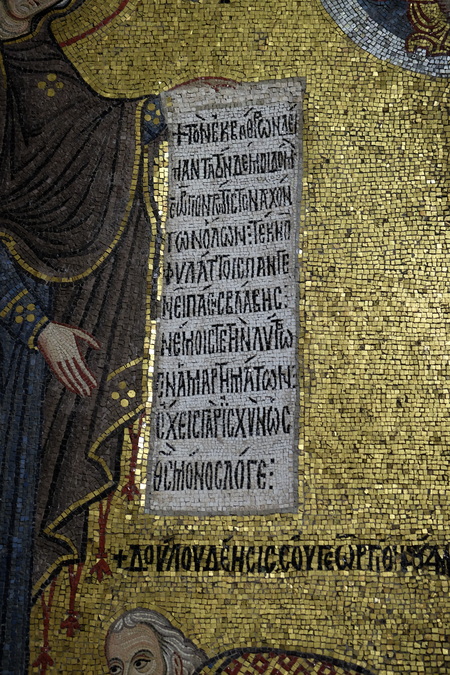
Mosaic, «George of Antioch before the Theotokos.» Fragment with a Greek inscription and an image of Christ. Circa 1143–1151.