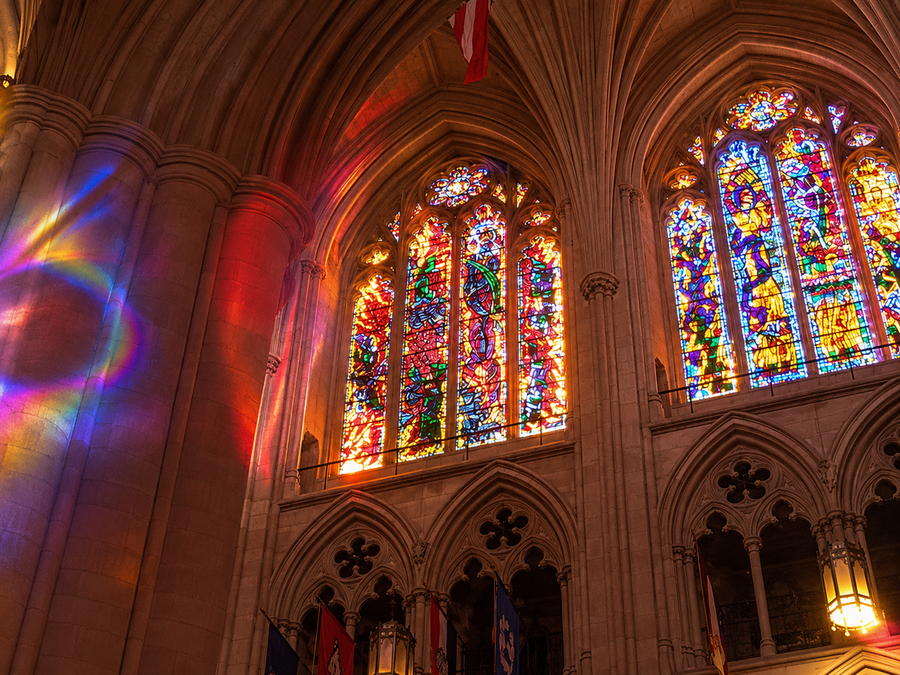
Цвет и свет витража в визуальной системе готического собора
Concept
The stained-glass windows of Gothic cathedrals—which allow light to pass through vibrant glass fragments—have captured attention and drawn people in both in the 12th century and today. The interplay of color and light creates an emotionally rich space and a sense of connection to a transcendent world. This is why stained glass remains a relevant object of visual investigation: it allows us to understand how fine art and religious consciousness coalesce into a single system.
Stained Glass (from French vitrage—glazing) is the surface of walls, windows, and door openings that are covered with glass. Thanks to the unique combination of colors, their placement in the image, the thoughtful interaction with light, and symbolic meaning, stained glass has become one of the forms of fine art.
Stained glass can be considered a mechanism for transforming the space of a cathedral using color and light. It is thanks to these indispensable elements that the religious experiences of people inside the sanctuary have become more complex and profound.
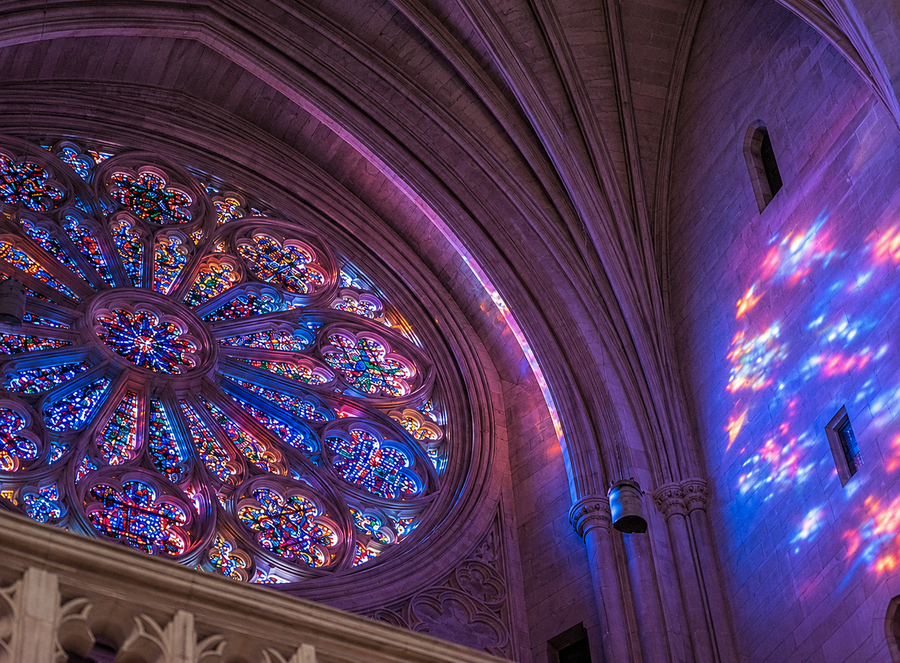
«West Rose» Window. Washington National Cathedral. Washington, D.C. 1976.
The color and light of stained glass are integral components of a person’s visual and spiritual perception of the cathedral and of faith. I was specifically drawn to the unified visual language of stained glass art: color and light coexist inextricably with one another. Color is only manifest because of light, which in turn gains symbolic expressiveness through the colored glass.
The research topic focuses on studying color and light as integral elements of Gothic stained-glass art, and their role within the cathedral’s visual system.
Ключевой вопрос:
How do the color and light of a Gothic stained-glass window function within the visual system of a cathedral as a unified language, shaping a particular sacred perception of the entire interior space?
Hypothesis: In a Gothic cathedral, the stained glass functions not merely as a decorative element but as an instrument for imbuing the entire interior space with sacred meaning. As light passes through the stained glass, it begins to symbolize the divine image descending into the earthly world, and the color shapes the human connection to higher powers.
For the visual context of my research, I selected photographs of stained glass, which most vividly illustrate the interaction between color and light. I chose images that allow one to examine the functions of stained glass: creating a sacred atmosphere and transforming the cathedral into an emotionally resonant space.
In studying the materials for this research, I relied on literary sources, academic articles, and electronic resources that thoroughly describe the history of stained glass, its development during the Gothic period, and the elements of stained glass itself (color and light). Because this topic remains relevant, researchers continue to study it today, so I utilized contemporary literature to find information. I examined books, articles, and other materials dedicated to Medieval stained glass from the 12th to 14th centuries. Thanks to these resources, I was able to analyze how stained glass changed its decorative and utilitarian significance to a spiritual and religious one, as well as identify the functions, characteristics, and symbolism of color and light within the visual system of the cathedral.
In my visual research, the color and light of stained glass are examined sequentially following a unified framework: their function within the cathedral, their artistic characteristics, and their symbolic meaning. Separate chapters are dedicated to a brief history of stained glass and the human perception of the synthesis of color and light. This approach allows for the exploration of the two components of stained glass art not merely as standalone elements, but as part of a cohesive visual and spiritual system.
Historical Background
The Gothic period is considered the zenith of stained-glass artistry. Furthermore, it is worth noting that stained glass has held significant importance for people across all eras. In Ancient Egypt, inhabitants crafted various vessels from glass, and the Sumerians, for instance, decorated the roofs of their temples with it. However, over time, the utilitarian significance of glass evolved into something spiritual. By placing glass within the window frames of a cathedral and allowing light to filter through the colored fragments, humanity discovered another world—a world where one can feel a connection to the divine.
The flourishing of stained glass art occurred during the Gothic period: pointed arches became a defining feature of 12th–14th-century Gothic architecture, leading to the colossal development of stained glass. It is also worth noting that, in addition to the increased amount of light in the cathedral’s interior space, the narrative compositions of the stained glass replaced earlier imagery.
Windows in the Saint-Saëns Cathedral. France.
«Light passing through colored glass, like the brilliance of precious stones, helps the soul ascend to the source of true light—to Christ, ” said Abbot Suger. [1]
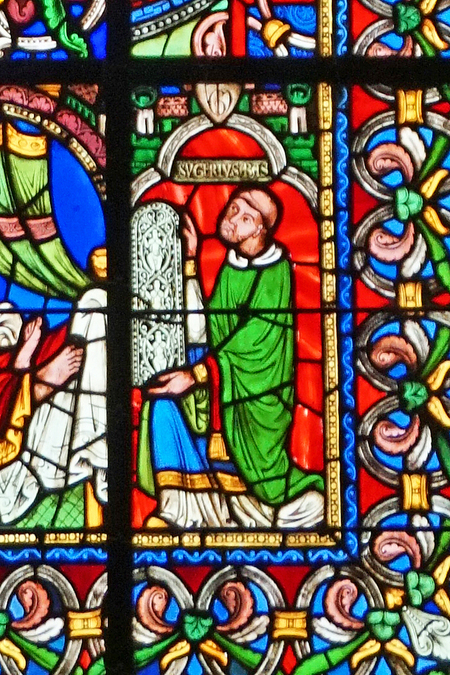
It was Abbot Suger, the father of Gothic architecture, who imbued the construction of one of the churches with special significance regarding the symbolism of light, thereby opening up new possibilities in stained-glass artistry within the sanctuary. The light filtering through the colored stained-glass panes washed over the walls of the church, creating a sense of a mystical, divine presence.«For him, contemplating the stained glass became one of the spiritual paths from the material to the immaterial, from the human to the divine.» [?] St. Petersburg Stained Glass, KnyazhitskayaIllustration: Abbot Suger is depicted kneeling in the lower right corner of the stained-glass window, «The Tree of Jesse, ” in the Chapel of St. Mary, Basilica of Saint-Denis, France.
Color
1. Functions
Color in Gothic stained glass serves several functions, moving from the stained glass as an object to its influence on the human inner world.
Color in a Gothic stained-glass window performs several functions—shifting from the stained-glass panel as an object to its influence on the inner world of the human being.
(1) Artistic Function: A complete image is created through the repetition of colors. The stained glass palette consists of specific hues, and their color unity creates a harmonious perception of the entire work.
It is worth noting that this harmony can be built upon both analogy and contrast. In the case of analogy, the color combination is achieved through the similarity of tones and the closeness of saturation and brightness, which consequently evokes feelings of calm and tranquility (Illustration 1). If one chooses a stained glass color scheme in opposition to the principle of similarities, a harmony of contrast results (Illustration 2): in this case, the colors become more dramatic, reflecting stronger and more complex emotions.
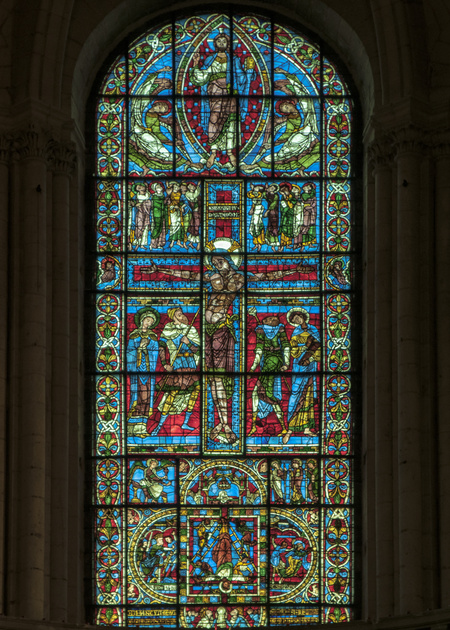
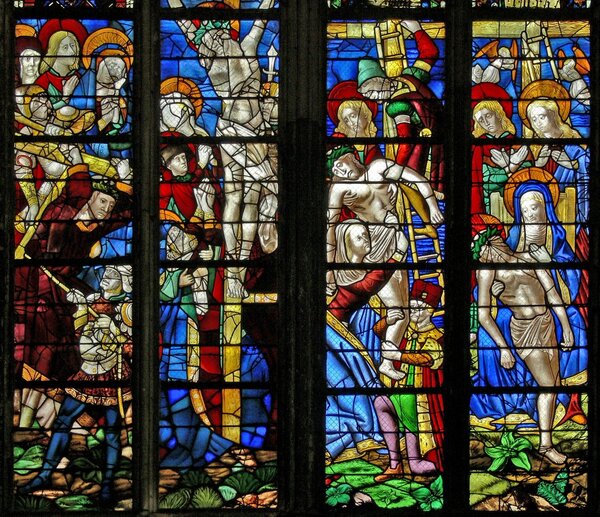
(1) Stained Glass of the Crucifixion in St. Peter’s Cathedral. France. (2) Notre-Dame Cathedral in Rouen. France.
(2) Compositional Function: Color separates sections of the stained glass and helps emphasize the main motifs in the composition.
(3) Notre Dame de la Belle Vue. France.
With the help of color contrast, masters highlight primary figures, logically separate distinct elements, and entire compositions. Color assists the viewer in organizing and structuring the image of the stained glass. The red color in illustration 3 frames the saint’s figure, setting it apart from the background figures surrounded by blue.
(3) Spatial Function: Color transforms the cathedral’s interior by illuminating the walls with vibrant patches through light passing through stained glass.
Light filtering through the stained-glass windows adorned the cathedral’s floors and walls with «jewels.»
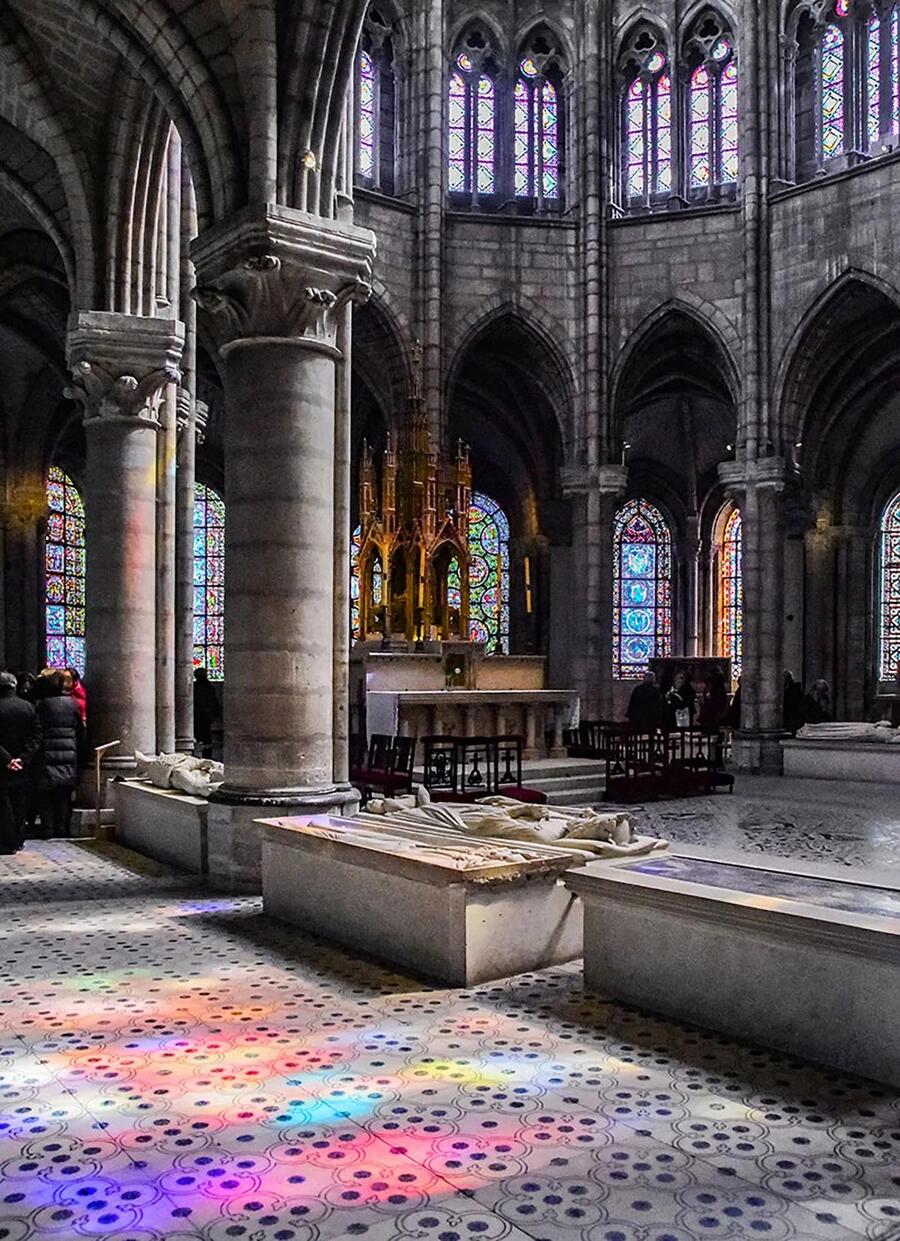
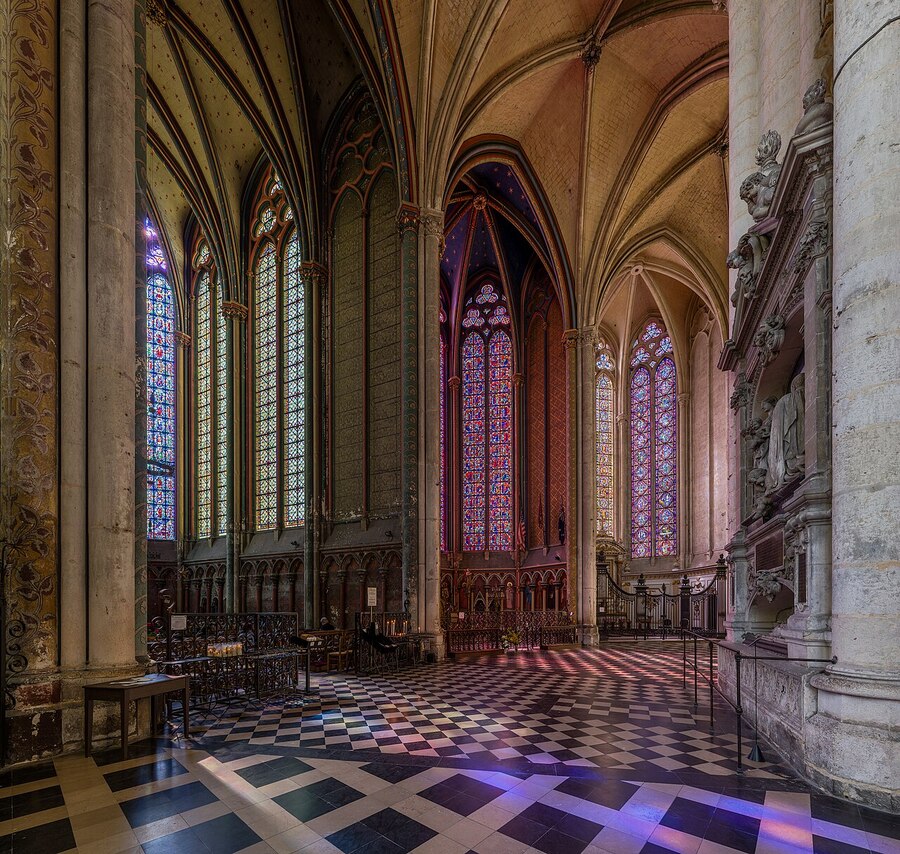
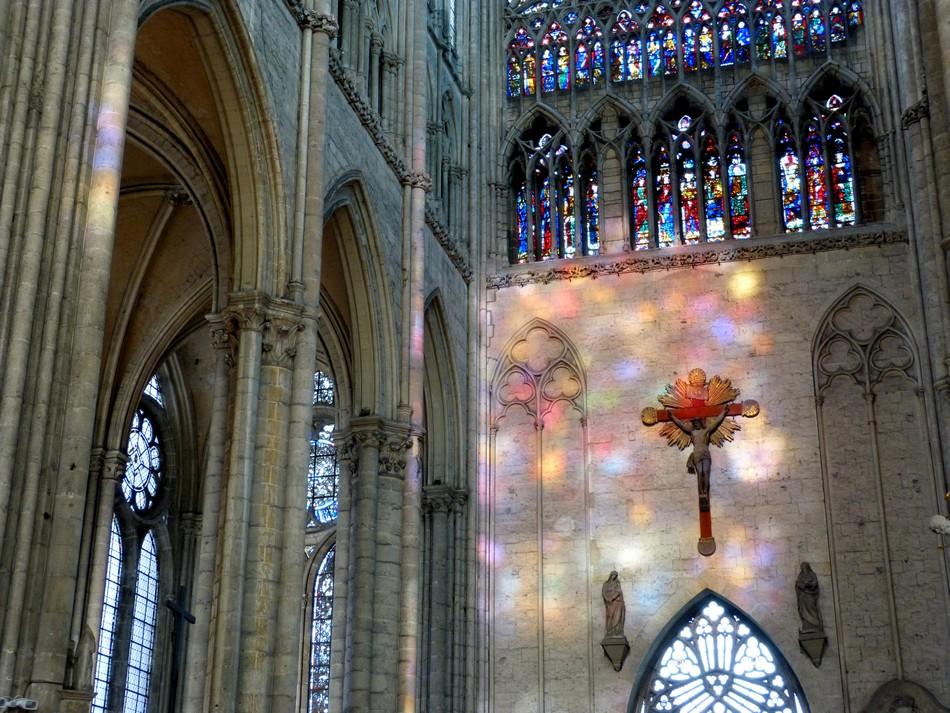
Cathedral (1 illustration) https://ru.pinterest.com/pin/462885667973663517/ (last accessed: 11/04/2026)
Abbot Suger kneeling in the lower right corner of the «Tree of Jesse» stained glass, St. Mary’s Chapel, Basilica of Saint-Denis, France: https://en.wikipedia.org/wiki/File:Basilique_Saint-Denis_Abbot_Suger_04_2024_8421.jpg (last accessed: 11/02/2026)
Crucifixion stained glass in St. Peter’s Cathedral. France: https://arthive.com/res/media/img/oy1200/article/fa6/707809@2x.jpg (last accessed: 11/08/2026)
Rouen Cathedral Notre-Dame. France: https://www.meisterdrucke.es/impresion-artística/French-School/479784/Ventana-w51-que-representa-el-Via-Crucis%2C-la-Crucifixión%2C-el-Descendimiento-y-la-Piedad.html? utm_source=chatgpt.com (last accessed: 11/08/2026)
Notre-Dame de la Belle Verrière: https://passerelles.essentiels.bnf.fr/fr/chronologie/construction/5975c2d4-8549-4941-8d1d-cb647f1e5eb9-cathedrale-notre-dame-chartres/article/0223f505-ff40-423a-82f1-d6a3531d0858-bleu-chartres (last accessed: 11/08/2026)
Amiens Cathedral: https://commons.wikimedia.org/wiki/File%3AAmiens_Cathedral_Ambulatory%2C_Picardy%2C_France_-_Diliff.jpg?utm_source=chatgpt.com (last accessed: 11/08/2026)