Concept
The motif of the dream in Symbolist painting embodies the shift of nineteenth-century art from external observation to the exploration of the human inner world. Through the image of the dream, artists sought to visualize the internal reality hidden from rational perception. The dream becomes a method for investigating emotional memory and the spiritual experiences of the individual.
The turn of the century in France marked a period of crisis in rationalism. Despite the rapid growth of science, technology, and industry, many artists felt disillusioned with the idea of rationalism—an ideology based on the belief that the world could be entirely explained by reason and science. People of that era increasingly felt a lack of spirituality, mystery, and emotional depth. In this atmosphere, sleep began to be perceived not merely as a natural human state, but as a special space of internal freedom. In dreams, individuals are liberated from logic, social norms, and the control of the mind. This is why Symbolists turned to this theme—through it, they attempted to reveal the hidden inner world of humanity: its fears, memories, dreams, and mystical experiences. This research aims to study how French Symbolist artists of the late 19th century utilized the image of sleep to convey the spiritual world of society.
The work is based on a holistic visual analysis of French Symbolist painting from the late 19th century. The principle for selecting material for research is rooted in identifying representative works where the state of sleep becomes a key motif for conveying emotional states, experiences, and subjective perception of reality.
The principle of material selection is concentrated on French painting, which allows for the tracing and analysis of a specific continuity of ideas—from the academism of Gustave Moreau to the philosophical panels of Puvis de Chavannes. The methodology for analyzing textual sources relies on the manifestos of Symbolism and contemporary critical articles. A key aspect is moving beyond simple plot description toward an analysis of the visual code of dreams. This research posits that French Symbolism was not merely a style, but the art’s first profound immersion into the human consciousness.
The structure of the research follows the logic of a gradual «lulling» of consciousness: beginning with an introduction that outlines general cultural prerequisites, developing the theme within the context of historical disillusionment with progress, and culminating in an analysis of specific visual techniques for representing the invisible.
Key research question: How did French Symbolist painters transform the static image of the sleeping human into a means of expressing emotion and the hidden processes of the subconscious?
The research hypothesis is that sleep in the painting of this period is depicted not as a state of repose or inactivity, but as a specific inner experience. Through dream imagery, artists attempted to convey hidden feelings, thoughts, and the work of the unconscious mind. This allowed their work to anticipate the ideas of psychoanalysis and influence the emergence of surrealism. In these paintings, dreams help dismantle conventional perceptions of reality—instead of logic and sequence, associations, emotions, and imagery take center stage.
Pierre Puvis de Chavannes (1883)
The painting depicts a sleeping protagonist, who is personified by the allegorical figures of Love, Glory, and Wealth. However, unlike Baroque visions, everything here is emphasized as flat and serene. Space seems carved out of time. For Shavann, sleep is this space of silence, where worldly concerns transform into pure ideas.
A Turning Point
In the latter half of the nineteenth century, French art found itself at a crossroads. Official academicism continued to use sleep as a pretext to demonstrate virtuoso command of anatomy (as seen in Cabanel’s Birth of Venus, where the goddess is in a state of delicate doze), yet within the depths of art, a different understanding of this state was forming. Sleep began to be perceived as the only refuge from the «terror of reality.» Following the defeat in the Franco-Prussian War and the tragedy of the Paris Commune, French society sank into an atmosphere of melancholy. In literature, Baudelaire and Mallarmé celebrated twilight and fog, and in painting, the search began for ways to depict what cannot be seen with the eyes.
The Birth of Venus (1863)
Artists realized that the impressionists' objective gaze upon light and color only captured the fleeting surface of the world. To grasp the essence, they needed to «close their eyes.» This state became a visual manifesto—the figure with closed eyes in the symbolist painting signaled to the viewer: «I am not here; I am in a more significant place.» Thus, sleep transformed from a passive state into an act of intellectual and spiritual resistance against the materialistic world.
Sleeping Woman. Maurice Denis (1892)
Medical Origins of Symbolist Imagination
Interest in sleep was fueled not only by poetry but also by science. In late 19th-century France, the Charcot School at the Salpêtrière Hospital was actively researching hypnosis and altered states of consciousness. Artists attended these lectures, viewing the seizures and trances of the patients not as medical pathology, but as a key to freeing human imagination from the shackles of propriety. Symbolism incorporated this «clinical» interest, blending it with ancient mysticism.
Gustave Moreau Orpheus (1865)
Gustave Moreau, an instructor to many future avant-garde artists, created paintings where sleep took on the qualities of mysterious stupor.
His characters often reside in a state of somnambulistic trance. This is not mere repose, but a mystical revelation—a moment when the soul departs the body to contemplate divine truths. The painterly texture of his works, overloaded with detail and ornamentation, itself evokes a viscous, detailed dream in which time has frozen. This shift from dynamic narrative to static contemplation became the foundation for the entire oneiric aesthetic of France.
Gustave Moreau. Galatea (1878)
On the canvas, the nymph Galatea is depicted as if immersed in a motionless, almost hypnotic state, while the Cyclops Polyphemus observes her from the darkness. Reality here seems dissolved in a world of dreams, silence, and secret desire.
Gustave Moreau Salomé (1876)
The Space Between Reality and Imagination
The central point of the transformation of sleep in art was the emergence of works where the boundary between subjective vision and reality is finally blurred. The visual repertoire of Symbolism offers us three fundamental images of dreams, each of which reveals the research hypothesis in its own way.
Dreams as a dive into the subconscious and mystery
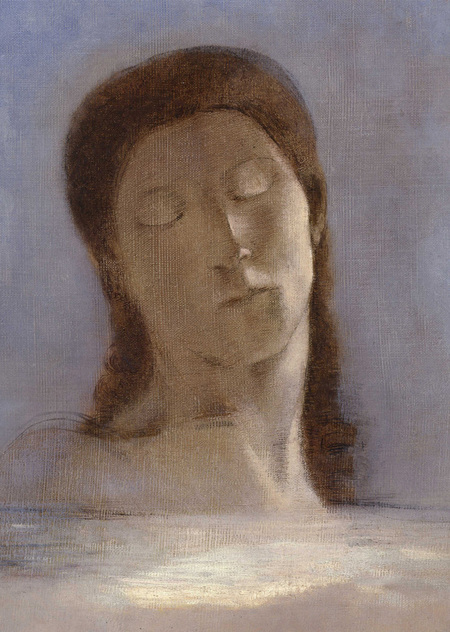
Odilon Redon, «Closed Eyes, ” 1890
A female face with closed eyes seems suspended between sleep and meditation. The blurred contours and soft light evoke a sense of inner vision rather than a literal portrait. This is one of the purest examples of sleep as a journey into the depths of consciousness.
Sleep as an erotic and fateful vision