
Meet the brand
Duolingo was founded in 2011 by Luis von Ahn, a Carnegie Mellon professor who previously sold reCAPTCHA to Google, and Severin Hacker. The app launched publicly in 2012 and grew rapidly into one of the most downloaded educational applications in history. By 2024, Duolingo reported over 500 million registered users, with approximately 37.2 million daily active users — a number that increased 65% year-over-year according to their 2023 Annual Report. [1]
Duolingo’s mission statement is pretty direct: «Our mission is to develop the best education in the world and make it available to all.» [3] Everything sits on three main ideas: Free access — the core app costs nothing, supported by a premium subscription tier (Duolingo Plus/Super Duolingo) and ads; Gamification — the whole learning experience is structured like a game, with streaks, points, leagues, and little rewards; Accessibility — you don’t need any background knowledge, no teacher, and no set schedule to jump in. This positioning deliberately sets Duolingo apart from expensive programs like Rosetta Stone (which used to charge hundreds of dollars per language). The brand basically frames itself as the democratic alternative to traditional language education.
Duo — brand’s mascot that helps connecting with target audience
Brand’s social media voice is chaotic, self-aware, and darkly humorous — built entirely around Duo the owl as a character with feelings, jealousy, passive aggression, and an obsessive attachment to users who neglect their lessons.
Who they’re talking to: The app reaches a really wide audience, but the communication strategy isn’t one-size-fits-all: 18–34 year olds are the digital sweet spot they engage most with TikTok* and Instagram* content, share memes, use the app for travel prep, career stuff, or personal interest Teenagers (13–17) often get into it through peer recommendations, for school support or curiosity; Adults 35+ tend to use it for travel, immigration prep, staying sharp, or reconnecting with a heritage language; Big international markets like India, Brazil, Mexico, and Russia have huge user bases where the free model really appeals. What ties all these groups together? Duolingo reaches them with very different messages, and that’s a big part of why the communication approach deserves a closer look.
What this research argues: Duolingo’s communication success is not accidental or purely creative, it is the result of a coherent dual-route persuasion architecture that simultaneously satisfies multiple psychological needs in its audience. By analyzing Duolingo through the Elaboration Likelihood Model and Uses and Gratifications Theory, this research shows how the brand operates at the intersection of persuasion and genuine value delivery, and where that strategy still has meaningful gaps.
Brand’s communication channels
Tiktok* Duolingo’s TikTok* account (@duolingo) has gathered over 16 million followers and is constantly brought up in marketing and communications circles as one of the platform’s most successful brand accounts.
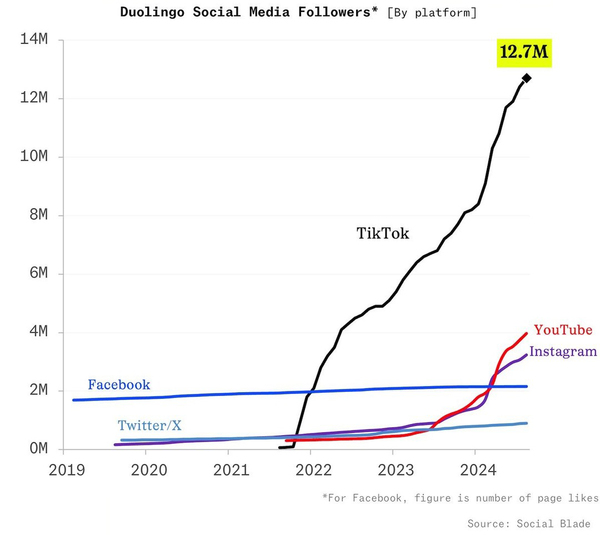
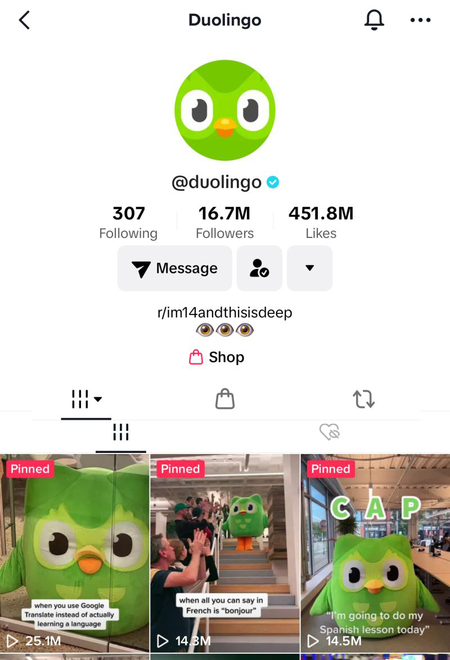
Followers comarison graph from 2024 / Screenshot from 2026
Their strategy gleefully breaks almost every old-school brand communication rule. You’ll see: — The Duo owl «stalking» celebrities; — Duo acting jealous when you spend time in other apps; — The brand jumping into trending dances, sounds, and challenges that have nothing to do with learning a language; — Self-referential jokes about their own push notification culture; — Playful back-and-forths with other brand accounts (Scrub Daddy, Ryanair) in the comments. They went viral in 2021 when Duo showed up «in person» at a Dua Lipa concert — a PR move that played on the «Dua"/"Duo» sound similarity. That video racked up millions of views and earned coverage in places like We Got This Covered [4].
What’s interesting from a communication perspective is that a huge portion of people consume this content with zero intention of ever using the app. It functions as pure entertainment, which, as we’ll get into later, fits perfectly with what Uses and Gratifications theory predicts.
Instagram* Over on Instagram* (@duolingo, about 4,8 million followers), the voice is a bit more polished but still recognizable. Content includes language-learning memes, culturally specific humor tied to the languages they teach, behind-the-scenes glimpses, and user success stories.
Twitter/X* The Twitter/X* account leans into real-time cultural commentary. The brand jumps into trending conversations with dry, offbeat humor.
YouTube YouTube serves a different purpose than the short-form social stuff. The channel features: «Duolingo Stories» animated short films in target languages with English subtitles Language learning tips and methodology explainers «How we built Duolingo» brand documentary content Collaborations with polyglot creators This channel is aimed at motivated learners, people actively studying who want extra material. The communication here is notably calmer and more informative than the TikTok* chaos.
Screenshot of Duolingo’s Yotube page
In-App Notifications, an Overlooked Channel Duolingo’s push notification system deserves its own spotlight as a communication channel, not just a product feature. These notifications became culturally famous for their escalating emotional tone.
Notification screenshots
These function as little branded micro-messages each one reinforcing the parasocial bond between user and Duo, framing a missed practice as a social letdown instead of a personal one, and using humor to smooth the path back to re-engagement. Research by Oulasvirta et al. has shown that such persistent notification patterns become deeply integrated into daily smartphone habits.
Applying communication theories to the brand
Elaboration Likelihood Model (ELM)
ELM in Action: How Duolingo Persuades Different People Differently
The vast majority of Duolingo’s social media output, particularly on TikTok*, is designed to operate through the peripheral route. The content does not argue that Duolingo teaches languages well: it does not cite learning science, present testimonials, or explain curriculum structure. Instead, it activates specific peripheral cues: Liking is the most central cue in Duolingo’s social media strategy. Duo is deliberately designed to be loveable and slightly absurd. The character’s exaggerated emotional reactions (crying when users miss lessons, celebrating when they return) make him relatable and funny. According to ELM, when we like a communicative source, we transfer that positive feeling to the message and ultimately to the brand. A TikTok* user who finds Duo’s antics genuinely funny develops a warm feeling toward Duolingo without ever evaluating whether the app actually works. This is not accidental. Zaria Parveen, who built Duolingo’s TikTok* strategy, stated in a 2022 Greater Rochester’s R/AD Week event: «People aren’t hanging out on social media to be sold to–they just want to be entertained. So be entertaining!» This is a practically perfect description of peripheral route communication.
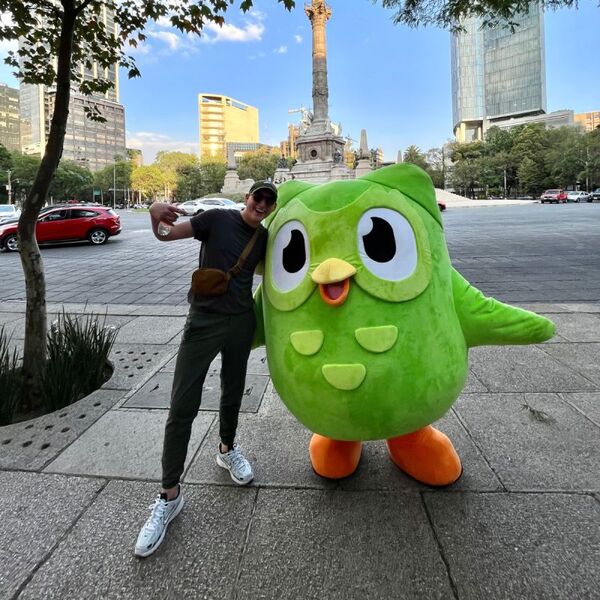
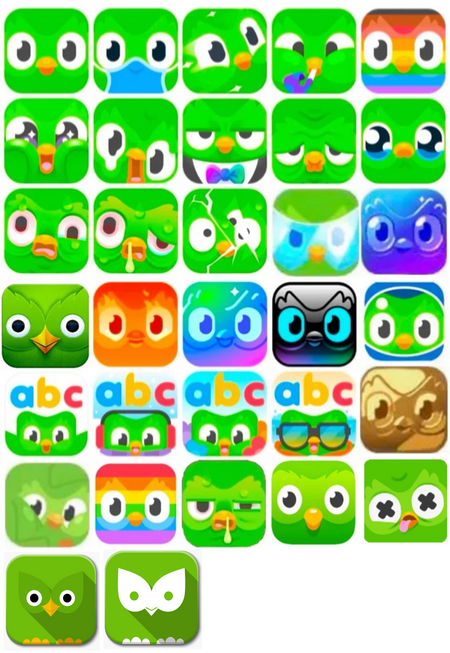
Photo of Duo with a fan / Expressive app icons
Social Proof operates through the sheer scale of Duolingo’s following and the participatory culture around its content. When a TikTok* video shows thousands of users sharing their Duolingo streaks, or when «Duolingo made me do this» becomes an internet meme, new users receive a powerful implicit message: this is what people like me are doing. This is the peripheral cue of social proof: no argument is made, but conformity pressure creates attitude change.
App’s gamification and engagement method
Consistency and Commitment operate through the streak system. Once a user has maintained a streak for 30 or 60 days, a psychological mechanism identified by Cialdini (1984) in Influence: The Psychology of Persuasion activates and people feel a strong drive to remain consistent with their past behavior. The streak counter is not just a product feature, it is a persuasion architecture that locks users into continued engagement through the peripheral cue of prior commitment.
Scarcity appears in streak protection mechanics. Duolingo sells «streak shields» (through in-app currency or subscription) that protect a streak if a user misses a day. The streak’s value comes partly from its scarcity, because it can be broken at any moment. This manufactured vulnerability makes continued engagement feel urgent.
Screenshot from research.duolingo.com
The Central Route: Website, Press Materials, and Educational Content When Duolingo communicates with audiences who are actively evaluating whether to use the app or whether it actually works, the communication shifts toward the central route. The Duolingo Research page (available at research.duolingo.com) publishes peer-reviewed studies and internal research on learning outcomes. A 2012 study by Vesselinov and Grego, commissioned by Duolingo, found that 34 hours of Duolingo study produced equivalent Spanish learning outcomes to a semester of university instruction. This is a central route argument. It provides specific, evaluable evidence for motivated decision-makers.
The «Science of Duolingo» webpage explains the app’s use of spaced repetition algorithms, the work of psychologist Hermann Ebbinghaus on the forgetting curve, and behaviorist reinforcement principles. This content targets users who want to know why the app is structured as it is and processing information through the central route.
YouTube popular science content including videos like «How to Make Learning as Addictive as Social Media» tells the brand’s origin story with enough detail and evidence to satisfy central route processors. The emphasis on Luis von Ahn’s academic credentials and the app’s development research supports the authority cue even within central route content.
Uses and Gratifications Theory (U&G)
Diversion In 2023, Rex Woodbury’s analysis of Duolingo’s TikTok posts (published on the Digital Native website) shows that the vast majority of the content is entertaining rather than educational. The brand focuses on memes, humor, and recurring gags featuring the Duo mascot. Users who consume this content are satisfying their diversion need: they come for humor, not homework and the content delivers relaxation and amusement. The gratification obtained matches the gratification sought, which, according to U&G research, predicts continued consumption. For Duolingo, this is valuable even without direct conversion. Brand salience built through repeated diversion-gratification is a real and measurable marketing outcome. A user who watches Duolingo TikTok* content every week for six months is not a student yet, but they are not a stranger to the brand either.
Relatable social media posts bring relaxation and enterntainment
Personal Identity Duolingo’s in-app design is built around identity construction. The streak counter functions as an identity marker: someone with a 200-day streak is not just a user, they are «a person who learns every day.» League standings, achievement badges, and milestone certificates all reinforce this identity performance. This connects to the personal identity gratification category. U&G research by Blumler and McQuail (1972) found that audiences used media partly to reinforce and reflect their self-concept. Duolingo’s gamification system turns language learning into a measurable identity — users can compare their learner identity to peers through leaderboards, share streaks on social media, and collect visual markers of their progress. The brand’s social media content reinforces this by celebrating the learner identity publicly. Posts like «POV: you’re on a 365-day streak» validate and amplify an identity that users have constructed through their app behavior.