
Project Outline:
1. Theoretical Reflection: Communication Theory in Design and Contemporary Art 2. Brand Presentation for a General Audience 3. Brand Presentation for a Professional Audience 4. Theoretical Basis: Applying Communication Theory to the Project 5. Bibliography and Image Sources
1. Communication Theory in Design and Contemporary Art Author’s Reflection
In the field of design and contemporary art, communication theory plays a crucial role in shaping how meaning is created, transmitted, and interpreted. Visual works are not neutral objects; they function as messages embedded in cultural, social, and emotional contexts. Every design decision — from color and typography to composition and rhythm — becomes part of a communicative process between the author and the viewer.
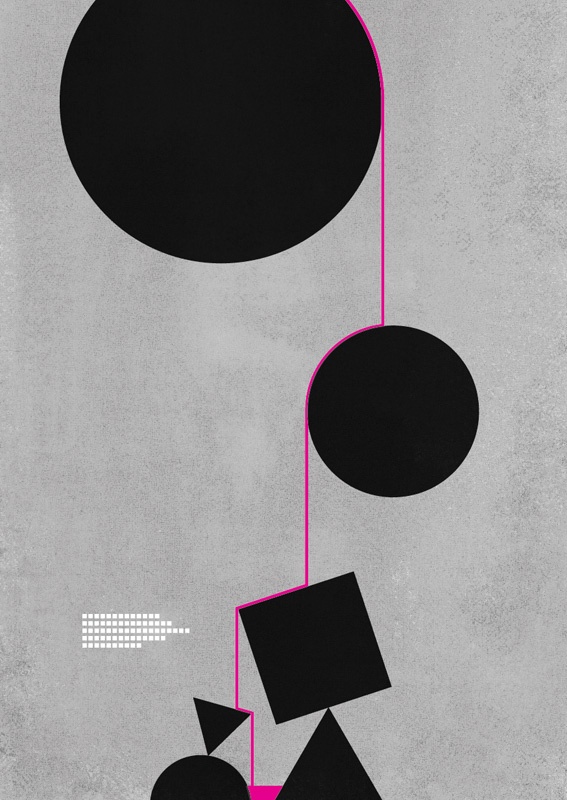
Abstract Composition of Dialogue Between Color and Form
Non-verbal strategies allow designers to address heterogeneous audiences by creating open systems of meaning. Instead of prescribing a single interpretation, visual design invites viewers to engage emotionally and cognitively, activating their own cultural references and personal memories. In this context, ambiguity is not a weakness but a deliberate communicative choice that enhances engagement and dialogue.
Contemporary visual design often employs minimalism, silence, and absence as communicative tools. Empty space, reduced color palettes, and fragmented compositions slow down perception and draw attention to subtle visual signals. These strategies challenge the viewer to become more attentive and reflective, transforming the act of viewing into an active process of decoding.
Abstract Composition of Dialogue Between Color and Form
From the perspective of communication theory, non-verbal design strategies emphasize the importance of context and the role of the receiver. Meaning is not fixed at the moment of creation but emerges through interaction between the visual message and its audience. As a result, design becomes a dynamic communicative process rather than a static transmission of information.
Thus, non-verbal communication in contemporary visual design can be understood as a conscious strategy aimed at creating deeper, more flexible, and more participatory forms of communication.
Inclusion of Context and the Role of the Message Receiver
Context plays a fundamental role in the communication process, influencing how messages are interpreted and understood. The receiver is not a passive recipient but an active participant whose cultural background, experiences, and situation shape the meaning derived from the message. Effective communication acknowledges this dynamic interaction between context and receiver, allowing meanings to emerge through interpretation rather than mere transmission.
2. Brand Presentation for a General Audience
Introduction to the Brand
Non-Verbal Communication as a Strategy in Contemporary Visual Design is an innovative art and design platform that explores the power of non-verbal communication. Our mission is to reveal how silence, space, and subtle visual cues carry meaning beyond words. We create experiences that encourage viewers to slow down, reflect, and engage with the unspoken language of visuals.
Minimalist design that highlights the power of negative space, creating a calm and contemplative atmosphere where silence becomes a meaningful part of communication.
What We Do?
We organize exhibitions, create digital and printed visual projects, and produce artworks that focus on the invisible dialogues between colors, shapes, and spaces. Our work challenges the overload of information in today’s world, offering moments of pause and contemplation.
An example of minimalist design showcased within a silent space, emphasizing simplicity and the communicative power of absence.
An example of minimalist design showcased within a silent space, emphasizing simplicity and the communicative power of absence.
Who We Are For?
Our brand speaks to those who seek deeper emotional and intellectual connections through art — people who feel overwhelmed by constant noise and desire meaningful visual experiences. Whether you are an art enthusiast, a curious observer, or someone looking for inspiration, Non-Verbal Communication as a Strategy in Contemporary Visual Design invites you to discover communication beyond words.
An example of minimalist design showcased within a silent space, emphasizing simplicity and the communicative power of absence.
An example of minimalist design showcased within a silent space, emphasizing simplicity and the communicative power of absence.
Visual Style
Our visual identity embraces minimalism, using a restrained color palette with a focus on negative space and subtle textures. Typography is clear yet expressive, supporting the feeling of quiet dialogue. Imagery is abstract, often fragmented, leaving space for personal interpretation.
Vincenzo Fagnani
Our Promise
We offer a unique journey into the language of silence and visuals, opening new ways to understand and feel the world around us.
Abstract Composition of Dialogue Between Color and Form
3. Brand Presentation for a Professional Audience
Strategic Positioning
Non-Verbal Communication as a Strategy in Contemporary Visual Design positions itself at the intersection of art, design, and communication theory. Our brand is dedicated to advancing the understanding of non-verbal cues as essential tools in creating meaningful visual experiences. We target professionals in the fields of design, visual arts, marketing, and cultural studies who value innovative approaches to communication.
Abstract Composition of Dialogue Between Color and Form
Core Values and Goals
Our core values include conceptual rigor, emotional resonance, and intellectual engagement. We aim to challenge conventional communication by emphasizing the power of silence, absence, and subtle visual signals. Our goal is to inspire new strategies for visual storytelling that transcend language barriers and foster deeper connections between creators and audiences.
Our core values include conceptual rigor
Communication Strategy
Grounded in communication theory, our strategy involves creating open-ended visual narratives that invite interpretation. We leverage minimalism, spatial tension, and symbolic abstraction to engage viewers actively. Our work is designed to function across multiple platforms—exhibitions, digital media, and collaborative projects—ensuring broad professional relevance and adaptability.
Our core values include conceptual rigor
Visual System and Design Elements
Our visual system is based on restrained color palettes, clear typography, and thoughtful use of negative space. Each design element is chosen to enhance non-verbal dialogue and facilitate meaning-making. We prioritize coherence and flexibility, allowing the brand to maintain consistency while adapting to diverse professional contexts.