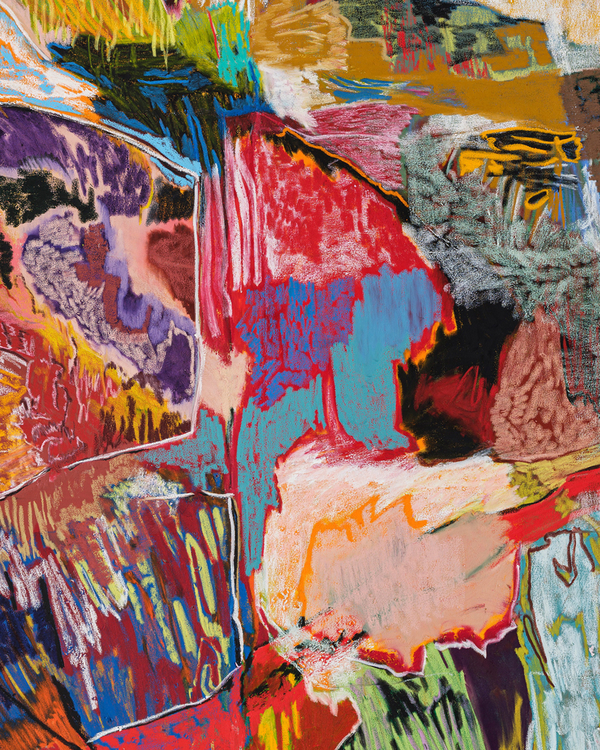
«Red Composition» (1946) by Jackson Pollock
Abstract Expressionism is a post–World War II art movement that emerged in New York City in the late 1940s, marking the shift of the global art center from Paris to the United States. It is defined by a radical focus on the act of painting, where process becomes as significant as the final image. In visual research, it is often interpreted as the liberation of the visual mark from representational function. The movement is commonly divided into Action Painting, emphasizing gesture and physicality, and Color Field Painting, based on large-scale chromatic immersion.
«Autumn Rhythm (Number 30)» by Jackson Pollock
The development of Abstract Expressionism was shaped by the post-war context, including the trauma of World War II and the ideological tensions of the Cold War. These conditions intensified interest in individuality, existential experience, and universal symbolism. Influenced by Surrealism and its concept of automatism, as well as European modernism and the influx of avant-garde artists to the United States, the movement combined formal experimentation with philosophical inquiry into human existence.
Key works include Jackson Pollock’s Autumn Rhythm (Number 30) (1950), which exemplifies Action Painting through its all-over composition created by dripping and pouring paint directly onto the canvas. Mark Rothko’s No. 61 (Rust and Blue) (1953) represents Color Field Painting, using large, luminous color zones to produce a contemplative emotional effect. Willem de Kooning’s Woman I (1950–1952) occupies a hybrid position between abstraction and figuration, combining fragmented imagery with energetic brushwork.
Jackson Pollock
Among the main practitioners, Jackson Pollock developed the technique of «drip painting» emphasizing bodily movement and chance. Mark Rothko focused on color as a medium of emotional and spiritual resonance. Willem de Kooning explored the tension between figure and abstraction through aggressive, layered gestures. Barnett Newman and Franz Kline further expanded the movement’s vocabulary through minimal vertical structures and bold gestural contrasts.
Theoretical interpretation was shaped by critics Clement Greenberg, who emphasized medium specificity and formal purity, and Harold Rosenberg, who described painting as «an arena in which to act» framing it as a record of performance. Meyer Schapiro contributed a historical and humanistic reading of abstraction, linking it to broader cultural and social transformations.
I want to express my feelings rather than illustrate them
Abstract Expressionism significantly influenced later movements, including Minimalism, which reacted against its emotional intensity, as well as Color Field Painting, Performance Art, and Fluxus, which expanded the idea of art as process. Its emphasis on gesture, materiality, and artistic autonomy also reshaped contemporary understandings of painting and established a new model of the artist as an active, existential agent.
Rosenberg H. The American Action Painters // Art News. — 1952. — Vol. 51, № 8
Greenberg C. Modernist Painting // Arts Yearbook. — 1961. — № 4
Schapiro M. The Nature of Abstract Art // Marxist Quarterly. — 1937. — Vol. 1, № 1
Anfam D. Abstract Expressionism. — London: Thames & Hudson, 1990
Турчин В. С. По лабиринтам авангарда. — М. : Изд-во МГУ, 1993
Google Images