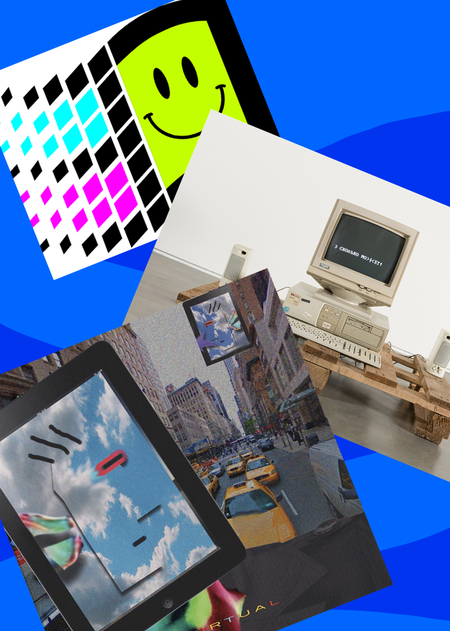
Concept
The sounds of old computers are returning to music, net projects, and museum spaces. A short startup melody, a synthetic voice, and an error signal evoke a former experience of working with a screen. However, the familiar timbre doesn’t yet prove that the artist intends to elicit nostalgia. One project preserves a real machine, another transfers the signal into a composition, and a third recreates the computer’s past.
Research question: How does the sound of a digital interface change its role in media art, and under what conditions does it become a sign of the past? Working hypothesis: The effect of nostalgia depends on the connection between the timbre, the device’s imagery, and the user’s familiar action. The same sound can function as a command, musical material, or a prompt to recall past experiences.
The core of the work involves three case studies: Alexei Shulgin’s Computer. 386DX (1998), James Ferraro’s Far Side Virtual (2011), and Zombectro and Jankenpopp’s WINDOWS93 (since 2014). The first demonstrates the reuse of technology. The second examines the boundary between signal and music. The third transforms an old desktop into an interactive artistic environment. The material includes museum photographs, covers, interface images, music recordings, and video documentation. For each case, I correlate four attributes: the source of the sound, its former function, the visual framework, and the listener’s action. This is a comparative analysis of a small corpus; it does not encompass the experience of an entire generation, nor does it replace audience surveys.
The theoretical foundation is built upon the works of Yossi Parick, Kim Cascone, and Dominic Schrey. Parick helps distinguish the re-running of old techniques and their image in new media. Cascone explains musicians' fascination with technical limitations and glitches. Schrey raises the question of why a former shortcoming of a medium acquires aesthetic value. His concept of analog nostalgia serves as a point of comparison: early digital media require separate analysis [1–3].
The work moves from the real computer to the album, and then to the browser environment. This sequence demonstrates three ways sound can return. The dates refer to the start of the projects; photos and release pages may be from a later time. WINDOWS93 changes over time, so the images in the catalog and the current version of the site have different statuses.
From Signal to Material
In an interface, sound is usually tied to an event: the program opened, a message arrived, or an error occurred. Its meaning depends on this proximity. In an artistic context, the previous command may lose its recipient but retain its recognizability. The listener hears the signal and anticipates an action that is no longer necessary.
In the article «The Aesthetics of Failure, ” Cascone describes how digital glitches and incidental noise become material for composition. The focus is placed on the instrument and the limits of its function. The author cites the example of Oval: CD reading errors are integrated into the musical structure [2, pp. 12–13]. For my comparison, what is important is the shift of attention to the technical trace itself. Furthermore, MIDI, speech synthesis, and a standard error signal are not equivalent to a breakdown. They cannot automatically be labeled a glitch.
386 DX: The Computer Takes the Stage
Alexei Shulgin. Computer. 386DX, 1998. Museum view of the work; the photograph date is not specified in the card. Garage Museum, inventory no. MSIG_OF_16_I_6/1–6/5. Image source: garagemca.org/en/collection/catalogue/CT19 [I1].
In the museum photograph, the monitor sits on the system unit. Two speakers flank it, and a keyboard is positioned in front. A wooden base replaces a desk, resembling a low stage. The «group» lacks a human body, yet the arrangement of its components invites the viewer to envision a performer. The screen, displaying a short line of text, captures attention in the place where a viewer might expect to see a singer’s face.
Shulgin began the project in 1998. The computer ran on Windows 3.1; MIDI dictated the instrumental parts, and TextAssist converted text into speech [4, 5]. The voice retains a mechanical quality. The emotional gesture of a rock song clashes with the flat articulation of the computer. Here, the focus shifts to how the device performs a familiar cultural form.
The wig directly references Shulgin’s performances in the chapter on artistic methods of media archaeology. He categorizes these as practices that give a new purpose to a technology after its obsolescence [1, p. 139]. Therefore, 386 DX is significant as an early case of a computer’s second life. The old machine is not hidden by a new casing or substituted with an image; its function forms the basis of the project.
Comparing the photograph and the recording helps avoid a simplistic reading rooted in nostalgia. The beige casing might remind the viewer of a home computer. However, the same object raises questions of authorship: one person wrote the song, others wrote the software, and Shulgin organized the meeting between them [5]. Recognizing the past is one possible reaction—but it does not exhaust the meaning of the work.
Audio Example 1. 386 DX — Smells Like Teen Spirit, 4:15. Album The Best Of; the Staalplaat digital release page is dated 2020 [A1]. The page date does not match the project start date of 1998.
When listening, compare the vocal character and the instrumental parts. Then, return to the photograph. What establishes the artist’s image: a recognizable song, a synthetic timbre, or the appearance of a computer? The recording allows you to hear the device, but it does not convey the entire situation of a live performance.
Far Side Virtual: The interface becomes an album
James Ferraro. Far Side Virtual, 2011. Album cover. Image source: Apple Music, album page 1494039350 [Image 2].
On the cover, the tablet screen overlays a city street. Visible on the screen are the sky, clouds, and a stylized face. Another screen appears in the upper right corner. The device frames divide the image into several layers: the street, the tablet, and the world within the display. The viewer does not receive a single vantage point.
This structure offers an angle for listening to the album: everyday signals and musical phrases can coexist in the same environment. The sight of the tablet alone does not make the image nostalgic. For the 2011 release, it might have signified contemporary digital life. Today, the distance to that time has grown, which has consequently changed the context of perception.
In an interview with The FADER, Ferraro explained that his influences included contemporary Google advertising, mobile services, and ringtones. He attributed comparisons to CD-ROMs and 1990s software to the audience’s reaction. The musician also highlighted the phone’s dynamic range as a crucial means of reproduction [6]. This clarification narrows the initial hypothesis: retro sound may arise in the audience’s perception without the artist’s direct intention to evoke the past.
Andrew Cappetta has already explored Far Side Virtual through the concept of functional sounds [7]. Therefore, the mere combination of the album and interface is not a novel observation. My perspective is to compare this transposition with Schulgin’s real computer and the WINDOWS93 browser environment.
Audio Example 2. James Ferraro — Global Lunch (2011). This is a 20-second excerpt from the Apple Music preview; the fragment does not replace the full track [A2]. Full recording: music.apple.com/us/song/global-lunch/1494039356.
Cappetta analyzes the synthetic voice and Skype launch signal in this composition, which Ferraro incorporates into the rhythmic structure [7, p. 47]. In everyday interfaces, such a signal communicates the status of a program. In the album, it enters the musical form. However, a listener who recognizes the source may retain the original association. Transferring it into music does not guarantee a complete severance from the interface.
Compare two modes of listening: first, perceive the track as standalone music; then, open the cover art and recall the concept of ringtones. Does this alter the role of short phrases and synthetic timbres? Does this technique offer a personal investigation of the question rather than a ready-made answer for the audience?
The difference from the 386 DX lies in the mode of operation. Shulgin presents a specific machine and its capabilities. Ferraro compiles the sonic image of a digital environment into an album. In the first case, the technology remains the visible performer. In the second, the listener reconstructs the environment based on timbres, names, and cover art. Nostalgia here depends on precisely what the listener recognizes.
WINDOWS93: The Past as a Medium for Action
Jankenpopp and Zombectro. WINDOWS93, a project dating from 2014. Interface view from the IFdigital catalog; the exact capture date is not specified, and the card was updated on 05/31/2024. Source: ifdigital.institutfrancais.com/en/creation/windows93net [I3].
The desktop in the image features a pink and purple background. Small icons are positioned on the left, and a taskbar runs along the bottom. Several gray windows overlap each other. A black area displaying «Hello world» sits next to a Facebook meme. The familiar logic of the desktop unifies materials from different contexts. This prevents the screen from being mistaken for an accurate reconstruction of a single historical computer.
The authors define WINDOWS93 as an independent web art project and a parody of an operating system [8]. Here, the old interface serves as a method for organizing a collection. The user opens applications, moves windows, and selects a sequence of events. The past returns through the gestures that once connected humans to the screen.
WINDOWS93. View of an installation environment from the IFdigital catalog. The date of the photograph is not specified. Source is the same [I4].
In the photograph of the installation, the screen is surrounded by a keyboard, wires, and various objects. The space resembles a personal workspace. This offers an alternative way to present a project: the browser environment is given a physical context. Comparing it to 386 DX reveals a compositional similarity—the computer occupies the center of the composition. However, in Shulgin’s work, a specific machine produces music, whereas in WINDOWS93, the appearance of an old computer can serve as a frame for a contemporary web project.
The current version of the website features applications such as CrazyError, Bytebeat, Karaoke Player, and other sound instruments. This suite cannot be transferred to the 2014 version without verification. Therefore, the following audiovisual example has a separate date and status: it is original concert documentation, not a recording of the site’s initial release [A3].
Audiovisual Example 3. WINDOWS93™ — LIVE SHOWREEL. Channel jankenpopp, 06/16/2016, 1:59. Music: Jankenpopp; video: Zombectro; camera: Mr Blønde; editing: VJ MACHINTOSH [A3].
Correlate the concert situation with the desktop shown in the image above. The source itself presents a performance through techno, punk, and chiptune. This is another context for the digital interface—its elements become part of the stage event. The reel shows a specific concert form of the project and does not serve as a recording of all the site’s sounds.