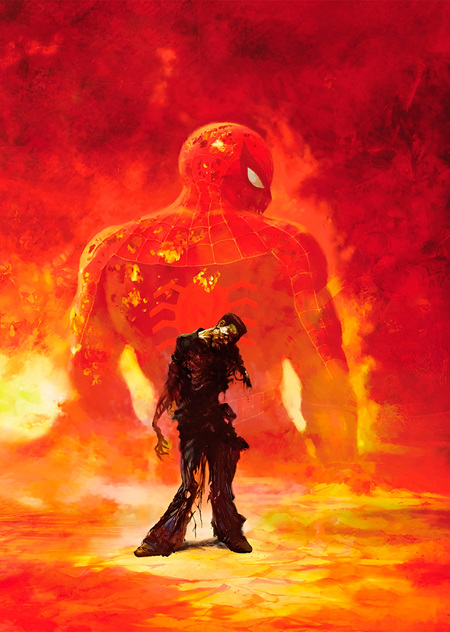
Concept
To properly examine the history of American horror comics, one must consider the constraints of imagery. For my research, it is as important as what was specifically shown to address the question of what level of visual safety the recognizable product could promise to the reader. For instance, the «Comics Code» adopted by publishers in 1954 regulated the content of graphic novels, specifically banning depictions related to zombies and cannibalism. However, the return of horror to the pages cannot be explained by the repeal of this document. Its provisions were reviewed, and the development of direct distribution through specialized stores allowed comics to be published outside the approval system: Marvel opted out in 2001 by implementing its own age rating structure, which DC and Archie followed in 2011.
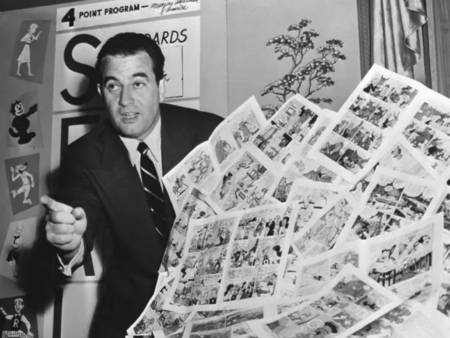
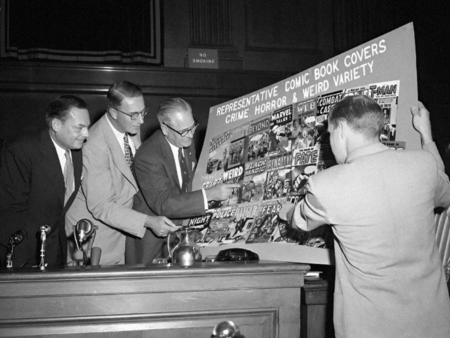
1 — Charles Murphy discussing comic books, 1954, USA; 2 — Senate hearings, 1954, USA
The core of this work lies in altering a familiar image. I am interested in situations where a character remains recognizable by silhouette or a distinctive detail, yet their environment and familiar attributes change significantly. In such cases, horror can be explored through specific juxtaposition: what the image retains from its predecessor, and what compels us to see it differently.
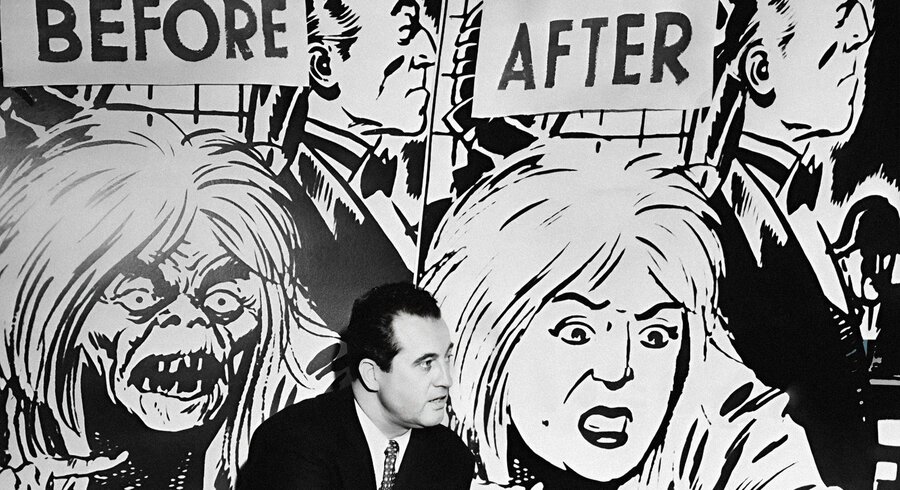
Chief Censor Charles Murphy in front of an edited comic, 1954, USA
It is worth noting that by «visual canon» in my research, I do not mean a collection of supposedly correct events within a fictional universe, but rather a stable set of images, compositions, and characteristics that ensure recognizability. Transforming these attributes allows for the examination of shifts in the meaning of posture, color, and space.
In my research—while analyzing the composition, character design, chiaroscuro, and color palettes, as well as individual panel sequences—I will demonstrate that an additional source of visual anxiety in the chosen zombie comics stems from the disruption of conventional imagery.
The work is structured as a gradual narrowing of focus: from overall form to surface, and subsequently to the tone of expression. In the first section, I analyze how maintaining a familiar compositional scheme or employing traditional horror imagery techniques alters the perception of characters and space. The second part discusses how color and chiaroscuro decisions contribute to changing the familiar image. The third segment is dedicated to how the defining traits and attributes of recognizable heroes take on absurd or repulsive meaning.The visual material is based on what I believe are the most illustrative images, allowing for an examination of the relationship between preserved and altered characteristics. The research material consists of the «Marvel Zombies» series and the initial arc of «Afterlife with Archie.» This selection allows for a juxtaposition of two methods of handling recognizability without expanding the analysis to the entire genre history.
Composition as a Vehicle of Horror
The first method of canon transformation involves accurately reproducing the original composition while substituting its internal content. The key material here is the «Marvel Zombies» poster series. Arthur Suydam recreates the compositions of classic covers, copying the characters' poses, angles, and the placement of elements.
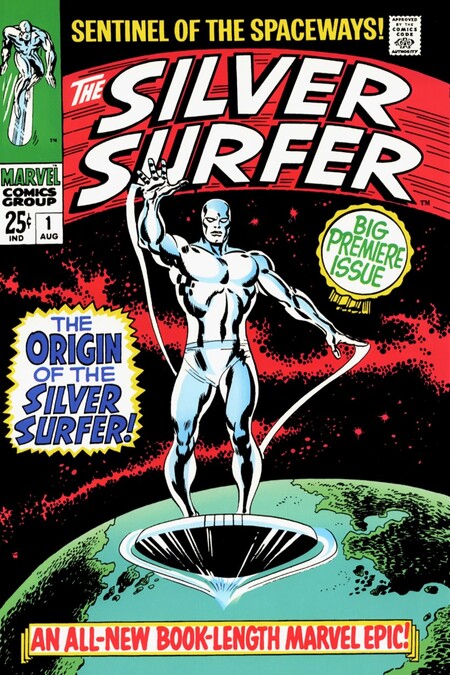
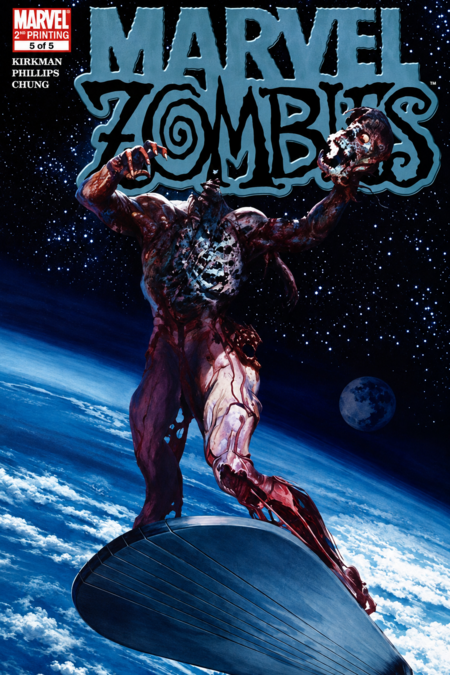
Covers: 1 — «Silver Surfer, ” #1, John Buscema, 1968; 2 — „Marvel Zombie, ” Volume 1, #5, Arthur Suydam, 2006
Dread arises primarily because the reader recognizes familiar graphics and simultaneously witnesses their disintegration.
covers: 1 — «The Avengers,» #4, Jack Kirby, 1964; 2 — «Marvel Zombies,» Volume 1, #2, Arthur Suydam, 2006; 3 — «Amazing Spider-Man,» #21, John Romita Sr., 1987; 4 — «Marvel Zombies,» Volume 1, #5, Arthur Suydam, 2006
For example, one of the covers for «Marvel Zombies» repeats the composition from «The Avengers»: Captain America, holding his shield aloft, stands at the forefront of his comrades. The heroes' faces bear zombie features: an ugly distortion of the bodies is visible beneath their masks; however, thanks to their typical attributes (shield, iron suit, helmet, wings) and the preserved hierarchy—built on the principle of leader–team—the group of heroes remains recognizable, even though the characters' flesh and their costume details have been transformed into decaying matter.
This effect is based on cross-perception: the page presents both the hero’s actual image and the ghost of his classical prototype. The juxtaposition of these planes creates an additional source of anxiety that goes beyond a mere depiction of a damaged body.
In Frankaville’s «Life After Death with Archie,» the same mechanism is realized not through a reference to a specific cover, but through an homage to the genre. The composition, familiar to the reader from its cinematic language—featuring great, looming danger and small, vulnerable heroes—creates the sensation of traditional horror, and the recognizable characters find themselves drawn into this narrative machine that is foreign to them.
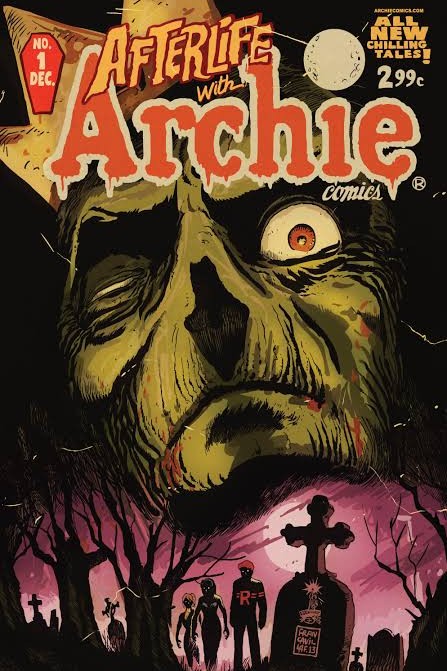
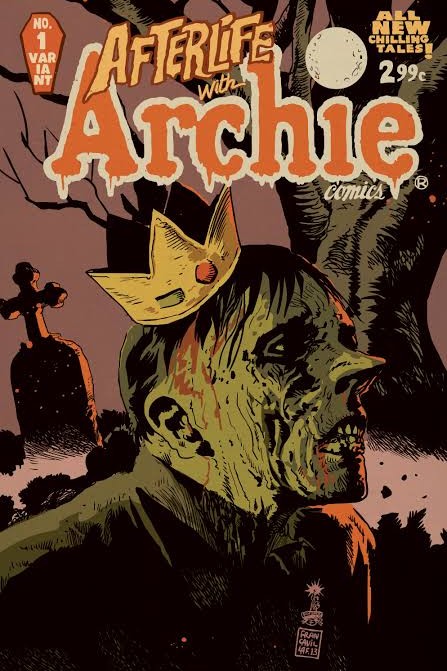
«Life After Death with Archie» covers, Francesco Francavilla, 2013
The frame space within the comic is obscured by heavy shadows and door jambs—the reader sees only fragments of the action, and the source of danger is intentionally pushed outside the panel boundaries. This difference arises between the comic’s original benevolent and light universe, causing the sense of horror to build.
Panel from the comic «Life After Death with Archie, ” #4, Francesco Francavilla, 2014
The stylized forms of the characters are preserved using the principle of counter-form, which lifts them from the background through silhouettes and hatching. Familiar characters (Archie, Betty, Veronica, Jughead, etc.) are immediately recognizable by their distinct details and attributes. For instance, Jughead Jones is almost always depicted in his signature crown and an «S» sweater, while the distinctions between Betty Cooper and Veronica Lodge are established by their hairstyles and natural hair colors (platinum blonde versus brunette).
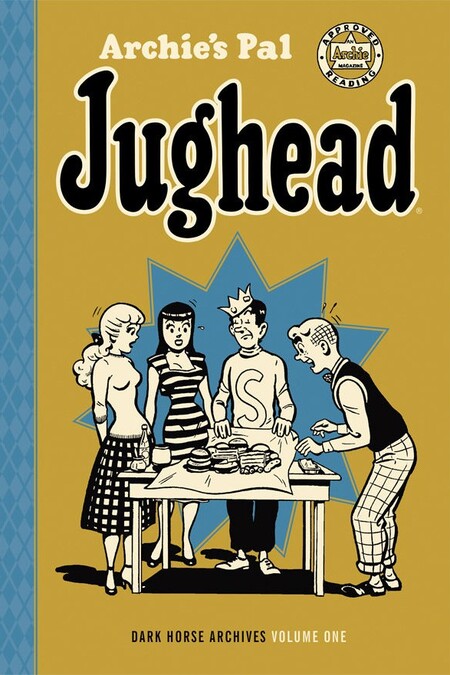
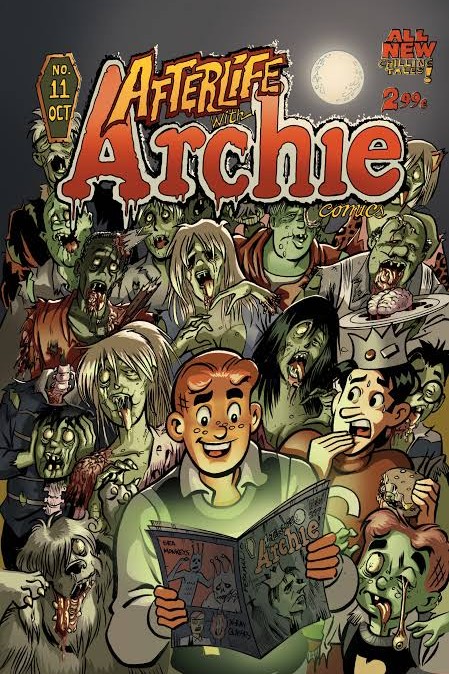
Covers: 1 — «Archie and His Friend Jaghead, ” Vol. 1, Sam Schwartz, 2015; 2 — „Life After Death with Archie, ” #11, Fernando Ruiz, 2016
Similar combinations function as an immediate character identifier across all plot versions.
panel from the comic «Afterlife with Archie, ” #1, by Francesco Francavilla, 2013
Thus, visual horror is largely built upon the violation of the familiar image. Both authors maintain the compositional framework of a recognizable image (a specific cover in Sydam’s work, a genre cinematic canon in Francavilli’s) and perform a substitution within it. Horror arises in the gap between a form that promises recognition and a content that violates that promise.
Color and Light as Narrative
The chiaroscuro solution and chosen palette transform from mere decoration into a vehicle for threat, articulating the decay of the protagonist’s very being or the fragility of the world in which they live.
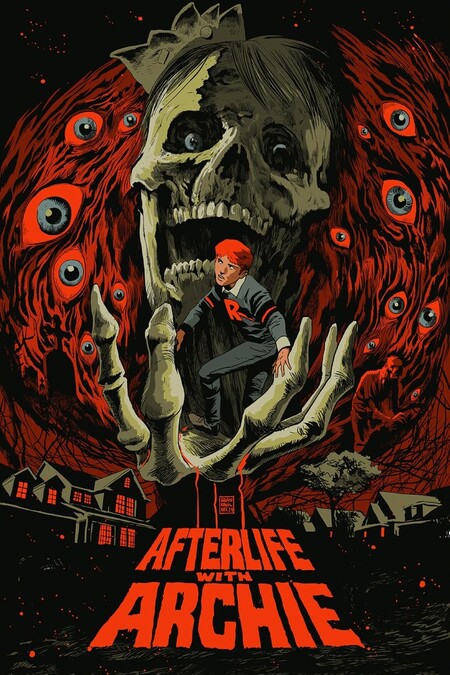
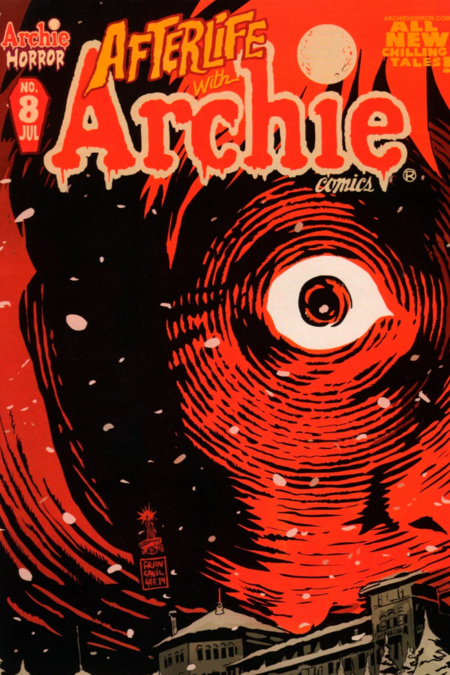
Covers for «Life After Death with Archie,» Francesco Francavilla, 2013
The recognizability of the heroines in Francavilli’s work is partially transferred from color to form and text: Betty’s and Veronica’s hair is identifiable by silhouette, but their natural colors are often subordinated to the overall monochromatic palette, so the character must be identified by name in the text for the reader to recognize her.
Panel from the comic «Life After Death with Archie,» #1, Francesco Francavilla, 2013
The familiar marker remains, but it functions at half-strength, which provides an additional source of anxiety: a characteristic that always guaranteed recognition is no longer reliable.