Navigation
Concept
The history of Berlin Dada is usually told as the story of men: Raoul Hausmann, George Grosz, John Heartfield, and Johannes Baader. Hanna Höch remained a «girlfriend of the Dadaists» in this narrative, although her photo montages are now among the most recognizable works of the movement. The photomontage itself long surpassed the scope of 1920s art—it lives on in posters, advertising, record covers, and punk graphics. Therefore, this subject matters not only to art history but also to the history of graphic design.
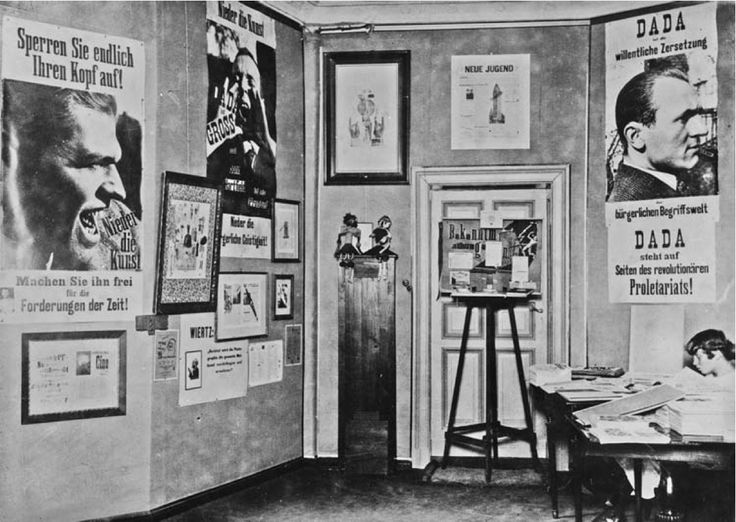
First International Dada Fair, Otto Buchhard Gallery, Berlin, 1920.
How does Höch’s photomontage differ from the montage of her partner, Raoul Hausmann, and why did her specific approach to the magazine image resonate with 1970s punk graphics?
Research Hypothesis: Höch’s photomontage is not a variation of a general Dadaist technique, but an independent visual language. It is constructed from material considered «feminine» and secondary: illustrated magazines, sewing patterns, advertisements, and kitchenware. Hausmann built his montage around the letter, the sound, and the masculine archetype, ridiculing ideas. Höch, conversely, analyzed how the mass media constructs the image of women. It was this viewpoint—the domestic object and the magazine body—that traveled, via Don Ades’s book Photomontage (1976), to Linda Sterling and ultimately to punk album covers.
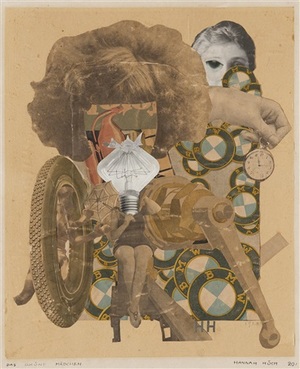
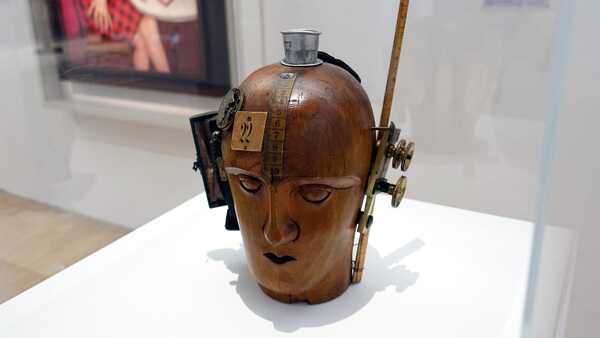
1 — Hannah Höch. Beautiful Girl, 1919–1920. 2 — Raoul Hausmann. Mechanical Head, 1920.
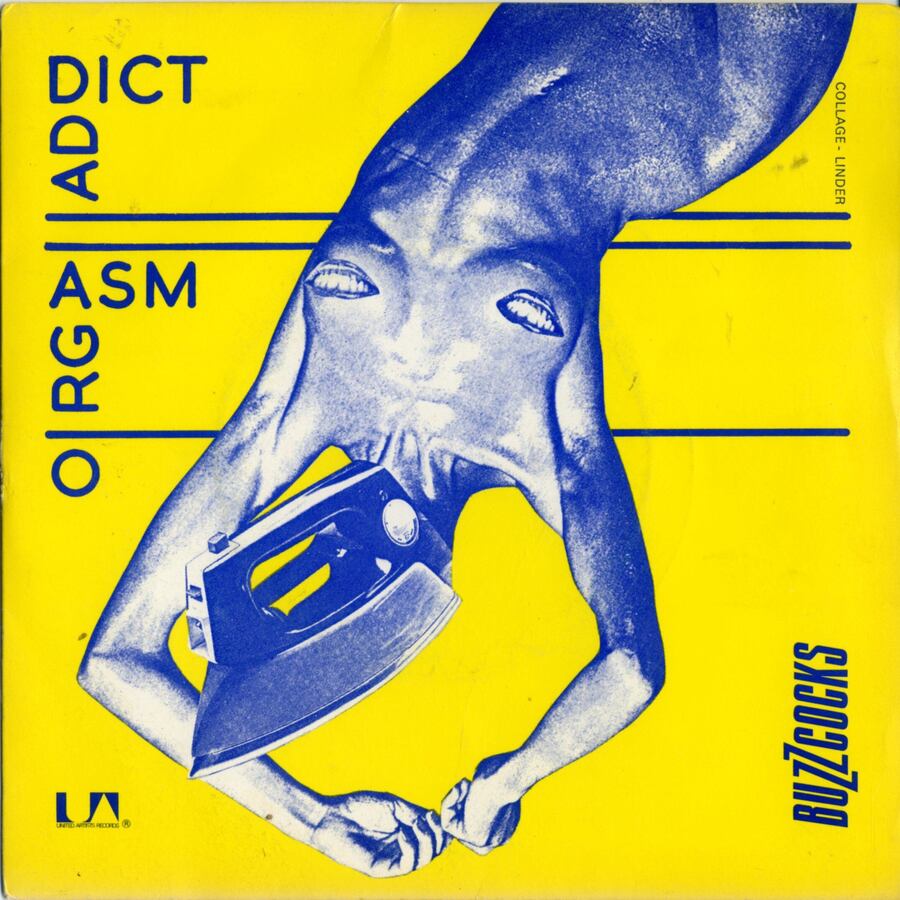
Lindsey Sterling. Cover art for the Buzzcocks single «Orgasm Addict, ” 1977.
The sections are organized not chronologically, but by montage tools and motives: scissors, template, kitchen knife, head, mask, iron in place of a face, cut-out letter. Each motive serves as both a method of practice and a theme that Höch explores through it. In each section, her work is presented alongside works by Hausmann, magazine sources, or the descendants of her influences.
Scissors: How Editing Became a Method
The war is lost. The Kaiser flees, gunfire erupts in the streets, revolution gives way to the suppression of revolution, and from this chaos, the Weimar Republic is born. Newspapers and illustrated magazines print massive editions of photographs of politicians, generals, athletes, movie stars, cars, and crowds. Photography becomes a mass medium for the first time—everyone sees it, every day.
Street fighting in the newspaper quarter of Berlin, 1919.
Into this atmosphere came Dada from Zurich. There, in 1916, at the Cabaret Voltaire, poets and artists who had fled the war read nonsensical poems and ridiculed an art that had failed to stop the carnage. The movement was brought to Berlin by the poet Richard Huelsenbeck, where it became more aggressive and political.
Dada is not a style like Cubism or Impressionism. You cannot recognize it from a single image; it lacks a general manner of writing or a defined palette. It is rather an attitude, which can be described in three words: against, absurd, ready-made.
Against. Dadaists believed that the old culture had driven Europe into war: museums, academies, «eternal values, ” stuffy gentlemen with monocles. Therefore, they ridiculed everything that was supposed to be respected—art, power, the military, the church, bourgeois comfort.
Absurd. If the world has gone mad, answering it seriously is foolish. Thus, meaningless poems made of syllables, scandalous evenings, and nicknames instead of names. Haussmann was „Dada-soph,“ Hartfield „Montardada,“ Baader „Oberdada.“
Finished. Dadaists did not paint „the beautiful“ in oils; they took what already existed: a newspaper, a ticket, a photograph, a scrap of advertising. This is where photomontage comes from.
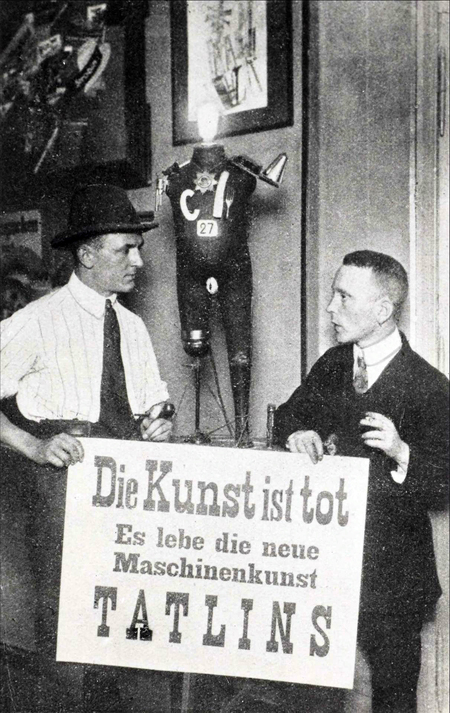
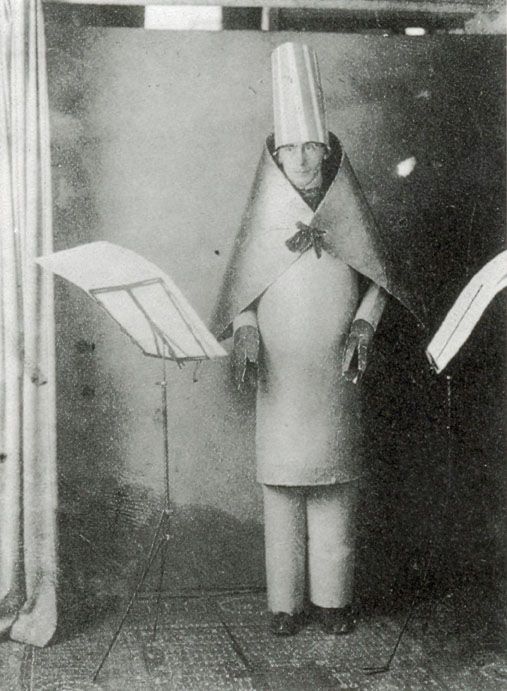
1 — Georg Grosz and John Hartfield with the poster «Art is Dead. Long Live the New Machine Art of Tatlin, ” 1920. 2 — Hugo Ball in a „cubist“ costume at the „Cabaret Voltaire, ” 1916.
In the summer of 1918, Höch and Hausmann were vacationing on the Baltic island of Usedom. There are two accounts of the invention of photomontage, and both involve soldiers. According to Hausmann, cheap lithographs featuring a grenade were hung in fishing houses; onto the grenade, they would glue a photograph of the family’s son who had gone to war instead of the head. Höch recalled a similar «trick» used by regimental photographers: a ready-made image with a uniform onto which a face was pasted.
1 — German postcard with photomontage, 1902. 2 — The Noble Trinity. Postcard with Poincaré, 1914. 3 — Defense of Germany. Commemorative postcard, 1913.
The idea is simple: take existing photographs, cut them up, and assemble them into a new image that communicates something none of the individual photos could convey alone. The term «collage» (or «montage») was chosen not by chance. Hans Richter quotes Hausmann: Dadaists didn’t want to «pretend to be artists»; they saw themselves as engineers constructing and assembling the work, like a machinist. The tools were scissors, glue, and other people’s images—not a brushstroke or inspiration.
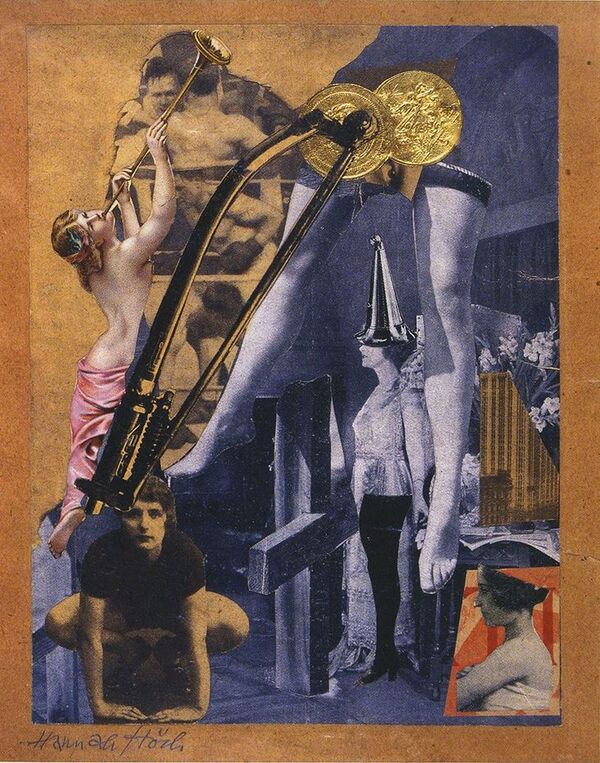
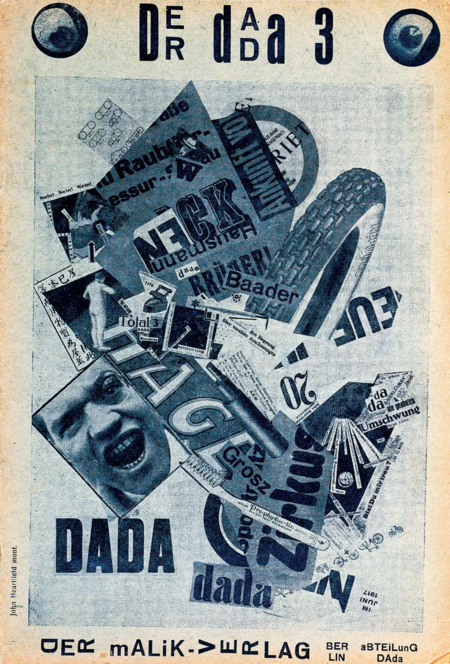
1 — Hannah Höch. Dada-Ernst, 1920–1921 2 — John Heartfield. Cover of Dada Magazine No. 3, 1920
Then many debated the title: Haussmann, Georg Gross, John Hartfield, Johannes Bader. Today, the Berlin Gallery, which houses the Höch archive, states cautiously: Höch and Haussmann developed the principle of photomontage together. Their method is shared. They begin to differ in what precisely they cut.
Hannah Höch and Raoul Hausmann at the First Dada Fair, 1920.
Pattern: The material of «feminine» craft
Hanna Höch was born in 1889 in the small town of Göthe. She came to Berlin to study applied arts and worked at the major publishing house Ulstein from 1916 to 1926. There, she illustrated patterns for embroidery and lace for women’s magazines.
This detail is more significant than it seems. Every day, she held fresh illustrated magazines—the very material from which she would later cut out her projects. And her habit of working with patterns and motifs taught her to think in terms of assembling components.
1 — Collage «White Forms, ” Hannah Höch, 1919 2 — Collage „Taylor Flower, ” Hannah Höch, 1920 3 — Collage „On Tulle Net, ” Hannah Höch, 1921 4 — Collage „Design for a Memorial to an Important Lace Shirt, ” Hannah Höch, 1922
The cut-out in her work is more than just a backdrop. In «Heads of State, ” Heoh pasted President Ebert and Minister Noske in swimming trunks directly onto the embroidery pattern, and she used the same photograph again in „Dada Review.“ The photo, printed in an illustrated magazine, caused a sensation. Power, cut out from the press, finds its way into the territory of domestic needlework.
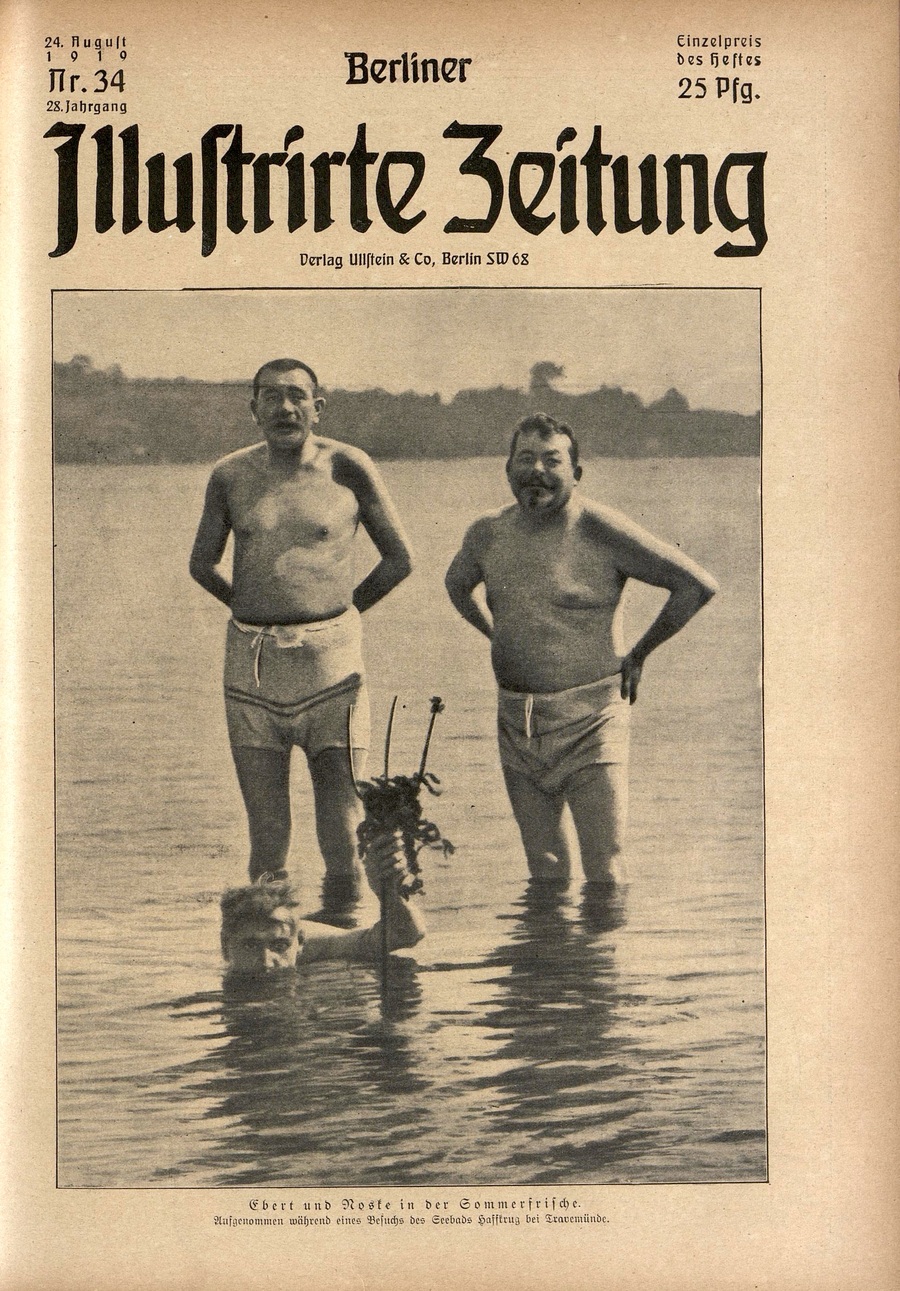
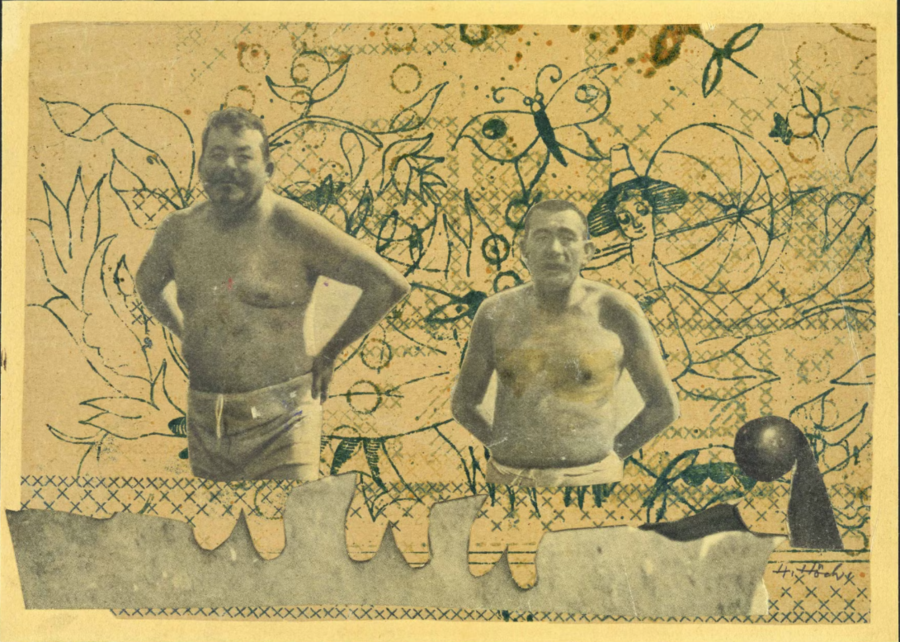
Ханна Хёх. Главы государства, 1918–1920 гг.
The same photograph, featured a second time, in the «Dada Review.» 1 — Hannah Höch. Dada Review, 1919. 2 — Hannah Höch. Dada Review. Fragment: Ebert and Nosek, 1919.
All of her material was cut from Ulstein magazines—that is, from mass media that the Dadaists simultaneously despised and utilized. The scrapbook that Höch collected over the years was her personal archive of such imagery.
Hanna Höch. Scrapbook. Double-page spreads, 1933.