Navigation
- Concept
- The Edge of the Table as a Boundary and Entry Point into the Artwork
- Visual Weight
- Diagonals and Vectors: Where the Gaze Travels
- Light as a Director
- How the Style Evolved
- Conclusion
- Bibliography
- List of Images
1. Concept
In the early 17th century, an unprecedented shift occurred in the Northern Netherlands that reshaped European painting: objects on a table ceased to be mere backgrounds for saints or portrait attributes and instead became the central subjects of the artwork.
Dutch still life—or stilleven (quiet life)—developed as an independent genre within the context of the Protestant republic, where the church did not commission altar pieces, and the affluent bourgeoisie sought to adorn their homes with images of the familiar, immediate world. That is, depictions of their own banquets, flowers from their gardens, and expensive tableware. Artists began painting «for the market, ” which stimulated experimentation with composition, light, and texture.
In the history of art, Dutch still life has often been analyzed through iconography: the lemon recalls transience, and the overturned glass speaks to the futility of pleasure. However, hidden behind this symbolism lies an equally complex language of composition—a way the artist organizes objects on a plane, distributes visual weight, charts paths for the viewer’s eye, and creates the illusion of depth on a flat canvas. The goal of this genre is not simply to display symbols, but to compel the viewer to notice them. This is precisely what compositional techniques achieve.
Through my research, I aim to uncover these techniques and demonstrate that the Dutch still life is not a passive reflection of daily life, but an active construction that directs the viewer’s attention.
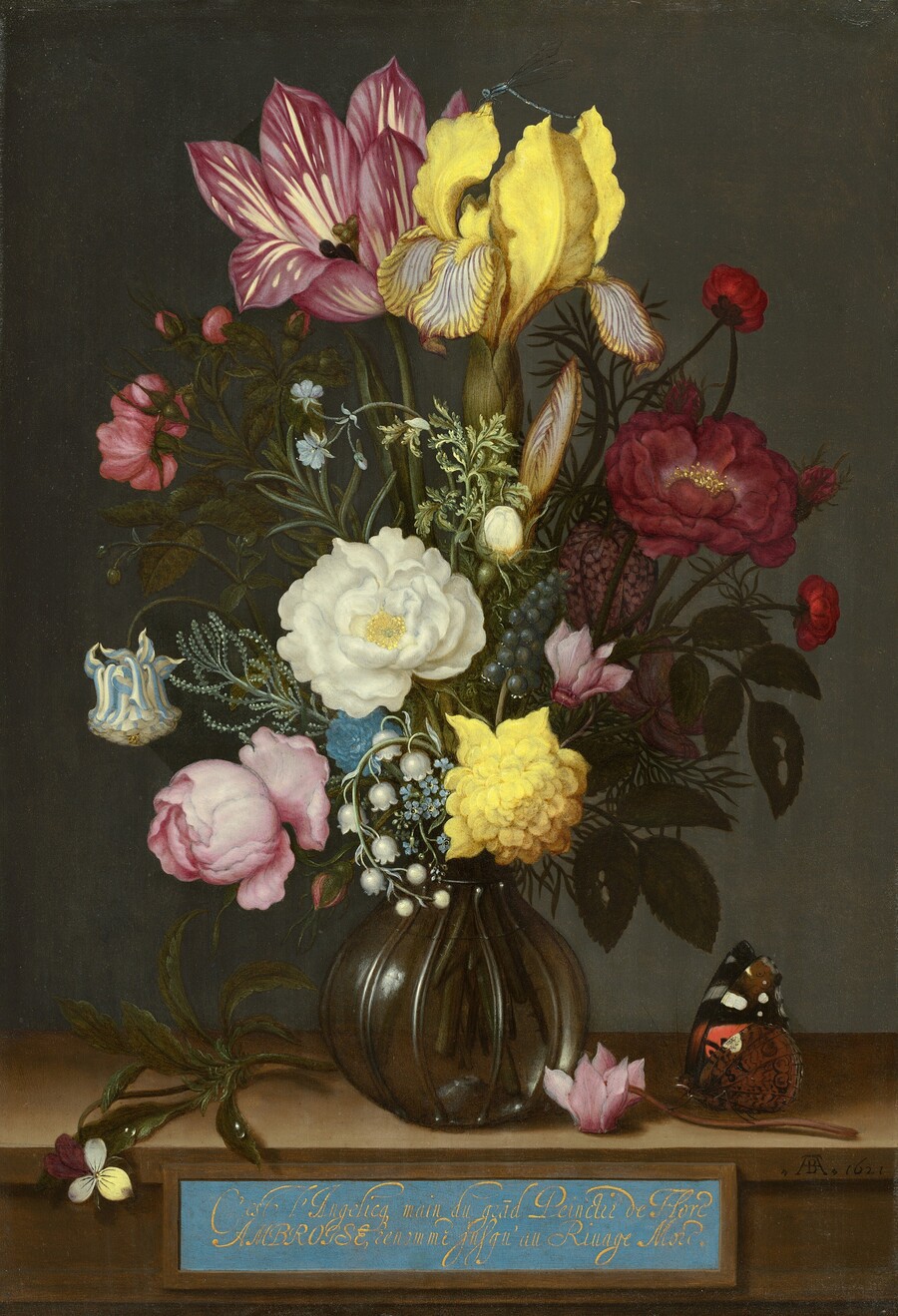
«Bouquet of Flowers in a Glass Pitcher,» Ambrosius Bosschart the Elder, 1621.
Key research question: How do compositional elements (line, balance, diagonal, light, structure type) direct the viewer’s gaze in Dutch still life painting?
Hypothesis: 17th-century Dutch still life uses a limited set of compositional techniques to create a programmed sequence of «reading» the image. These techniques do not operate in isolation; rather, they function as an integrated system that is subservient to a semantic center (the main subjects), transforming contemplation into guided visual movement. Furthermore, the complexity and activity level of these techniques directly depend on the historical style and the specific type of still life.
The principle for selecting representational material focuses on the key masters of the Dutch still life during the «Golden Age.» The selection includes the ascetic «breakfasts» by Pieter Claesz and Willem Claesz Heda, the tonal compositions of Jan Jans den Uyl and Jan Jans Trek, the opulent Baroque still lifes by Willem Kalf, Willem van Alst, and Abraham van Beyeren, as well as the early «draped tables» by Floris van Decken and Nicolaes Gyllis, and the floral arrangements by Ambrosius Bosschaert the Elder and Rachel Ruysch. This selection allows for a clear tracing of the genre’s evolution.
The structure of the research is based on a problem-oriented principle: each section is dedicated to a specific compositional device, and the fifth section demonstrates how these devices developed over time.
The theoretical foundation of this study draws upon fundamental works in composition theory, research on the psychology of visual perception, and textbooks and methodological guides on visual literacy, covering tonal relationships, spatial organization of the subject matter, the laws of perspective, and chiaroscuro.
2. The edge of the table as a boundary and an entry point into the picture
The edge of the table in the painting functions like a boundary of the stage in a theater: it separates our real room from the depicted space. However, Dutch artists constantly broke this rigid straight line so that the viewer would feel like a participant in the scene. The simplest way to achieve this is to place an object so that it projects forward, hangs over, or literally «spills out» toward us.
«Still Life with Cheeses, Fruits, Bread, and Nuts, ” Floris van Deeck, 1616.
On this painting, the edge of the table runs parallel to the lower frame. Near the center, an apple peel, draped in a spiral, perpendicularly crosses the corner of the table, breaking the rigid horizontal line of the tabletop. To make the entry into the painting even smoother, van Dijk pushes the edge of the pewter plate forward and turns the knife handle toward the viewer. Our gaze is first caught by these small details in the foreground, and then, like ascending steps, moves upward—to the enormous cheese wheels.
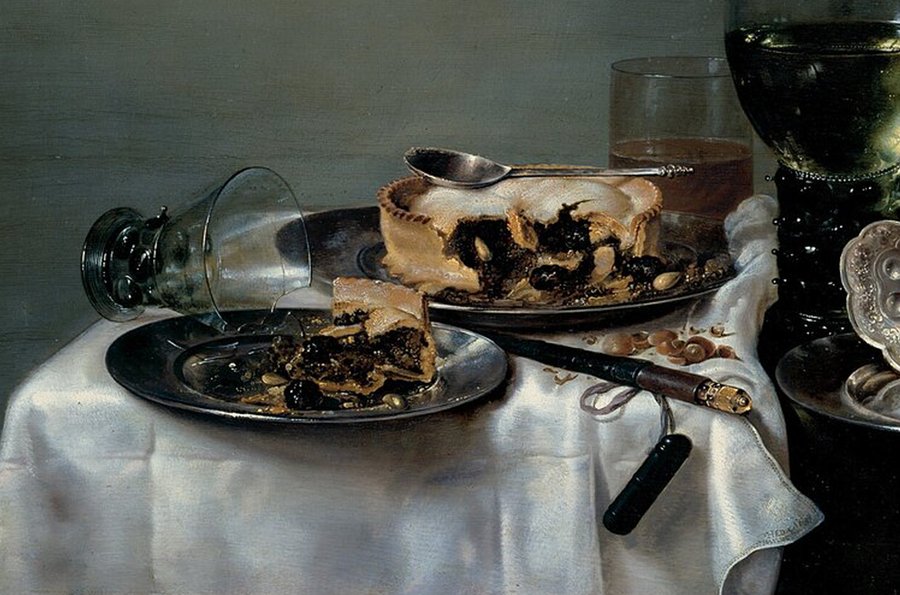
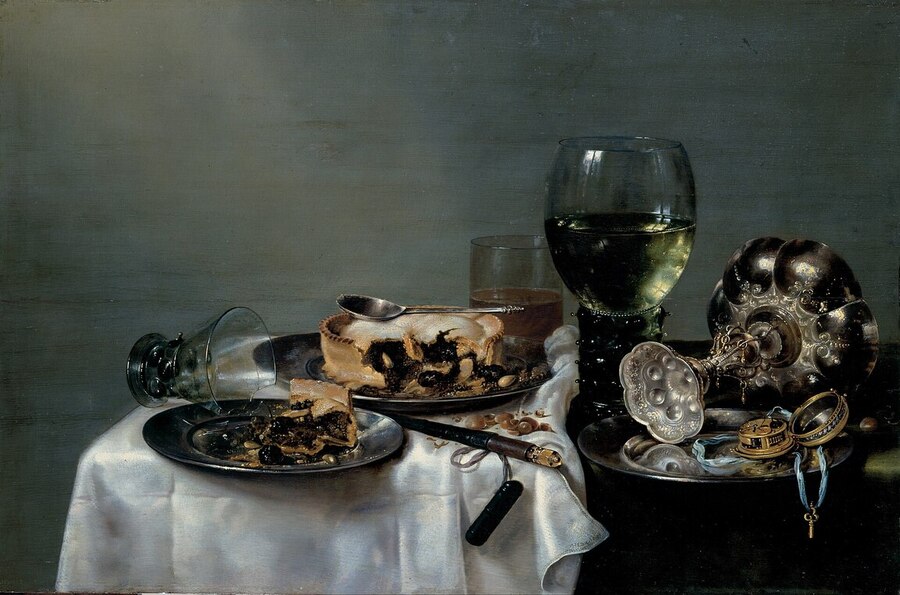
«Breakfast with a Blackberry Pie,» Willem Claesz. Heda, 1631.
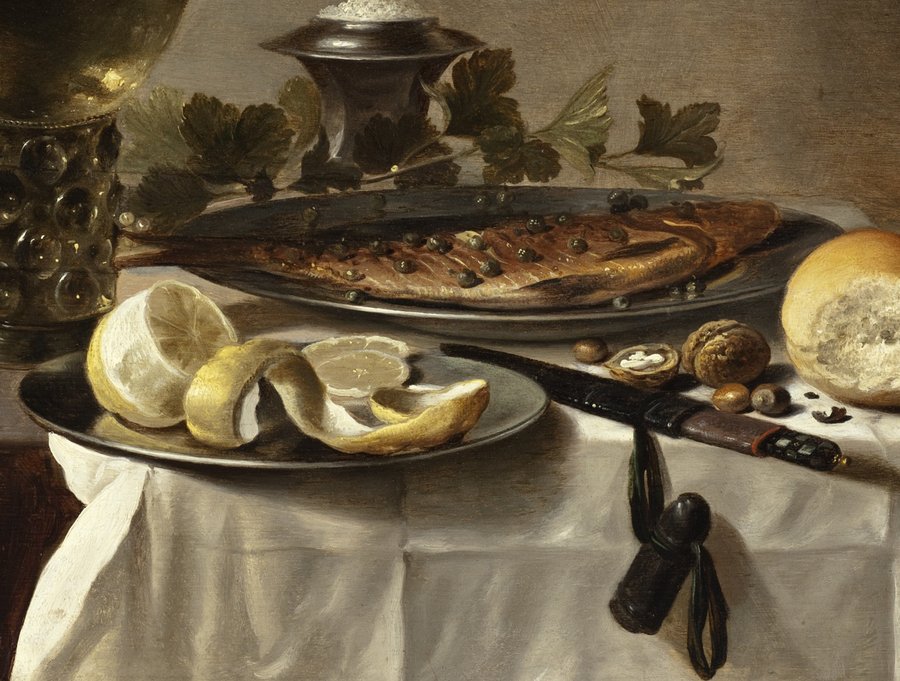
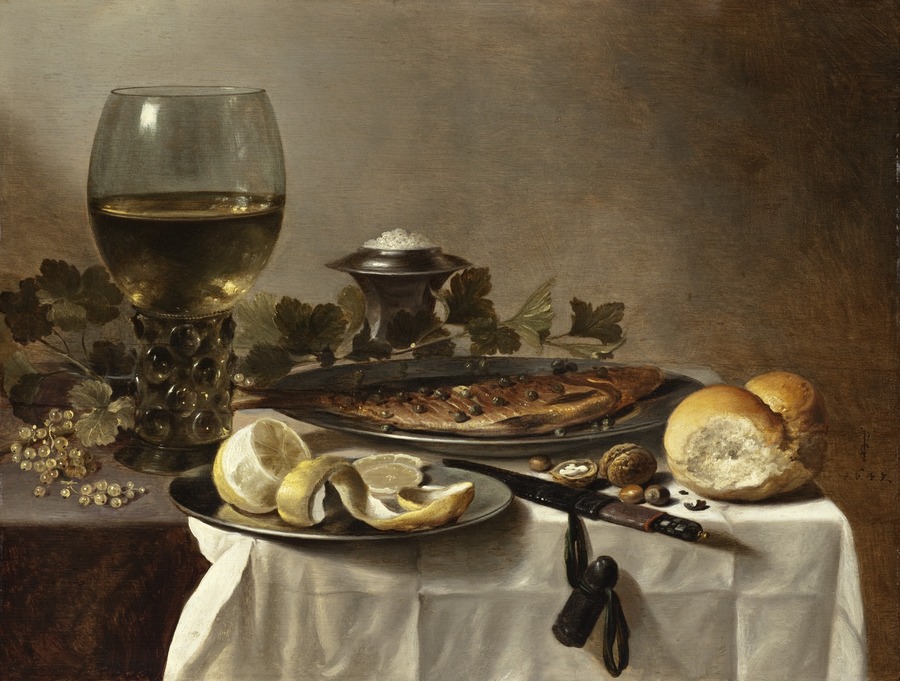
«Still Life with Herring, Wine, and Bread,» Pieter Claesz, 1647.
Here, you can see a similar construction—a dish, a diagonal knife, and a vertical piece hanging from it. All of this guides the viewer’s eye toward the massive objects above.
3. Visual Weight
The second principle is visual weight. Without conscious thought, we perceive that a dark spot is heavier than a light one, and an object on the edge feels heavier than one in the center.
«Still Life with Cheeses, Almonds, and Pretzels, ” Clara Peters, circa 1615.
On the left side, even extending through the center toward the right, lies a dense pyramid of three cheeses. This mass powerfully draws the eye. To prevent the left side from completely overwhelming the composition, Peters places a tall glass of delicate Venetian glass and an earthen jug on the right. The glass is physically light, but due to its height, complex form, and the sparkle on its surface, it visually balances the heavy cheese mass on the left.
«Vanitas Still Life with Spinario, ” Pieter Claesz, 1628
In the upper left, there is a large white plaster statuette of a boy. It is light and intricately formed, immediately catching the eye. Below it, Class groups dark fabric, armor, and musical instruments, though an unexpectedly white book appears on the left.
The weight in this composition is distributed unevenly to create a sense of anxiety and tension—a mood necessary for the theme of life’s fragility.
«Still Life with Peacock Pie, ” Pieter Claesz, 1627
On the table to the right looms a massive, dark pie adorned with a peacock figure, which appears quite heavy. To balance this mass, the artist depicts a white tablecloth upon which an entire system of shiny, light objects is visible: pewter dishes, cookies, pewter plates, sweets, and nuts, and a lemon. Numerous small, bright highlights on the left and in the center successfully compete with the large, prominent object on the right.
4. Diagonals and Vectors: Where Does the Gaze Land
Horizontal lines are read by us as repose, and vertical lines—as stability. But when an object is placed at an angle, dynamism immediately appears in the composition. Dutch painters arranged knives, spoons, tree branches, and tablecloth folds along a diagonal so they would act like arrows, guiding the viewer’s eye from one object to another.
«Still Life with Musical Instruments,» Pieter Claesz, 1623
The entire composition is permeated by intersecting diagonals. These lines form an invisible grid, compelling the eye to move in a zigzag pattern from one object to another, smoothly receding into the depth of the room.
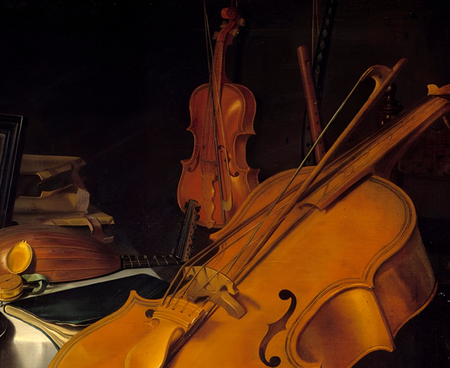
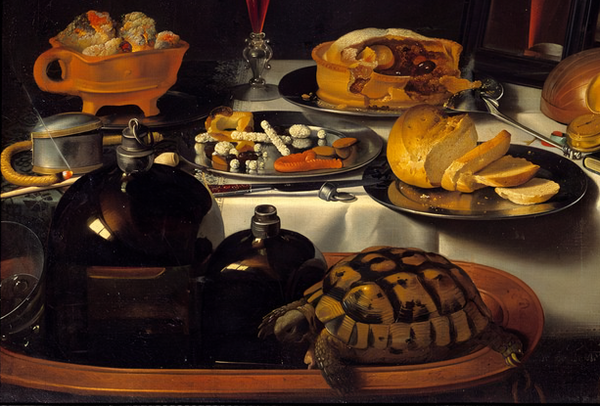
Fragments of «Still Life with Musical Instruments,» Pieter Claesz, 1623.
The stringed instrument lying in the foreground is oriented with its neck turned up and to the right, and the light pages of the book behind it stretch down and to the left. The instruments and bows lying in the background are not arranged strictly horizontally or vertically; they intersect one another.
In the left portion of the composition, the diagonals are not as obvious, but they can still be traced—more as suggested directions than as concrete forms: the turtle’s legs are parallel to the silver cutlery near the pie, and a knife points in the opposite direction, as does the edge of the bowl on the left.