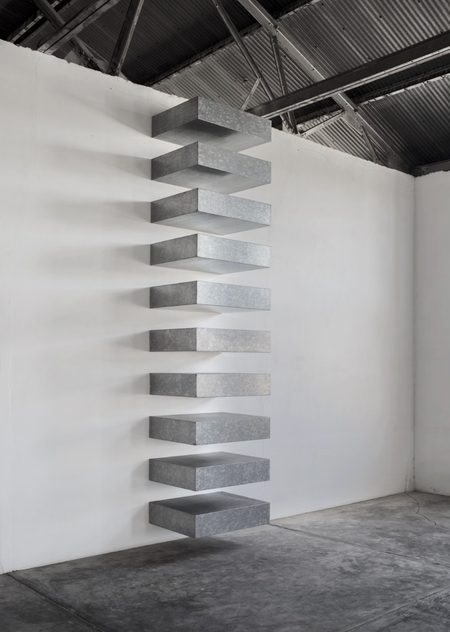
Minimalist art is a tendency that emerged in the United States during the 1960s and transformed the relationship between artwork, space, and spectator. Rejecting illusion, symbolism, and personal expression, minimalist artists created simple geometric forms and industrially fabricated objects. Rather than communicating meaning through representation, these works emphasized the viewer’s direct physical experience. In Minimalism, the artwork was no longer an isolated object to be contemplated from a distance; its meaning emerged through the spectator’s movement and perception within a specific environment.
The principal representatives of Minimalism were Donald Judd, Robert Morris, and Dan Flavin. Judd produced modular structures composed of repeated geometric units, such as his Untitled stack sculptures. Morris explored the viewer’s bodily relationship to objects and space in works such as Untitled (L-Beams) (1965), where identical forms appeared different depending on the spectator’s position. Flavin used fluorescent light tubes to create environments that transformed the perception of architectural space, as seen in Monument for V. Tatlin (1964–69). These works exemplify the minimalist emphasis on experience rather than representation.
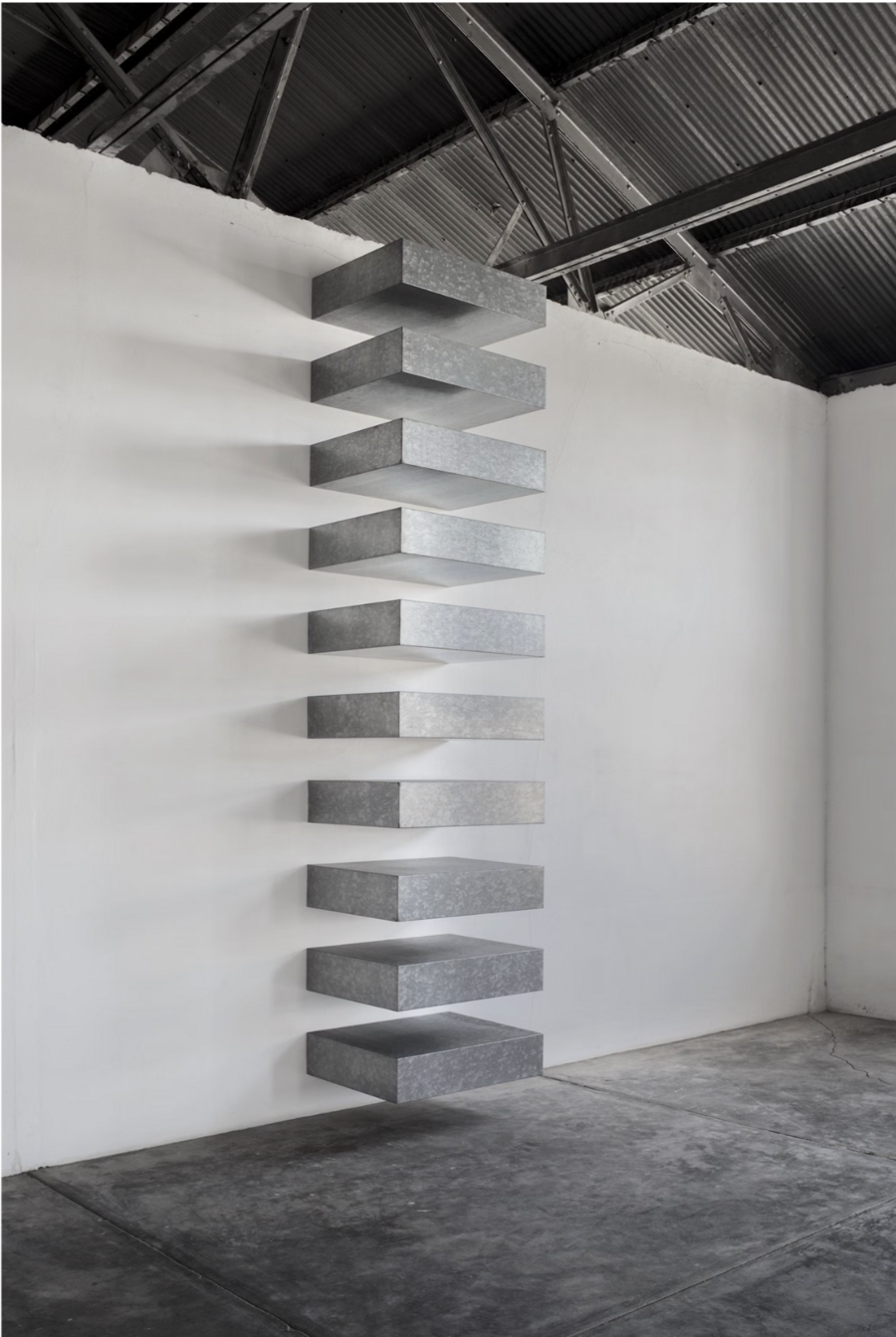
Donald Judd Untitled, 1966
Robert Morris Untitled (L-Beams), 1965
Dan Flavin «monument» 1 for V. Tatlin, 1964
The main theorists of Minimalism were often artists themselves. In «Specific Objects» (1965), Donald Judd argued for a new form of art that existed between painting and sculpture and rejected traditional artistic categories. In «Notes on Sculpture» (1966–67), Robert Morris emphasized scale, spatial perception, and the active role of the viewer in constructing meaning. A critical response to Minimalism was provided by Michael Fried in «Art and Objecthood» (1967). Fried argued that minimalist works possessed a «theatrical» quality because they depended on the spectator’s presence and unfolded through time. Although intended as criticism, Fried’s analysis clearly identified one of Minimalism’s defining characteristics: the transformation of the viewer into a participant.
Minimalism developed under the influence of Constructivism, especially the ideas of Naum Gabo, as well as the geometric abstraction of Piet Mondrian and the modernist emphasis on formal purity promoted by Clement Greenberg. At the same time, it rejected the emotional and gestural qualities of Abstract Expressionism.
The influence of Minimalism extended far beyond the 1960s. Its concern with spatial experience contributed to the development of Installation Art, Site-Specific Art, and Conceptual Art. By redefining the spectator as an active participant, Minimalism fundamentally changed the way contemporary art is experienced and understood.
Fried M. Art and Objecthood // Art in Theory 1900–1990: An Anthology of Changing Ideas / ed. by C. Harrison, P. Wood. Oxford: Blackwell, 1992. P. 822–834.
Gabo N. The Constructive Idea in Art // Art in Theory 1900–1990: An Anthology of Changing Ideas / ed. by C. Harrison, P. Wood. Oxford: Blackwell, 1992. P. 365–368.
Greenberg C. Modernist Painting // Art in Theory 1900–1990: An Anthology of Changing Ideas / ed. by C. Harrison, P. Wood. Oxford: Blackwell, 1992. P. 754–760.
Judd D. Specific Objects // Art in Theory 1900–1990: An Anthology of Changing Ideas / ed. by C. Harrison, P. Wood. Oxford: Blackwell, 1992. P. 809–813.
Mondrian P. Plastic Art and Pure Plastic Art // Art in Theory 1900–1990: An Anthology of Changing Ideas / ed. by C. Harrison, P. Wood. Oxford: Blackwell, 1992. P. 368–377.
Morris R. Notes on Sculpture 1–3 // Art in Theory 1900–1990: An Anthology of Changing Ideas / ed. by C. Harrison, P. Wood. Oxford: Blackwell, 1992. P. 813–822.