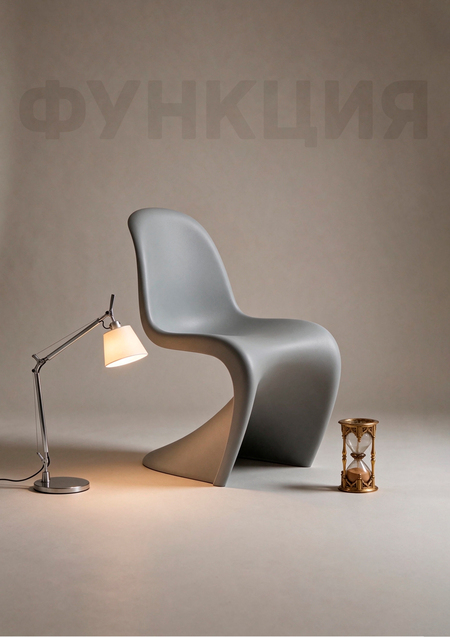
The functions of many courses have been implemented for quite some time and have not fundamentally changed. However, their design continues to evolve—new materials, structures, technologies, and artistic solutions are continually emerging.
Concept
The basis for selecting this topic was the observation that many design objects continue to evolve actively even after their primary function has been fulfilled. Throughout design history, new versions of existing objects constantly emerge, even if their basic purpose remains unchanged. Meanwhile, materials, constructions, manufacturing technologies, and forms change. This contradiction led to the formulation of the research hypothesis: design evolves despite its function. This statement does not deny the importance of function, but rather suggests that once the utilitarian task is addressed, the object’s further evolution is determined not only by practical necessity. If a function requires an object to perform a specific task, society imposes significantly more demands upon it. The object then becomes a carrier of cultural meanings, aesthetic preferences, ideas about status, and technological progress.
Key research question: What factors drive design development after the functional problem has already been solved?
A comparative method was employed to test the hypothesis. Visual material was selected based on the principle of maintaining function while noticeably altering other object characteristics. The study includes objects from various historical periods, reflecting crucial stages in the development of the object’s form, construction, technology, and cultural significance.The research structure is built upon a sequential comparison of the historical stages of object development. The analysis is conducted using similar criteria.
The theoretical foundation of this research is the work, «Design: History, Concepts, Conflicts, ” where design is examined through the tensions between functionality, production, consumption, and culture. Robert Venturi’s ideas are also highly significant, as shown in his book, „Learning from Las Vegas, ” which posits that the built environment is a system of symbols and communication, not merely a functional structure. The research is further enriched by the work of Charles Jencks, who connects the development of contemporary culture with the multiplicity of meanings and the rejection of a single universal language of form.
Chair
To the left is a stool with a woven seat, dating from 1991–1450 BCE, made of wood and reed. To the right is a high-backed chair from New England, 19th century.
The chair becomes a signifier of a person’s status and position at the table. The object’s function remains unchanged. The changes are aimed at enhancing comfort and reflecting the evolution of domestic culture. The first major alteration is not linked to a change in function, but rather to rising demands for comfort and the organization of the living environment.
On the left is a high-backed chair from New England, 19th century. On the right is Thonet Chair No. 14, Austro-Hungary, 1859.
The function of seating remains unchanged, but the technology of bentwood radically alters the object’s structure. The chair becomes lighter, cheaper to manufacture, and easier to transport. The evolution of the object is determined by industrialization and the possibility of mass production, not by a change in its purpose.
On the left is Thonet Chair No. 14, Austro-Hungary, 1859. On the right is a cast-iron garden chair with a woven seat, Provence, France, 19th century.
The transition to metal is linked to industrial development and the emergence of new manufacturing technologies. Metal provides greater strength and durability to a structure. The material becomes a reflection of technological progress and changes the visual aesthetic of an object while retaining its original function.
On the left is a cast iron garden armchair with a woven seat, Provence, France, 19th century. On the right is a Neo-Gothic garden chair with an oak seat, France, 19th century.
The development of metalworking allows for the creation of more complex decorative forms. A cast iron chair becomes not only a piece of furniture but also an element of artistic decoration for the space. These changes are linked to society’s aesthetic demands and the demonstration of the owner’s status.
On the left is a Neo-Gothic garden chair with an oak seat, France, 19th century. On the right is the Wassily Chair (Model B3), Marcel Breuer, Germany, 1925–1926.
The function remains the same, but Modernism completely rethinks the external appearance of the object. There is a shift away from decorative qualities toward rationality and constructivism. The chair begins to reflect the ideas of the Industrial Age, where technological capability, simplicity, and standardization are valued.
On the left is the Wassily Chair (Model B3), Marcel Breuer, Germany, 1925–1926. On the right is the Panton Chair (S Chair), Verner Panton, Denmark/Switzerland (Vitra), 1959–1967.
New capabilities in plastic allow for a departure from traditional construction using separate elements, enabling the creation of a monolithic form. Design becomes freer and more expressive. Aesthetics, experimentation, and the emotional perception of the object move to the forefront.
On the left is the Panton Chair (S Chair) by Verner Panton, Denmark/Switzerland (Vitra), 1959–1967. On the right is the Carbon Chair (Carbon Fiber Chair) by Berthe Van Pot and Marcel Wanders, Netherlands (Moooi), 2004.
The emergence of composite materials is tied to the search for new technical possibilities. Structural weight is reduced, strength is increased, and opportunities for shaping expand. Development is driven by advancements in materials science and digital design technologies.
On the left is the Carbon Chair (Carbon Fiber Chair) by Bertjan Pot and Marcel Wanders, Netherlands (Moooi), 2004. On the right is the Aluminum Gradient Chair by Joris Laarman Lab, Netherlands, 2014.
Modern design algorithms allow for the creation of structures whose forms are calculated by a computer. A chair becomes the result of the interaction between the designer, software, and new manufacturing technologies. Given that the function remains unchanged, the object reflects the shift toward a digital culture of design.
The history of the chair shows that once the basic function of seating is resolved, the object continues to evolve under the influence of new technologies, aesthetic ideas, and cultural values. This approach aligns with the ideas presented in the book «Design: History, Concepts, Conflicts, ” where the development of design is viewed through the conflicts between functionality, production, and culture. The example demonstrates this progression: initially, the development was driven by comfort; then by technology; then by aesthetics; subsequently by status; and most recently by digital design.
Hours
Left—stone sundial, Gelati Monastery, Georgia, 12th century. Right—half-hour hourglass made of gilded bronze and silver, Germany, early 16th century.
The measurement of time becomes independent of weather conditions and the sun’s position. This change is related to humanity’s need to control time under any circumstances, rather than a change in the function itself. Concurrently, time gradually transforms from a natural phenomenon into a tool for organizing human activity.
On the left is a half-hour hourglass made of gilded bronze and silver, Germany, early 16th century. On the right are the tower clocks (Kouranty) on the Spasskaya Tower of the Moscow Kremlin, Russia, 15th–19th centuries.
Time transforms from an individual tool into a public resource. The emergence of cities, trade, and artisanal production necessitates a unified timekeeping system for large populations. Tower clocks become symbols of urban power, order, and social organization.
On the left—the tower clock (Kuznetsky) on the Spasskaya Tower of the Moscow Kremlin, Russia, 15th–19th centuries. On the right—Peter Henlein’s pocket watch («Nuremberg egg»), Germany, early 16th century.