CONCEPT
In the late 1950s and early 1960s, a movement arose in Japan that redefined what sound could be and what art could be. The Ongaku Group (グループ音楽—"Musical Group»)—the first Japanese collective to engage in free improvisation—utilized not only traditional instruments (piano, cello, saxophone) but also a vacuum cleaner, a radio receiver, an oil drum, dolls, and kitchenware. It was a radical gesture: sound ceased to be «music»; it became an action.
I am interested in exploring how a group, through a simple gesture—taking an object and making it emit a sound—created a new understanding of what art could be. I am also interested in how this principle continued in the work of the group’s members after its dissolution. Thus, this is a visual investigation into how sound became visible through objects, cards, maps, and gestures.
INDEX
[01.] Group Ongaku: three entries.
[02.] Takahisa Kosugi: cards instead of notes.
[03.] Yasunao Tone: error as a method.
[04.] Mieko Shomi: event as a map.
[05.] Syuko Mizuno: a return to academic music.
MATERIAL SUBMISSION
Sources were selected based on the medium type: audio recordings, museum catalogs, and archival documents. The texts are used to contextualize the material—to help understand what is audible in the recording, how an object is structured, or to which period a work belongs. The analysis is built upon the author’s critical examination and listening experience.
- Only materials and works created by the group or its members.
- Only documentary materials: audio, photos, objects.
- Only what has been preserved and is available for analysis, without reconstructions or assumptions.
How did Group Ongaku and its members make sound visible and material through their techniques?
Hypothesis: the Ongaku group created a unique type of sound document where noise is tied to the object, not the melody. Their recordings are traces of actions performed on things. Later, the group members developed this principle in different directions: Kosugi—through instructional cards, Tone—through technological error and failure, Shomi—through postcards, Mizuno—through composition.
[01] Ongaku Group: three entries.
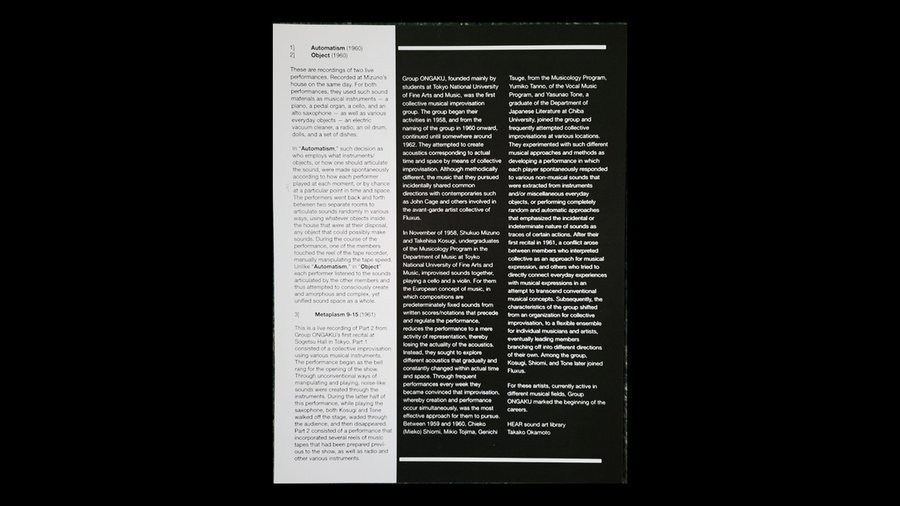
Group Ongaku was founded in 1958 by Kosugi Takehisa and cellist Syuko Mizuno. Yasunao Tone and Mieko Shomi later joined them. Their 1960 recordings capture music played on piano, cello, and saxophone—and simultaneously on a vacuum cleaner, radio, dolls, a oil drum, and kitchenware.
Concept: The group took everyday objects and transformed them into sound sources. A vacuum cleaner and a saucepan were not «instruments, ” but rather objects that produced sound without being intended for music. The group demonstrated that any object can make a sound if one pays close attention.
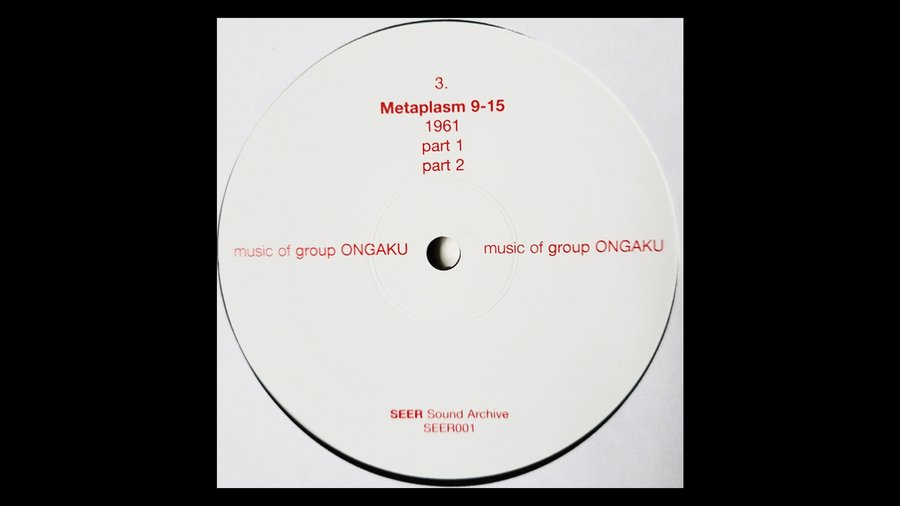
Regarding the recordings: CD «Music of Group Ongaku» was released in 1996 by Hear Sound Art Library. It contains three tracks: «Automatism» (26:20) and «Object» (7:34), recorded on May 8, 1960, at Syuko Mizuno’s home, and «Metaplasm 9-15» (25:49), recorded on September 15, 1961, at the Soge-tsu Kaikan Hall in Tokyo.
Music of the Ongaku Group (1961)
Recorded on May 8, 1960, at Suko Mizuno’s home. Participants: Kosugi, Shomi, Todzima, Tone, Tsuge, Mizuno. In addition to musical instruments, the recording features a vacuum cleaner, a radio receiver, an oil drum, dolls, and dishes.The sound in the recording is dense and chaotic, yet not random. Voices, the creak and clatter of objects, and the intermittent hum of a vacuum cleaner can be heard. One participant manually adjusted the tape speed, causing the pitch and timbre to change during the recording. This is not a melody or a rhythm in the conventional sense, but a kind of texture. The sonic fabric is built not on the succession of notes, but on the layering of incompatible sources: strings, wind instruments, household appliances, and the human voice. It is a collective improvisation where instruments and objects are equal.
If «Automatism» is a flow, then «Object» is a focus on a single subject. The sound is more sparse. You can hear something scratching, rustling, or tapping. It becomes clear here: the object isn’t «playing music.» It is emitting its own sound, and the musician merely helps it to emerge. The track title, «Object, ” directly indicates the method. What captures me most about this track is the pause: there is emptiness between the sounds, and in that emptiness, you can hear that the object exists on its own, independent of a human.
1