Concept
«The Last Chronicle»
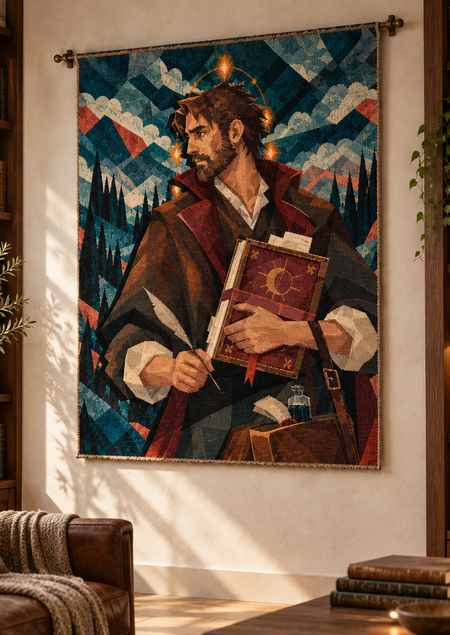
a tapestry inspired by the game *The Last Chronicle*, exploring a memory that resists time. At the center is a court chronicler holding a book—the kingdom of Aurelia’s sole repository of the past. Seven lights denote the days of the cycle, the repeating silhouette of the city signifies the weekly regression, and the scattering pages represent fading testimonies.
Format
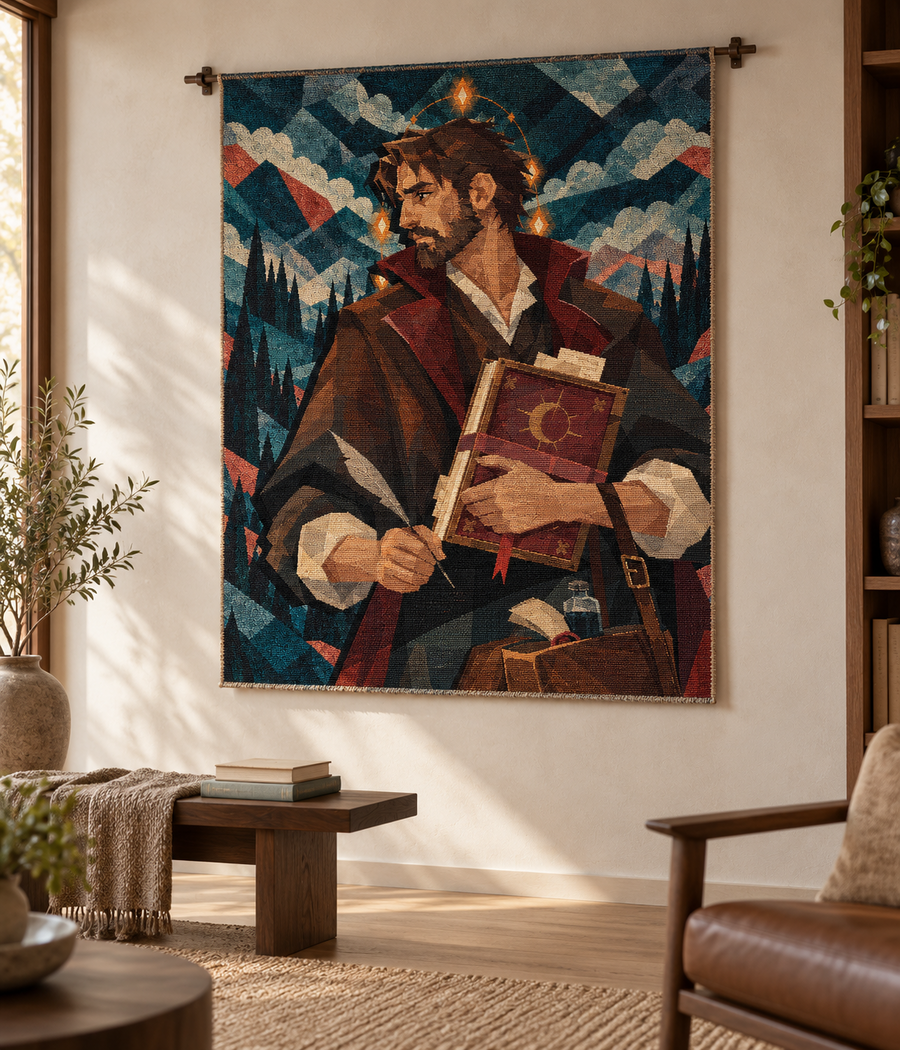
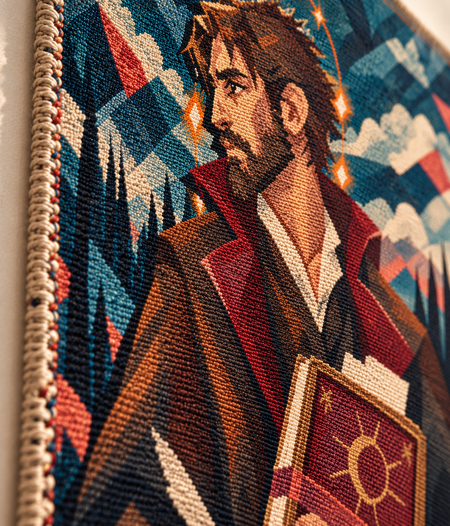
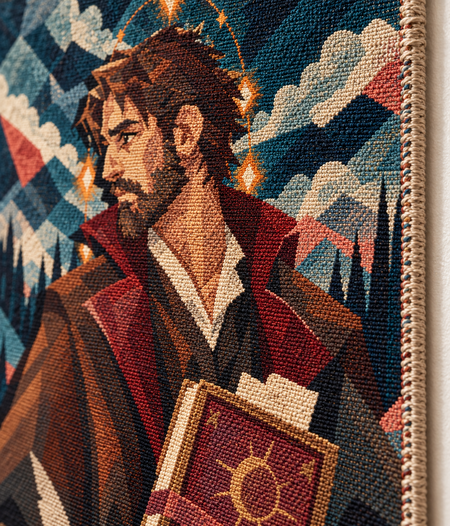
204 × 146 cm, jacquard weave.
In Aurelia, every Monday morning resets the kingdom to the beginning of the week. The residents forget the days they’ve lived, events vanish, and only the chronicler’s records preserve traces of the past. But the chronicler’s entries don’t just describe the world—they gradually begin to change it. A mistake or a lie cemented on a page is capable of distorting the present.
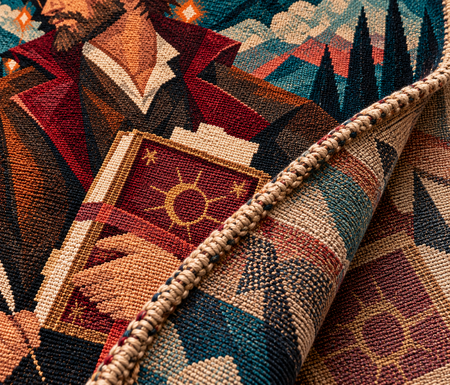

The tapestry, «The Last Chronicle, ” translates this narrative into textile. At the center of the composition stands the chronicler, carefully holding an open book. Its warm glow serves as the primary light source and a symbol of memory enduring another setback. Faintly visible behind the figure are the outlines of Aurelia: the castle, the towers, and the familiar sun symbol. Seven lights reference the seven days of the cycle, while the light fragments of the parchment move in a circle, as if the world is repeatedly trying to forget its own history.For this tapestry, the project’s digital graphics were adapted for a large format and the logic of jacquard weaving. The angular color planes and the expressive silhouette of the chronicler maintain a connection to the game’s visual style; the limited, large color blocks are designed to remain legible within the weave of the threads. The fabric’s texture continues the piece’s concept: the past is not applied onto the surface, but is literally stored within its structure.
The tapestry is conceived as a standalone wall-hanging piece. From a distance, one can discern a figure, a book, and the dark silhouette of a city; up close, individual symbols of the cycle and history reveal themselves. The work is executed in the format of 204 × 146 cm, using Jacquard weaving technique, and is mounted with a cornice and mounting hardware.