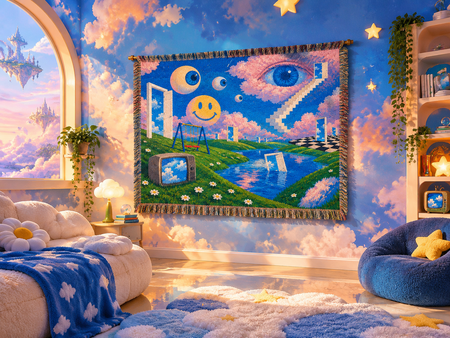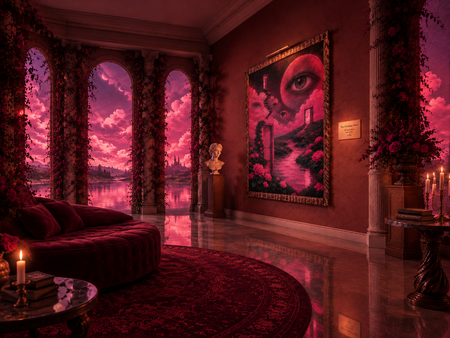
Diptych on the space between reality, memory, and dream. Two interconnected images depict one imaginary world in different emotional states: one bright and almost playful, and the other saturated with anxiety, mystery, and inner tension. Doors, eyes, stairs, water, and flowers become symbols of transition between states of consciousness. The tapestry translates digital imagery into a tangible, textured environment.
Concept
The project is based on two original images, constructed through the surreal combination of recognizable objects and impossible space.
First image is perceived as a light, open side of the world. The sky, clouds, green landscape, water, and flowers evoke a feeling of a child’s dream or memory. However, the presence of numerous eyes, doors, a staircase, a television, and a chessboard disrupts the familiar logic of the space. The world feels simultaneously friendly and slightly strange—like a dream where everything is familiar, yet nothing is in its proper place.
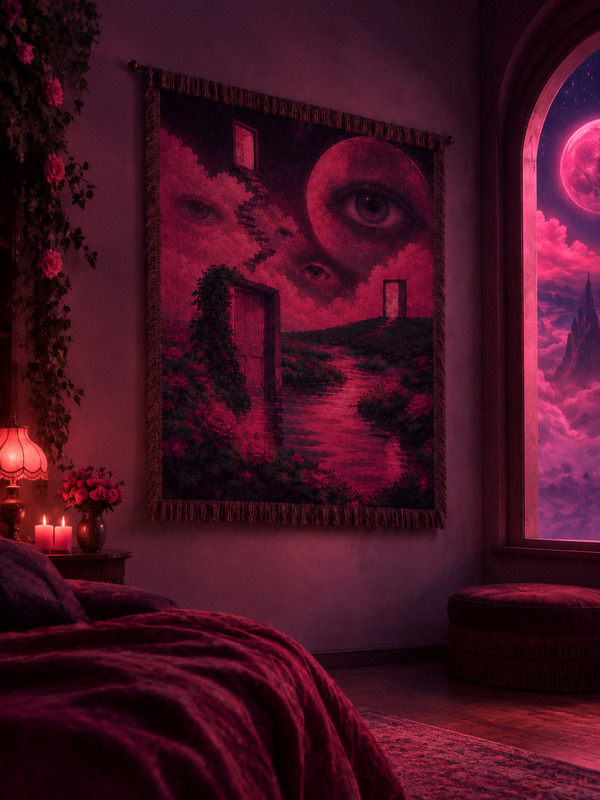
The second image becomes the same space in a different emotional state. Bright blue and green colors give way to a deep magenta-burgundy palette. The eyes become larger and more observant, the staircase leads to a door in the void, and the path passes through a dark landscape with roses. Here, the space no longer so much invites play as it compels one to pause and contemplate their own perspective and who is watching us.
Core concept
The tapestry is considered a transition between digital and physical imagery. The narrative is built around the door as a symbol of transition, the eye as a symbol of observation and self-awareness, and the water and road as movement between states.
Format
Tapestry 1 — «Light Side» 204 × 146 cm, horizontal format.Tapestry 2 — «Dark Side» 146 × 204 cm, vertical format.
Visualization of the finished tapestry in its entirety
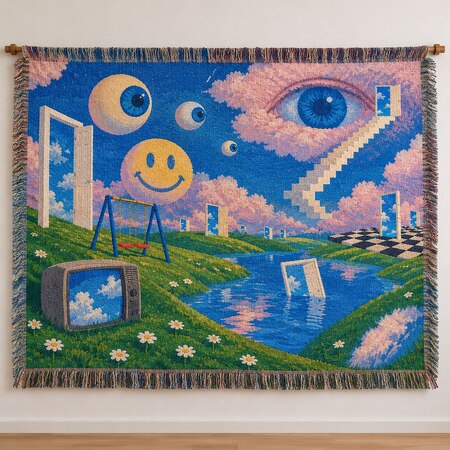
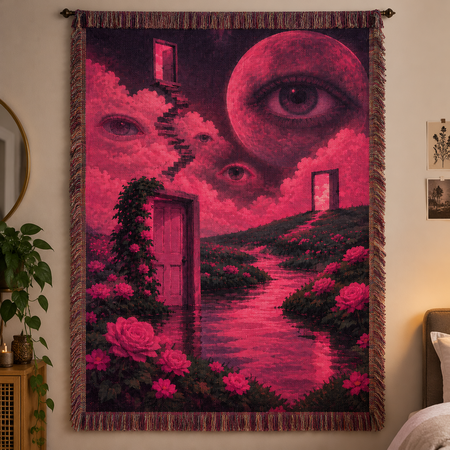
Tapestry visualization in an interior setting