Navigation
- Research Concept ———
- Historical and Archaeological Context 2.1. Neolithic and Bronze Age in Modern Belarus 2.2. Archaeological Cultures and Ornamental Traditions 2.3. Materials and Manufacturing Technologies 2.4. Archaeological Preservation and Study Boundaries ———
- Ornament on Household Objects and Utensils ———
- Ornament on Tools and Objects Made from Natural Materials ———
- Ornament in Jewelry and Accessories ———
- Ornament in Costume and Textiles ———
- Ornament in Housing and Material Environment ———
- Comparative Analysis
- Conclusion
- Bibliography and Image Sources
Research Concept
Ornamentation is one of the most ancient methods of decorating objects that surround human beings. Today, it is most often associated with applied arts, traditional costume, embroidery, and jewelry. However, the history of ornamentation is far broader: even in prehistoric eras, various patterns and decorative elements were applied to items related to daily human life.
This visual study is dedicated to ornament in the material culture of the population of modern Belarus during the Neolithic and Bronze Ages. The selection of this topic is driven by an interest in the origins of ornamental forms, the methods of their creation, and the interaction between decorative design, material, and the object’s intended function.
Special attention is given to the fact that ornamentation existed not only as an element decorating people but also as part of the material environment. Archaeological findings allow us to study the decorative design of ceramic vessels, individual tools, jewelry, and other artifacts. However, many items made of organic materials have barely survived, which limits our understanding of the diversity of ancient decorative practices.
The goal of this study is to identify the specific characteristics of ornament application on various everyday objects of the population in modern Belarus during the Neolithic and Bronze Ages, as well as to trace the relationship between the ornament’s form, the object’s material, and the technology used to apply decorative elements.
For the study, archaeological artifacts and their images are selected to examine the features of ornamental design. The main selection criteria are territorial and chronological affiliation, the reliability of attribution, the presence of distinguishable decorative elements, and the possibility of their visual analysis. Priority is given to materials from scholarly archaeological publications, museum collections, and catalogs.
The research structure is organized as follows:
— Historical and archaeological context.
— Examination of everyday objects and utensils, tools and artifacts made from natural materials, jewelry and accessories, textiles, as well as dwellings.
— Conclusion summarizing the results and findings of the research topic.
When working with sources, particular attention is given to archaeological research that provides information regarding the origin, dating, and characteristics of artifacts. Scientific descriptions of finds, publications on archaeological complexes, and studies of material culture are used to interpret images. It is important to distinguish between facts directly confirmed by archaeological materials, research hypotheses, and contemporary reconstructions.
The key research question is how the forms, materials, and methods of applying ornaments differed on everyday objects used by the population of modern-day Belarus during the Neolithic and Bronze Ages.
The research hypothesis posits that Neolithic and Bronze Age ornamentation was not limited to adorning costumes and accessories, but was applied to various everyday objects. Its visual characteristics depended on the material, the object’s manufacturing technology, and cultural traditions. However, the surviving archaeological finds only reflect a fraction of the decorative practices that existed. This hypothesis serves as the basis for this visual study, which aims to examine—not assert as proven—this premise.
Historical and Archaeological Context
2.1. Neolithic and Bronze Age in Modern Belarus
The Neolithic period in Belarus lasted from approximately the end of the 5th millennium BCE to the end of the 3rd millennium BCE.
The Bronze Age in Belarus began in the early 2nd millennium BCE and lasted until approximately the 8th–7th centuries BCE.
One of the most significant changes of the Neolithic era was the spread of ceramic production. Making clay vessels created new possibilities for ornamentation: the surface of unfired clay allowed for the application of indentations, imprints, incised lines, and repeating geometric elements.
Varieties of ornamentation on Neolithic clay surfaces
During the Bronze Age, the material culture continued to evolve, new technologies spread, and contacts between various populations intensified. Along with the changes in object manufacturing, the methods of their decorative design were also transformed.
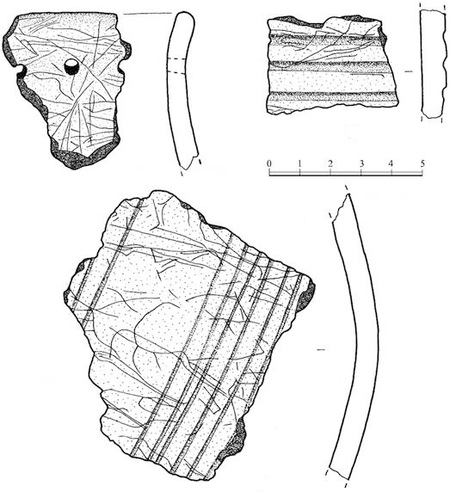
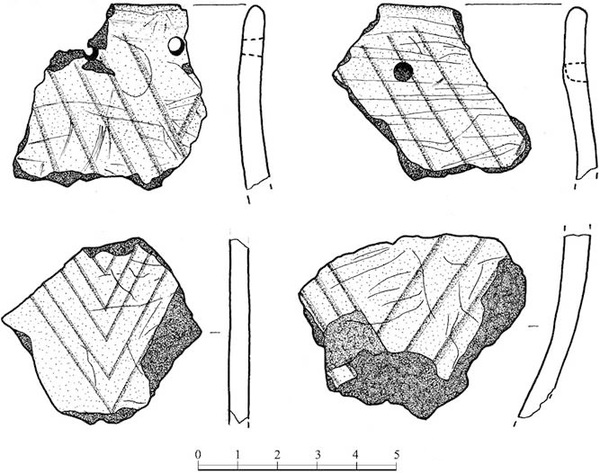
1. Dubichay-type pottery. Senchitsy 1. Bronze Age. 2. Dubichay-type pottery. Ostrov 3 (Veshnya). Bronze Age.
2.2. Archaeological Cultures and Ornamental Traditions
The territory of modern Belarus during the Neolithic and Bronze Ages was a zone of interaction among several archaeological cultures. These cultures are differentiated based on a combination of material culture traits: characteristics of pottery, tools, burial rites, and other archaeological evidence.
For the study of Neolithic ornament, the Pripyat-Neman, Neman, and Narva cultural traditions, as well as the monuments of the Upper Dnieper region, are of particular significance.
Neolithic Period in Contemporary Belarus
In the Late Neolithic and at the beginning of the Bronze Age, the traditions of cord-impressed pottery cultures, including the Middle Dnieper culture, played a significant role. Later Bronze Age complexes feature materials from the Tshynets cultural circle and the Sosnytska culture.
Dnieper culture, cord-marked pottery. 1800–1900 BCE
2.3. Materials and Object Fabrication Techniques
In everyday life, ancient populations utilized various natural materials: clay, stone, bone, horn, wood, and plant fibers. Each material possessed its own physical properties, which dictated the methods of processing and the possibilities for decorative design.
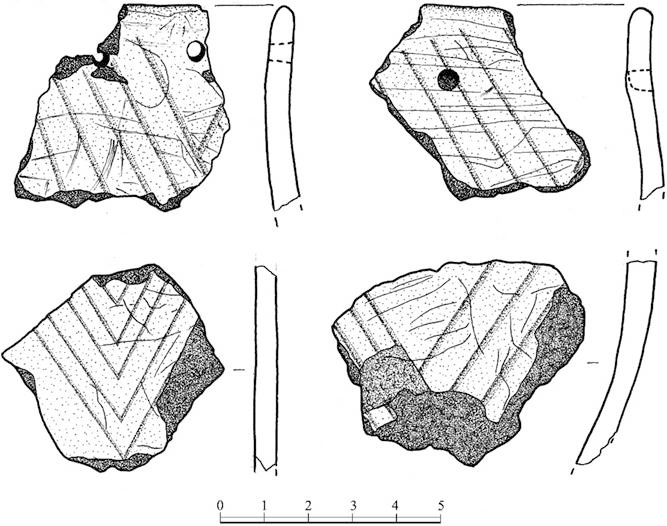
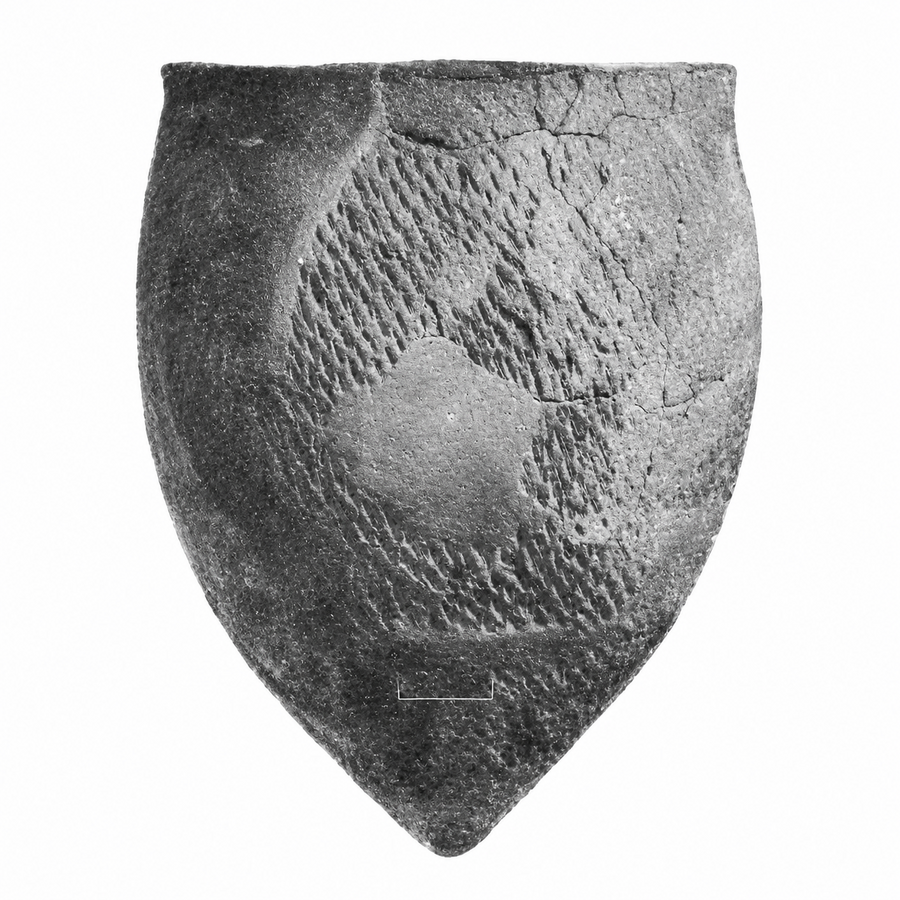
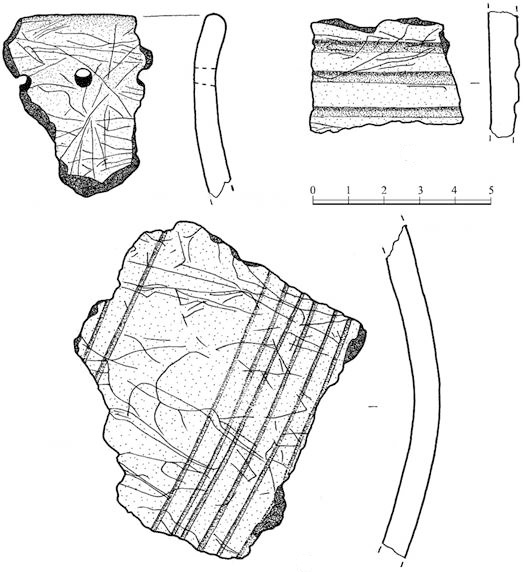
Material: Clay. Imprinting, incising, and coiling as methods of applying ornamentation.
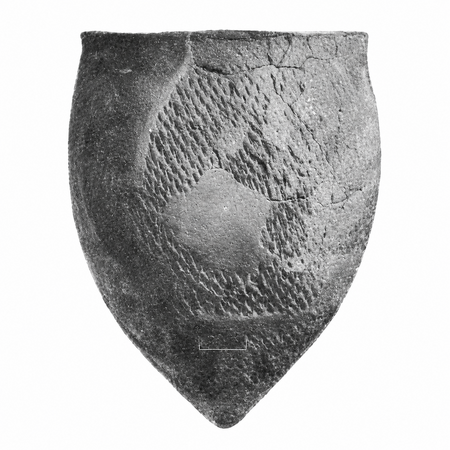
Neolithic Clay Vessel (by Khodosovich, sketch by Moska. Excavations by I. I. Artemenko.) Circa 3rd millennium BCE.
Impressed technique used for pattern application.
Tyachkov A. Yu. Neolithic Ceramics of Western Belarus: Current State and Research Prospects (2017) — URL: https://journals.rcsi.science/2309-4370/article/view/22289 (Accessed 04.11.2026)
Verghey V., Ganetskaya I., Gurin M. History of Belarus. Volume 1. Ancient Belarus (2007) — URL: https://djvu.online/file/VpIRLWuJOIlCZ (Accessed 04.11.2026)