Introduction
The period from Antiquity to the end of the 17th century in European culture was a time when people deeply believed in various myths; their consciousness was saturated with religious fear. Artists strived to visualize what frightened humanity the most—hidden evil, chaos, and witchcraft. Their goal was to visually illustrate the difference between the normal world and the supernatural. The figure of the witch held a special, central place within this circle of frightening imagery.
Visual art, owing to its illustrative nature, became a crucial medium for documenting popular beliefs, thereby exerting a decisive influence on the formation and evolution of the witch archetype. Analyzing paintings allows one to trace the shifting societal perception of sorcery: from minions of the devil to ironic portrayals of herb-gathering old women and romanticized figures of young maidens in elegant attire.
Research Concept
This study examines how the visual depiction of the witch evolved in European art from Antiquity through the mid-17th century. It focuses specifically on the visual details—the markers artists used to construct this frightening archetype—and how those markers shifted over time. This topic allows us to trace a very significant transformation: how art transitioned a majestic, mythical evil from ancient legends into everyday superstition and, ultimately, into the image of genuine human madness we see in 17th-century Dutch painting.
Research Hypothesis
The visual language of the witch evolved along a path of desacralization and grounding. While the witch was initially depicted as a semi-mythical being possessing supernatural power, by the 17th century, all magical attributes vanished, and the primary marker of witchcraft became the terrifying realism and the psychological madness of an ordinary person.
Research Structure / Rubric
The research is divided into three logical stages that visually demonstrate the transformation of the image:
Chapter 1. Ancient Roots and Medieval Monsters.
Chapter 2. Nudity, Flight, and Cauldrons in Northern Renaissance Graphics.
Chapter 3. Everyday Realism and Psychology in the 17th Century: From Witch to Madness.
Chapter 1. Antiquity and the Monsters of the Middle Ages.
Black-figure vase painting, «Circe and the Beast-men» (c. 6th century BCE, Boston Museum).
The sorceress Circe also tried to keep me—in the distant Aeae, wishing to make me her husband.
This vase painting vividly illustrates how feminine sacred power was perceived in Archaic Greece. The key visual markers of witchcraft here are the ritual vessel and the gesture of stirring a potion with a staff. The sorcery of Circe is depicted by the artist through bodily metamorphosis—the transformation of humans into animals, while the sorceress herself maintains idealized anthropomorphic facial features and body proportions.The composition captures the climactic moment when Circe has already given drink to Odysseus’s companions and touches them with her staff, completing the transformation. The artist masterfully conveys the hybridity of the characters, combining human bodies with animal heads. Thus, this enduring visual motif—a woman manipulating ritual objects and vessels to alter another’s nature—formed the basis of the visual archetype of the «witch» in European art.
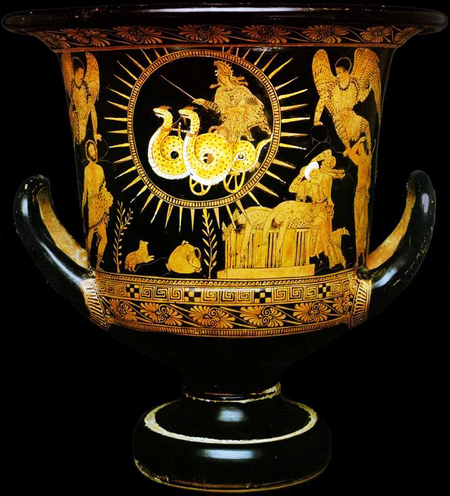
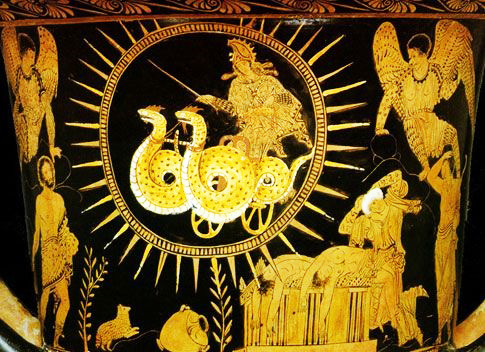
Red-figure vase painting «The Flight of Medea from Corinth» (c. 400 BCE, Cleveland Museum).
In ancient art, the archetype of the witch is a powerful figure commanding the elements. Medea is depicted in a chariot drawn by winged dragons, and her head is encircled by a halo resembling a solar disc. This element serves as a visual marker of her divine or semi-divine origin. Magic here is the ultimate sacred power, not mundane ugliness or marginality.On both vases, the artists employ different yet significant attributes of sorcery: while Circe is associated with domestic items, Medea is linked to a monumental chariot of chaos. The primary distinction between Medea’s and Circe’s depictions lies in the demonstration of absolute, transcendent power. Here, the witch’s triumph over Jason and the entire earthly world is shown. The compositional emphasis is intentionally placed on the unattainability, autonomy, and independence of feminine power.
Miniature from Martin le Flanc’s manuscript, «The Defender of Ladies» (1451).
This book miniature, illustrating the 1451 poem «Le champion des dames» («The Champion of Ladies») by the French poet Martin Le Frank, represents the first recognized depiction in European art history of witches flying on brooms. Here, the key visual marker of witchcraft is born—the flight on a broom or stick. This image radically subverts the conventional meaning of everyday objects: a tool of domestic labor becomes transportation for trips to sabbaths. The sorceress loses the sacred aura inherent in ancient goddesses and, in the eyes of medieval religious society, appears as a grounded, marginal sinner. The plastic quality and context of the image clearly illustrate the transition from the figure of an autonomous divine ruler to one perceived as socially dangerous and persecuted.
German woodcut. «Burning of the Witches in Dürnburg» (1555)
Late Medieval and Renaissance Graphic Arts illustrate the social endpoint of the evolution of the witch figure. The witch is fully desacralized and portrayed as a helpless victim of the judicial process. A crucial marker of demonic presence is presented here in the upper left corner—devilish clouds carrying souls, which visually connects the figure of the witch with chaos, foul weather, and crop failure as understood by people of that era.Thus, during Antiquity, sorcery was depicted as high magic involving bodily transformation, while closer to the Renaissance, it became firmly associated in art with religious sin, physical punishment, and demonic chaos.
Chapter 2. Nudity, Flight, and Cauldrons in the Graphics of the Northern Renaissance
Albrecht Dürer — «The Four Witches» (1497, copper engraving)
In Dürer’s composition, for the first time in history, the witches are depicted nude. The artist signals that these are not just women, but witches, through subtle background elements—skulls scattered on the floor, and the outline of a demonic creature on the left side. Special attention should be paid to the beautiful appearance of the girls; their sensuality is shown. However, this sexuality is now interpreted as sinfulness.
Albrecht Dürer — «The Witch Riding Backward on a Goat»
A dynamic, multi-layered composition. Interestingly, Dürer depicted the witch galloping backward, which seems to symbolize that she does not adhere to divine rules and is far removed from conventional moral values. Her body remains nude, but her age is approaching deep old age, which adds a sense of gloom and devilry to the figure. In her hands, she holds a spinning wheel—an object of witch power, through which she can cast spells. Angels below support the goat, symbolizing a connection to the real world, seemingly bringing the witch down to earth.
Hans Baldung Grien — «Witches' Sabbath» (1510, woodcut)
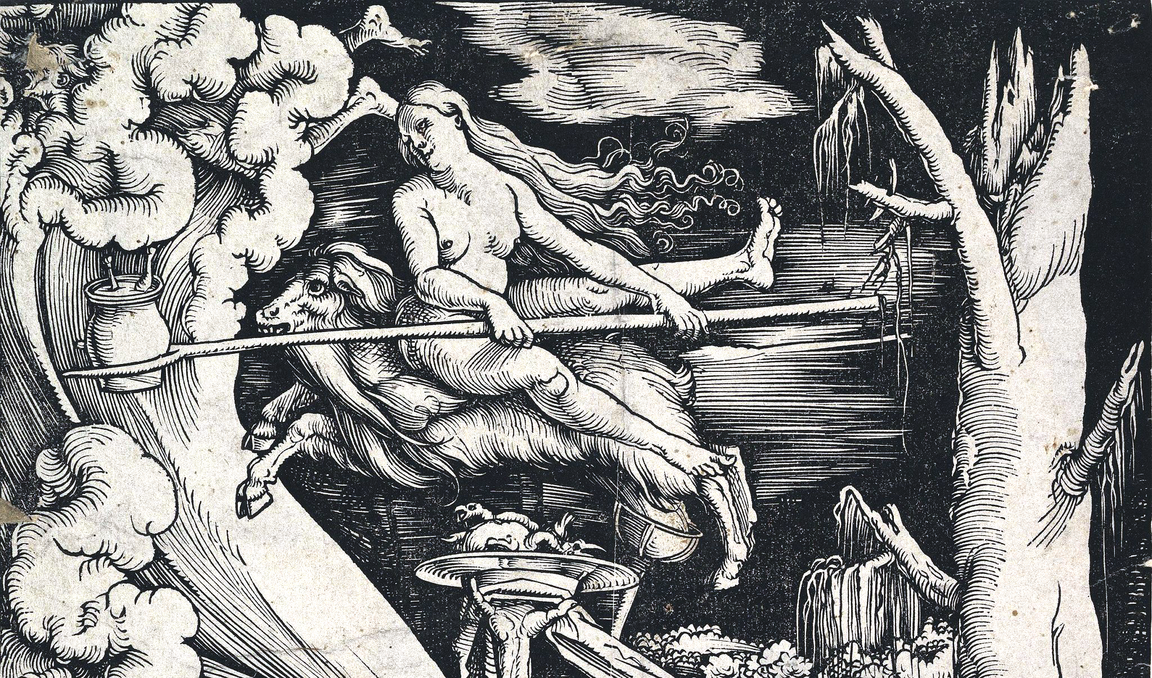
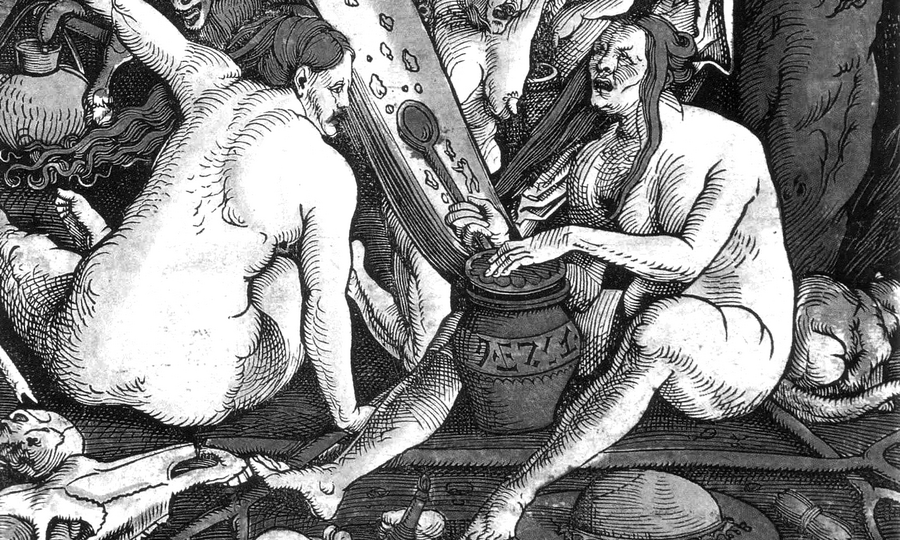
Baldung’s engraving depicts a more familiar image of wicked witches. The composition features sorcerers sitting on the ground before a cauldron, from which steam rises, smoothly guiding the viewer’s eye to a witch seated on a goat. Interestingly, Baldung—a student of Dürer—adopted his visual description of a witch. This engraving is a direct embodiment of the fear surrounding witchcraft, hexes, potions, and epidemics.
Hans Baldung Grien — Three Witches, 1514
In Baldung Green’s painting, «Three Witches,» three nude witches are depicted in unnatural, even broken poses. Furthermore, Baldung unites witches of different ages, which is clearly conveyed through their bodies. Thus, the artist suggests that any woman can be a witch, regardless of her age. Notably, only one witch has a gaze directed precisely at the viewer—a profound, menacing stare. This establishes a dialogue with the observer and conveys the tension of the scene.
Jacob de Gheyn II — «Two Witches with a Cat»
Jacob de Gheyn II’s composition, «Two Witches with a Cat,» presents what initially appears to be ordinary women—one seated and elderly, the other standing and younger. A cat rests on the old woman’s lap. The fact that these are not merely townswomen, but specifically witches, can be discerned from the commanding gesture of the younger figure—her index finger points left, while her head is turned to the right. Magic is currently transitioning smoothly from the forests into domestic spaces, thereby becoming something mundane.