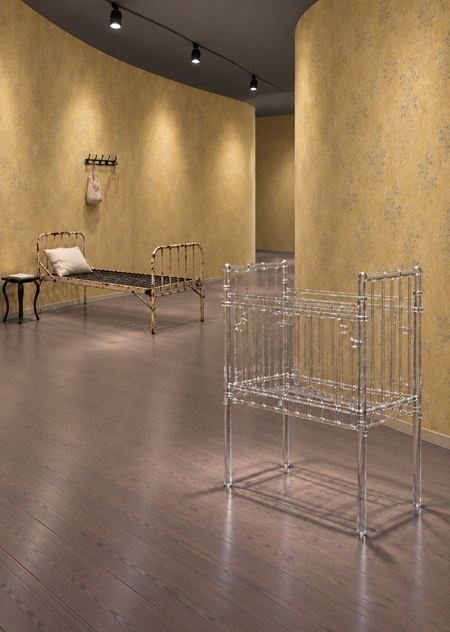
Concept
The feeling of security is constructed from almost imperceptible conditions. We assume that one’s own body serves as the guarantor of personal space, that household objects assist in daily life, and that familiar places will always be available for return. When these expectations are violated, the perception of the surrounding world changes. The exhibition «Mona Hatoum: Boundary as a Way to Feel» explores this experience through works in which the boundary of the body, room, or territory becomes palpable through material, scale, and spatial arrangement.The foundation of this project is the visual study «Mona Hatoum: Body, Home, World. Vulnerability and Interconnection in Works from 1983–2026.» Comparing works from different years with interviews with the artist revealed that bodily experience retains its significance when transitioning from performance to objects and installations. Vulnerability manifests as human dependence on the environment and connections with other people. The exhibition develops this conclusion: viewers will be able to trace how altering boundaries affects the possibility of approaching, acting, feeling at home, and maintaining intimacy.
Project Curatorial Question: How do the boundaries of the body, home, and world define our vulnerability?
The boundary here is understood specifically: skin conceals the inner space of the body, an object separates the accessible from the inaccessible, a threshold denotes entry into a home, and distance alters the relationship between those who are close. Some boundaries protect; others restrict. The exhibition focuses on what happens to a person on either side of such a division.Mona Hatoum was chosen for her ability to connect personal experience with political reality, leaving the viewer the freedom of interpretation. Today, against the backdrop of a globally unstable political situation, her art helps to comprehend the loss of home and safety through everyday experience.
Venue Selection
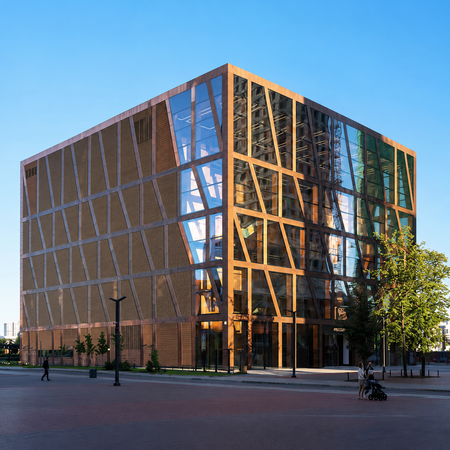
For the exhibition, the ZILART Museum was chosen. Its educational program views art as a tool for self-exploration and emphasizes the emotional engagement of the viewer. This aligns with Hatum’s approach, whose works prompt reflection on social issues through personal feeling.Fig. 1. The building of the ZILART Museum, Moscow. Photo: Ilya Ivanov. Source: The Art Newspaper Russia, 03.12.2025.
Exhibition Structure
The exhibition features 23 works by Mona Khatum in the «I Am Body, ” „Home, ” and „World“ galleries. This curation develops the visual research conclusion regarding humanity’s dependence on its environment: the route sequentially expands the scope from the human body to universally recognized global boundaries.
The first hall begins with a question of how much agency a person has over their own body, voice, and movement. Here, the boundary runs between the internal and the external, living material and its representation, personal action and constraint. This section connects early video work with installations and small hair pieces: various forms demonstrate that a person’s presence can be conveyed without a complete figure.
In the open area beyond the entrance, images of the body and traces of its presence are connected. The cylinder suggests an entrance inward, while the small works on the partitions invite close inspection. This juxtaposition poses the hall’s central question: how accustomed is a person to their own body when the method of its representation and the distance of observation change?
Fig. 3. Sketch visualization of the first zone of the «I Am Body» hall. Foreign body, 1994, and works titled Untitled, 2001, and Untitled, 2002. Created using imagegen.
Position 2. «Corps étranger, ” 1994.
Cylinder height — 350, diameter — 300
Fig. 4. Mona Khatoum. «Foreign Body» [Corps étranger], 1994. Exhibition view, Centre Pompidou, 2015. Photo: Georges Meguerditchian / Centre Pompidou, MNAM-CCI / Dist. GrandPalaisRmn.
Inside a cylindrical structure, video footage captured by a medical camera is projected onto the floor. The image moves across the artist’s body and penetrates into it, accompanied by the sound of the process. The viewer enters a confined space and looks down at magnified segments of the body. The familiar human form vanishes, leaving behind an unfamiliar intimacy with its internal structure.This work opens a pathway by immediately rendering the boundary of the skin permeable to the gaze. In the visual study «Foreign Body, ” the subject was explored through observation and the loss of privacy; in the exhibition, this idea finds spatial expression: the visitor finds themselves inside one casing while simultaneously observing another. This raises the project’s core question—what happens to the feeling of security when what is usually hidden becomes accessible to outsiders?
Position 3. «Untitled (hair grid with knots 3), ” 2001; „Untitled (grey hair grid with knots 3), ” 2002
First work: 35,9 × 27.9; second work: 33,7 × 27.3
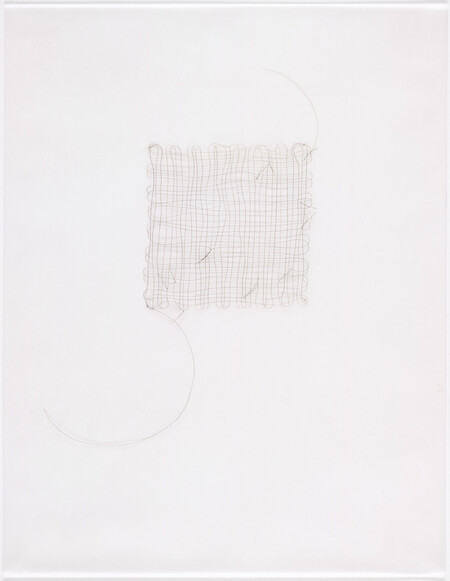
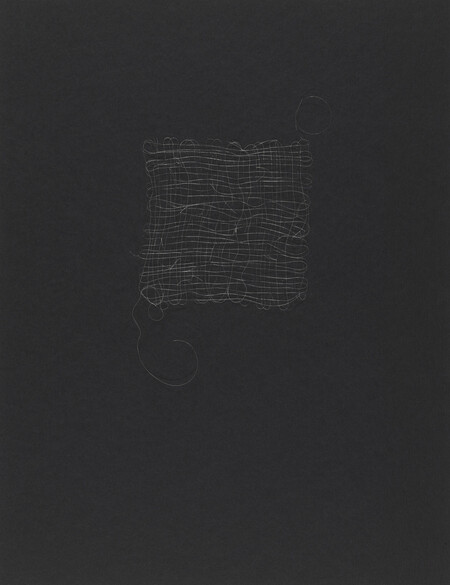
Fig. 5. Mona Hatoum. «Untitled (hair grid with knots 3), ” 2001. Hair on transparent paper. MoMA Collection, 301.2002. © Mona Hatoum. Fig. 6. Mona Hatoum. „Untitled (grey hair grid with knots 3), ” 2002. Grey hair on black paper. MoMA Collection, 399.2002. © Mona Hatoum.
In both pieces, human hair is woven into a mesh and secured with lacquer onto paper. In the first work, thin dark lines are visible on a transparent substrate, while in the second, graying hair stands out against a black background. The regular pattern preserves the unevenness of the organic material—a geometric form gradually unfolding as a trace of the human body.
The meshes are displayed together on a partition next to the installation «Foreign Body.» After an image of internal organs, the viewer encounters a subtle bodily material and must lean in to recognize it. The proximity of the two works allows viewers to observe how the hair color and the base alter the visibility of this trace.
Position 4. «Hair There and Everywhere, ” 2004
Each of the ten sheets measures 40,6 × 35.6 cm; the total size of the hanging depends on their arrangement
Fig. 7. Mona Hatoum. «Hair there and everywhere, ” 2004. Complete set of ten etchings. Source: Phillips, Editions & Works on Paper, 02/15/2024, lot 3, item 5/20. © Mona Hatoum.
The series consists of ten etchings created using the soft varnish technique with chine-collé—the process of gluing thin paper during printing. Hair was used to create the design on the printing plate, and its graphic trace is ultimately preserved on the final sheets. «Hair is here, there, and everywhere» continues the theme of bodily presence while shifting its intensity. The body’s own material transforms into a line that can be transferred onto another surface. In the gallery, it is displayed separately from the nets so that the viewer can distinguish these two modes of work.
«Light at the End, ” 1989. Position 5 on the plan.
Fig. 8. Mona Khatum. «The Light at the End, ” 1989. Installation view. Photo: Edward Woodman. Source: White Cube.
Six electrical heating elements are enclosed within a steel frame. In the darkened area, their glow is first perceived from a distance, and then the connection to heat becomes apparent. This effect allows one to sense the distance to the object directly with the body. In the floor plan, the piece is situated in a separate corner section: the designated depth allows the light source to be seen from afar and approached within the viewing zone. It is included in the exhibition as an example of a boundary that arises without a solid wall. It is defined by the material’s physical action and the human decision to pause.
«Light Sentence, ” 1992. Position 6 on the plan.
Ill. 9. Mona Khatum. «Light Sentence, ” 1992. Exhibition view at Centre Pompidou, 2015. Photo: Georges Meguerditchian / Centre Pompidou, MNAM-CCI.
The piece occupies a zone adjacent to the previous one. Inside the structure, made of metallic mesh modules, a lamp moves slowly. The shadows cast by the mesh spread across the walls, constantly shifting their position. The viewer simultaneously perceives a stationary object and the movement that envelops the surrounding space. Within the context of the exhibition, the grid becomes a boundary that extends beyond the object itself. While it may evoke the image of a prison bars, the work’s meaning is not limited to that association.
Position 7. «So Much I Want to Say», 1983
Size varies; video length is 4:47.
Fig. 10. Mona Khatum. «So Much I Want to Say,» 1983. Video still. Courtesy of the artist. Source: Museum of Contemporary Art Chicago.
The upper portion of the darkened room features a video about voice suppression. The screen and seating suggest a pause: here, the duration and repetition of the sound are critical elements that cannot be conveyed in a single image. Black-and-white photographs show the artist’s face, with her mouth being covered by male hands. The sound track repeatedly features the phrase, «I want to say so much.»
Here, the barrier functions as a direct interference with a person’s ability to express themselves. In the exhibition, the work links physical vulnerability with the right to speak: the body is restrained, yet the attempt to speak endures.
Position 8. «Roadworks, ” 1985
Size varies; video length is 6 min. 45 sec.