CURATORIAL EXHIBITION PROJECT
Forms of Presence
Masahisa Fukase · Ravens / Bukubuku
Artem Deikin’s curatorial project for the Gallery of Classical Photography, Moscow.
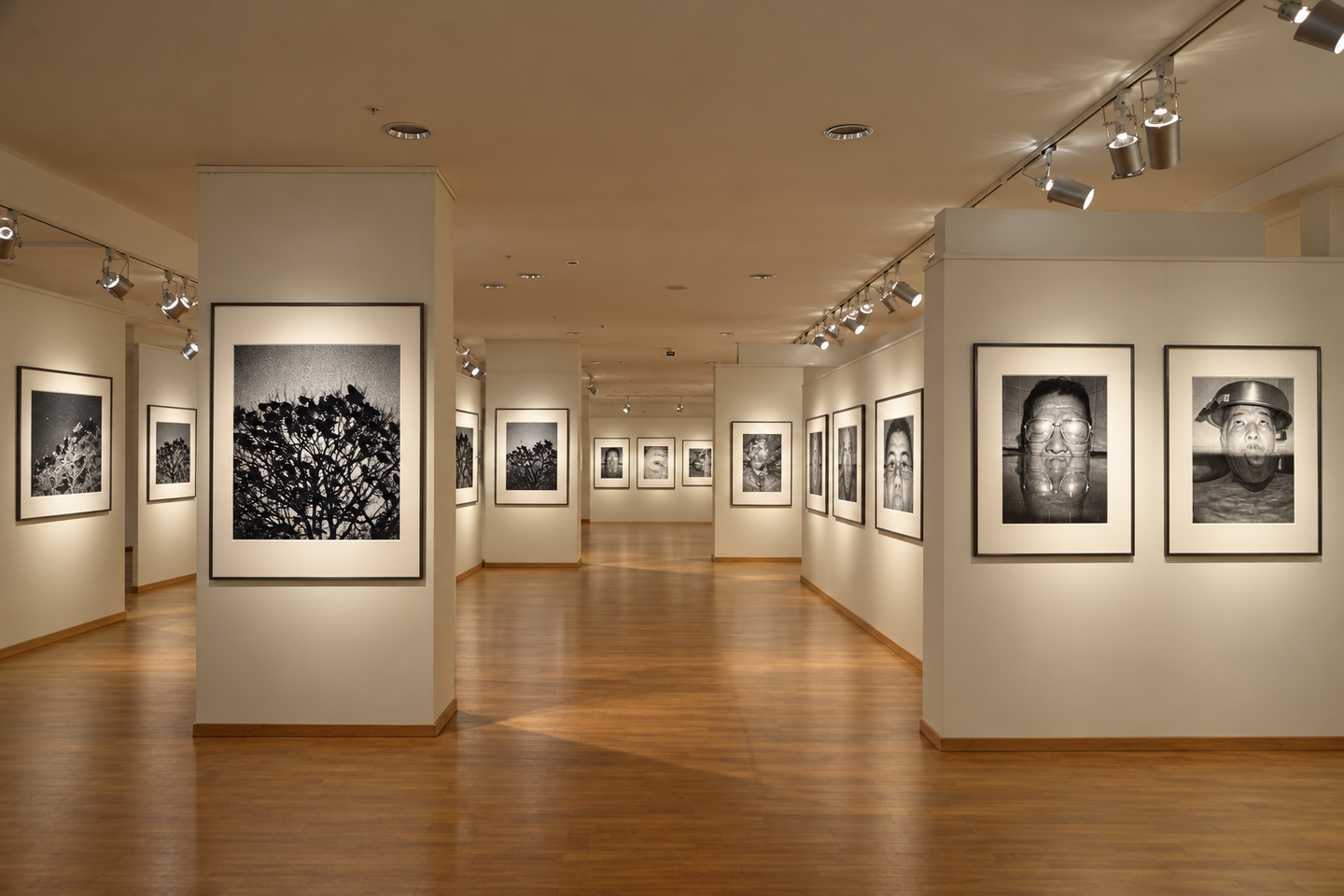
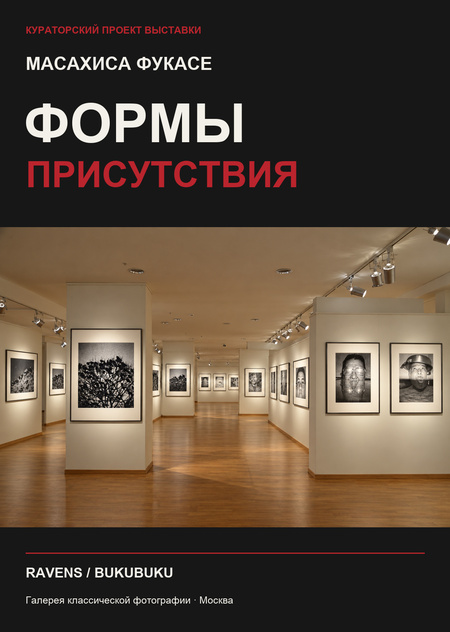
Conceptual visualization based on photographs of the large hall and reproductions by Fukase. The generated view conveys a spatial idea; the exact works are shown in the six juxtapositions below.
01 / CONCEPT
Exhibition-Dialogue
«Forms of Presence”—a monograph thematic exhibition in two series by one author. Ravens and Bukubuku are presented in independent sequences, punctuated by spaces for visual cross-reference.
The project is based on 64 prints: 32 from Ravens and 32 from Bukubuku. Each series is grouped into four blocks of eight works. Six points of comparison connect contours, light accents, reflections, and shifts in scale.
The viewer is invited to experience each series in its entirety, shifting their gaze to the adjacent line, and returning to the chosen photographs. Personal vulnerability, grief, play, and optical experimentation form several avenues of interpretation.
Masahisa Fukase
Masahisa Fukase (1934–2012) focused on intimate subjects: people, animals, the city, and his own body. Private life became the material for composition, repetition, montage, and working with the imprint. Across his diverse photographic subjects, the presence of the photographer himself is questioned. [03–04]
The exhibition centers on two temporally distant series. Their juxtaposition allows us to trace the persistence of this question and the variation in photographic approaches. A detailed chronological overview is provided in the visual study of Fukase’s work.
02 / SERIES SELECTION
Two Different Times and Two Ways of Shooting
Ravens / Karasu · 1976–1982; book — 1986. The main body of work is composed of trips and returns. The marital crisis is part of the personal context. The birds, road landscapes, and nighttime city gain coherence through changes in distance, print, and image sequence. [03; 05; 09]
Bukubuku · November–December 1991; exhibition — 1992. Fukase films himself in a home bathtub using a waterproof camera. The repeated setup offers numerous variations: the angle, face, breathing, and water surface change. A comical pose coexists with anxiety and the pleasure of the experiment. [03–04]
For Ravens, the main developmental phase of the project is noted. Broader dating for individual photographs is maintained in the gallery cards. For Bukubuku, the frame numbers refer to the published set of 14 works. [07–08]
Personal Vulnerability and the Form of Imagery
In Ravens, the author’s sense of self is conveyed through birds and the surrounding space. In Bukubuku, the photographer’s face and body enter the image directly. Black mass, blur, glare, and doubled outlines connect different ways of speaking about the self.
The curatorial juxtaposition holds the emotional tension together with the material work of the photograph. Grief takes on a visible form through the selection of distance, printing, repetition, and montage. The later play with reflection continues this work in a different medium.
Amanda Maddox’s essay and the curatorial model, Play, help to account for the experiment and comic undertones in Fukase’s work. Elise Voyo’s research explores the significance of the magazine page, the book layout, and the exhibition print. [04–06]
04 / STRUCTURAL PRINCIPLES
Serial Integrity and Comparative Space
Each series forms its own distinct line. Neighboring works maintain internal relationships established within the selection: repetition, scale variation, pauses, and motif recurrence. This arrangement allows the viewer to study the Ravens and Bukubuku independently over an extended period.
Points P1–P6 introduce a secondary level of viewing. During a general walkthrough, the viewer notices the cross-reference and can move closer to the works of both series. Comparison arises through the space, the direction of gaze, and the visitor’s own movement.
Paired reproductions in this project illustrate the logic of the curatorial reading. In the exhibition, photographs are grouped into serial blocks; photobooks and publication materials expand the context of the selection.
Unscaled arrangement diagram. R-1–R-4 — Ravens; B-1–B-4 — Bukubuku. Each block features eight impressions. End sections denote group boundaries, and the open spaces maintain a clear thoroughfare.
05 / VENUE
Gallery of Classic Photography
This project is designed for the large hall on the second floor of the Gallery of Classic Photography: Moscow, Savvinskaya Embankment, 23, Building 1. The hall covers 500 m². The space includes movable exhibition structures, professional lighting, and climate control. [01–02]
The selection of this venue relates to how the photographs are viewed. Here, one can approach an individual print, step back to view several works, or see the neighboring line through an aisle. Movable partitions allow for the separation of series into cohesive groups.
The gallery’s photographic specialization makes attention to print quality and book sequencing a natural part of the project. The reading area continues the exhibition viewing experience, allowing visitors to return to the origin of each body of work.
The real space of the large hall. The photograph is published by the gallery. [02]
06 / SPACE
Exhibition Layout
A — Exhibition Area. Two rows of L-shaped partitions are placed along the long side of the main hall. One row is dedicated to Ravens, and the second to Bukubuku. A central walkway connects the series and six points for visual comparison.
D — Introduction. The exhibition title, central question, and viewing map are located in the center of the layout.
C — Reading Zone. Photobooks and materials detailing the creation and publication of the series are placed in the lower section of the main hall.
The project layout has been placed on the official gallery plan. Areas D and C are situated based on the latest project revision. The geometry illustrates the placement principle; the precise fitting of the partitions must be verified through on-site measurement. [01–02]
Partition, Gap, Proximity
The long side of each screen holds a group of works, while the short end section denotes its boundary. The gaps between partitions allow for adjusting the distance and viewing the adjacent series. The two rows create a space for sequential viewing and free movement.
The calm presentation, the intervals between prints, and the localized lighting maintain focus on the image. The actual size and specific characteristics of each sheet are considered when selecting frames and matting. The lighting scheme is finalized in consultation with the owners and conservators of the works.
The proposed 32 prints per series determine the scope of the exhibition. The complete selection sheet and the order of the pieces are verified against the books and archive; the six presented pairings justify the chosen principle of juxtaposition.
07 / CORRESPONDENCES
Six Visual Rhymes
Each point P1–P6 highlights a specific photographic relationship. Formal similarity becomes an opportunity to notice differences in distance, environment, and authorial action.
P1 · Outline and Proximity
A solitary bird occupies a small portion of the space, while the face in the bathtub fills the frame. The figure and the background relate to each other in different ways. This pairing raises the question of distance: presence can be felt through removal or through extreme closeness.
Masahisa Fukase. Ravens: Untitled, 1975–1985. Bukubuku: 1991, frame 13 of the published series. Reproductions Michael Hoppen Gallery; works © Masahisa Fukase Archives. [07–08]
P2 · Surface Density
The network of branches echoes the trails of light on the water. Both photographs invite the viewer to gaze through a dense surface toward a living figure. The landscape and water create differing conditions of visibility.
Masahisa Fukase. Ravens: Kanazawa, 1977. Bukubuku: 1991, frame 02 from the published series. Reproductions courtesy of Michael Hoppen Gallery; works © Masahisa Fukase Archives. [07–08]
P3 · Gaze and Reflection
Points of light among the birds echo the glints off glasses. Water doubles the face. Light highlights the figure while simultaneously complicating its recognition; the viewer’s gaze lingers on the boundary between clarity and ambiguity.
Masahisa Fukase. Ravens: Kanazawa, 1978. Bukubuku: 1991, frame 08 from the published series. Reproductions Michael Hoppen Gallery; works © Masahisa Fukase Archives. [07–08]
P4 · Unstable Support
Birds occupy a grid structure, and Fukase appears with a metal object on his head. The similarity in support and balance introduces a playful tone. It preserves the humor and theatrical inventiveness of the artist’s work in the project.
Masahisa Fukase. Ravens: Nayoro, 1977. Bukubuku: 1991, frame 10 from a published set. Reproductions Michael Hoppen Gallery; works © Masahisa Fukase Archives. [07–08]
P5 · Liminal Approximation
A recognizable figure—a wing and a fragment of a face—nearly fills the image frame. The figure dissolves into a large, generalized form. This juxtaposition helps viewers see how photographic distance alters the scale and boundaries of the body.
Masahisa Fukase. Ravens: Erimo Cape, 1976. Bukubuku: 1991, frame 09 from the published series. Reproductions via Michael Hoppen Gallery; works © Masahisa Fukase Archives. [07–08]
P6 · Disappearance of Outline
Overlapping forms of birds and a close-up fragment of a face impede recognition. Rhyme emerges at the boundary of visibility. Movement, bodily surface, and reflection retain their inherent qualities.
Masahisa Fukase. Ravens: Untitled, 1976–1986. Bukubuku: 1991, frame 14 from the published series. Reproductions Michael Hoppen Gallery; works © Masahisa Fukase Archives. [07–08]