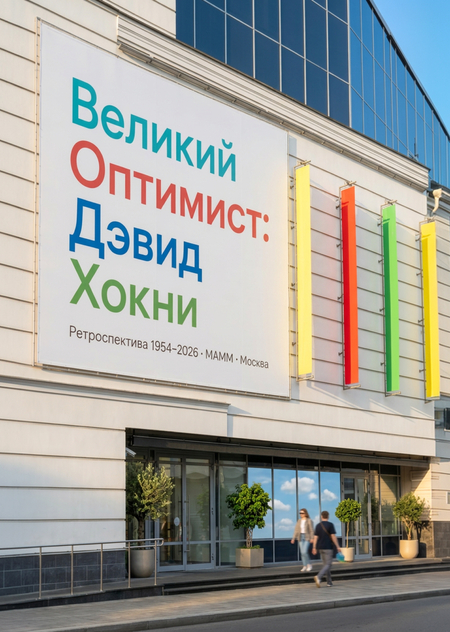
«David Hockney: A Great Optimist”—the first comprehensive retrospective of the artist in Russia: around 120 works, seven galleries, and seven decades of creativity at the Multimedia Art Museum in the spring of 2027.
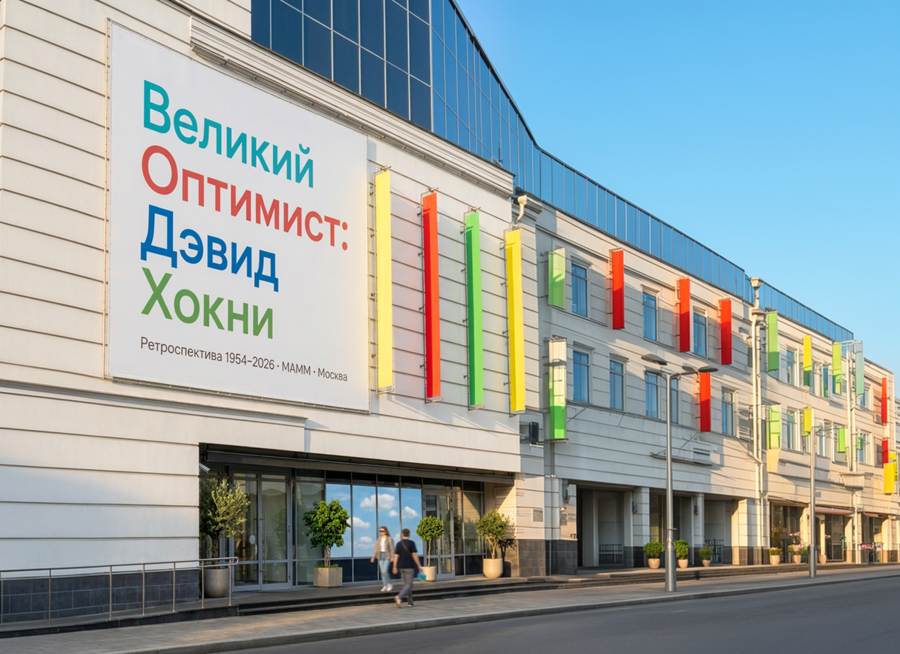
MAMM Facade Visualization with Exhibition Banner | MAMM Facade Visualization, Ostozhenka, 16
David Hockney died in 2026, and his passing concluded one of the longest and most consistent artistic biographies of the 20th and 21st centuries. Now, the full trajectory of the artist’s career can be seen. The exhibition is conceived not as a memorial nor as a nostalgic gesture, but as an attempt to understand how a man from industrial Bradford rethought the very concept of the gaze.
Hokni spent his entire life asking one question—how the human eye perceives—and sought the answer in oil, acrylic, photo collage, fax, and iPad. The retrospective traces this search.
The retrospective format was chosen intentionally: a thematic or immersive exhibition would only show a fragment. Only the chronological journey allows the viewer to sense time, transformation, and the scope of the artist’s life. Each period of Hockney’s work radically differs from the last, and it is only in the sequence that one sees how the same themes—water, light, portraiture, landscape—evolve along with the medium. The viewer themselves will walk the artist’s path—from one viewpoint to many. Moscow audiences will see Hockney in this scope for the first time: not individual works, but his entire life.
Location: Multimedia Art Museum
Multimedia Art Museum — Russia’s premier museum of photography and media art. For an artist who has spent a lifetime exploring the nature of imagery, this is a natural platform.
Visualization of the retrospective exhibition at MAMM
This space has hosted exhibitions by Henri Cartier-Bresson, Helmut Newton, and Annie Leibovitz, and the Hockney retrospective continues this tradition. The MAMM explores imagery as a language, while Hockney has spent his life asking how we see—a dynamic that naturally creates a dialogue between the artist and the institution.
The retrospective spans all seven floors of the Ostozhenka building: each floor represents a distinct chapter of the artist’s life, and the journey moves upward, from Bradford to Normandy.
Hall 5 «Yorkshire» Visualization | Hall 6 «Digital Garden» Visualization | Hall 3 «Portraits» Visualization
The floors are connected by a central staircase and atrium; the white walls—the «white cube”—create a neutral, unified space on each level. The total area of the building is approximately 9,000 m², with approximately 2,500 m² dedicated to exhibitions, averaging about 360 m² per floor. This diagram is conceptual and must be cross-referenced with the museum’s floor plan.
Retrospective Structure
The exhibition unfolds chronologically: seven halls represent seven chapters of the artist’s life, spanning from his early Bradford pieces to the Norman frieze.
Studio 1. Bradford. Beginnings, 1954–1963
The first gallery features three early works that already merge pop art, Expressionism, and personal autobiography.
David Hockney, «Tea Painting in Illusionistic Style, ” 1961 | David Hockney, „First Marriage, ” 1962 | David Hockney, „Grand Procession of Dignitaries in Semi-Egyptian Style, ” 1961
In the main hall—works from students of the Royal College of Art; in the corner—Bradford origins: «Self-Portrait» from 1954 and «Portrait of Father.» Here too, the influences of the «kitchen sink school, ” Picasso, and Francis Bacon are traceable.
David Hockney, «Self-Portrait, ” 1954 | David Hockney, „Portrait of Father, ” 1955
David Hockney, «Painting Emphasizing Stillness,» 1962 | David Hockney, «Doll Boy,» 1960–1961 | David Hockney, «Cha-Cha-Cha, Stanced Early Morning March 24,» 1961
«The Puppet Boy» and «Cha-Cha-Cha» illustrate how a young artist encodes personal experience into imagery, while «Painting Highlighting Stillness”—his first public dispute with perspective.
Room 2. California. First Light, 1964–1967
Second Room — «Water Room»: Los Angeles, sunshine, pools, and every version of «Splash» nearby.
David Hockney, «Plastic Tree and Town Hall, ” 1964 | David Hockney, „Pool in Hollywood, ” 1964
Opens the hall «Plastic Tree and City Hall”—one of the first Los Angeles paintings. Nearby are „Hollywood Pool“ and „Peter Getting Out of Nick’s Pool, ” where a person first enters the water.
David Hockney, «Peter Emerging from the Pool at Nice, ” 1966 | David Hockney, „Small Splash, ” 1966 | David Hockney, „Splash, ” 1966
David Hockney, «A Bigger Splash,» 1967
Culmination of the hall—“Great Splash» (1967). The projection of moving water onto the floor and the sound of the pool allow the viewer to literally step into the artwork.