Introduction
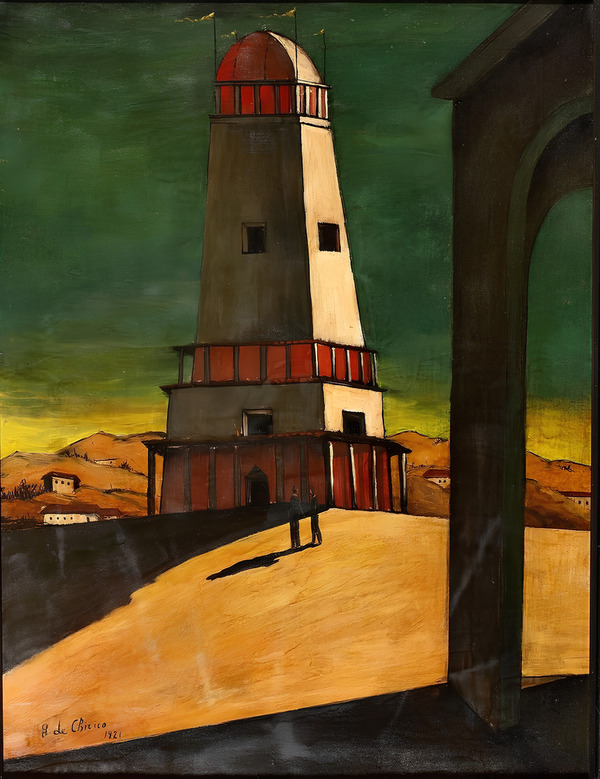
Metaphysical painting (Italian: Pittura Metafisica) is an artistic movement that emerged in Italy in the first half of the 20th century. The term was originally coined in 1919 by Giorgio de Chirico and Carlo Carrà in articles published in Valori Plastici, an Italian magazine based in Rome. It is usually typified by dream-like views of eerie arcaded squares with unexpected juxtapositions of objects with symbolic meanings. The word «metaphysical» comes from the Greek expression meaning «that which is beyond the physical world,» reflecting the movement’s central idea of depicting that which defies ordinary observation.
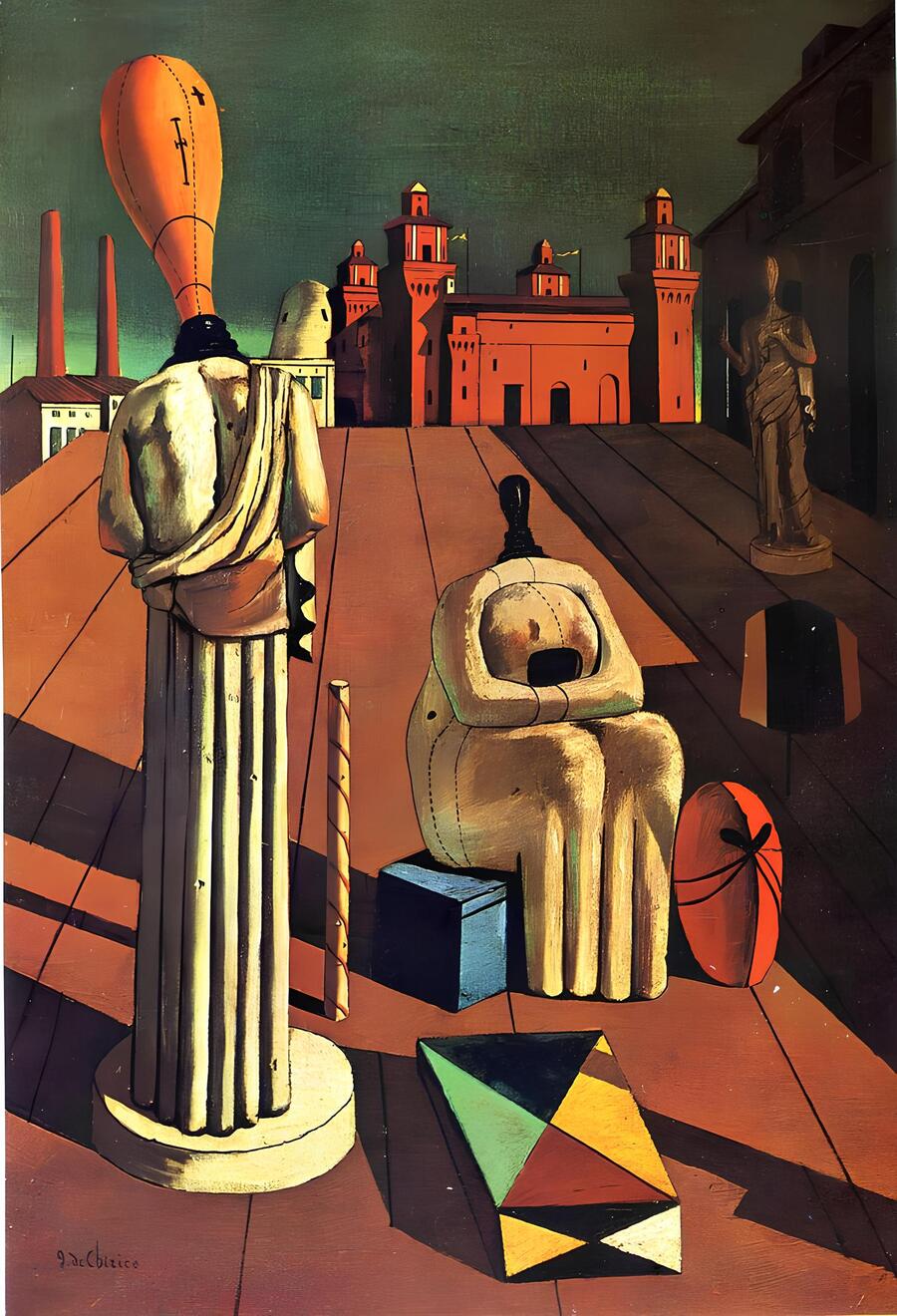
Giorgio de Chirico «Disquieting Muses», 1916-1918
The main practitioners of Metaphysical painting were four artists. Giorgio de Chirico, the founder, created the iconic empty squares and mannequins. Carlo Carrà, a former Futurist, brought monumental stillness and silence to the movement. Giorgio Morandi painted only everyday objects — bottles, boxes, jugs. Alberto Savinio, de Chirico’s brother, introduced mythology, irony, and a literary quality that anticipated Surrealism.
Giorgio Morandi «Metaphysical still life», 1918
For centuries, Italy had been a leader in the arts, yet with the radical changes brought by modernism, the country’s artistic identity entered a period of redefinition. During the heyday of modernism, all artists distanced themselves from the old and time-honored laws of classical art. Modernism meant a total abandonment of familiar techniques, which gave way to the progressive and conceptual principles of the second half of the 20th century. However, among all those who looked ahead and were confident in the steadfastness of the new art, a movement emerged that cited classical artists, inheriting anatomy and architecture, but representing them in a completely different style. One of them was Giorgio de Chirico, who, while hospitalized after the First World War, was inspired by its empty, deserted corridors, transforming the hospital’s oppressive architecture into an aesthetic. The trauma of war prompted metaphysical artists to place the subjects of their works in arid and immobile environments.
«Everything has two aspects. The first aspect is the familiar, which we see all the time, and which is seen by people in general. The other is the spectral or metaphysical aspect. This one is recognized only by a few in moments of clairvoyance or metaphysical abstraction.» — Giorgio de Chirico.
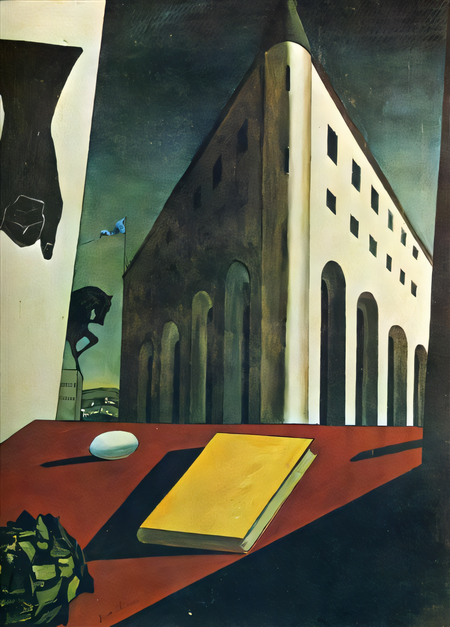
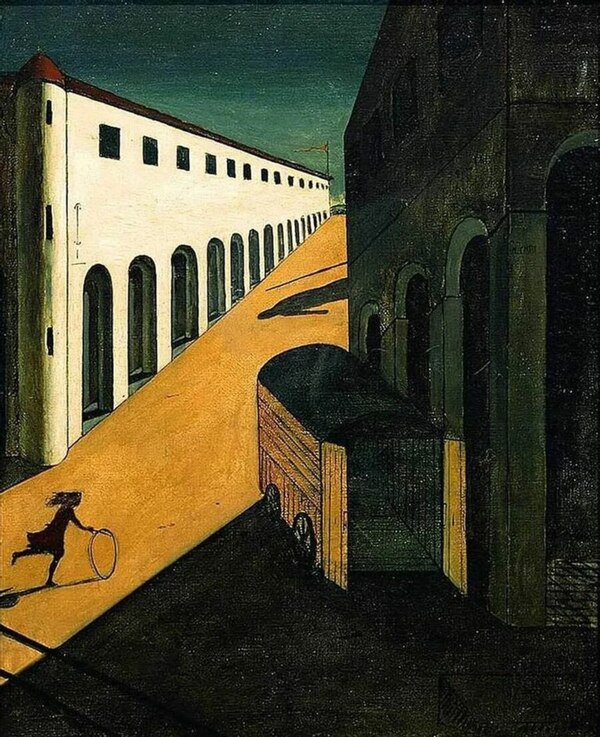
Giorgio de Chirico «Turin spring», 1914 / Giorgio de Chirico «Mystery and Melancholy of a Street», 1914
The Metaphysical artists very often depicted objects torn from their context. Looking at their works, one involuntarily recalls the scenes of one’s own dreams. Quotations from classical art, everyday objects, unnaturally dark corridors and arches seem to blend together like fragments of memories like on «Turin spring» and «Mystery and Melancholy of a Street» by Giordgio de Chirico. As if from scraps of memory, the Italian artists created their enigmatic works, in which there is no plot, only an empty existence without meaning. By looking at the yellow book you want to ask «Why is it nameless and what is inside?» or «Who is standing behind the corner and who is that girl running towards darkness?». Through this, the artists convey their core conviction: that truth is hidden from ordinary eyes. Speaking of the influence of philosophy on the Italian innovators, one cannot fail to mention Nietzsche, whose writings on the death of God left their mark even here. The spaces of the Metaphysical artists are clearly inspired by the great philosopher’s idea of the place one enters after death, where there is nothing but emptiness. Thus, in the paintings of the Italian artists, the squares and arcades that lead nowhere stand empty, frightening in their unnaturalness. De Chirico wrote: «After the death of God, only His shadows remain, and the task of the artist is to show this orphaned world.»
«Many of Chirico’s works are blind, but none of them are deaf.» — Jean Cocteau in «Le Mystère laïc», 1928.
Liminality as a discribtion
Carlo Carrà «Il pino sul mare», 1921
Speaking of the emergence of the feeling of anxiety when viewing the paintings of the Metaphysical artists, it is worth noting a term that is often overlooked, yet which reaches deep into anthropology and the nature of human perception — liminality. This term was introduced by Arnold van Gennep and later developed by Victor Turner. Limen in Latin means «threshold». Liminality is a state of being in-between — between a point of departure and a destination. For example, an archway is neither a room nor a street, but a transit space. Similarly, in de Chirico’s architecture, we find ourselves as if on the threshold of something, yet we freeze in this state because there is no way out.
In Carlo Carrà's painting, we find ourselves in what seems at first a familiar setting — the sea. Yet there are strangenesses. We are simultaneously on a beach, in a courtyard, near a mountain. We are somewhere in-between, standing before absolutely dark passages leading into the unknown.
The End of Metaphysical Painting
By 1919–1920, Metaphysical painting as an organized movement had ceased to exist. There were several reasons for this. First, the founder of the movement himself, Giorgio de Chirico, unexpectedly turned away from Metaphysics and announced a return to traditional academic painting. In November 1919, he published a programmatic statement in the journal Valori Plastici: «Pictor classicus sum» («I am a classical painter»), calling his earlier Metaphysical works «youthful mistakes.» Second, a bitter dispute broke out between de Chirico and Carlo Carrà over who had first discovered the Metaphysical method. This conflict destroyed their creative alliance. Carrà also returned to a more traditional style of painting, although he preserved some principles of Metaphysical composition. Giorgio Morandi, by contrast, remained faithful to Metaphysical silence but translated it into the pure contemplation of still life, without aspiring to create «great themes.» By 1921, the group had effectively disbanded, and the term «Metaphysical painting» itself gradually fell out of active use.
Conclusion
Metaphysical painting lasted only about ten years, but its influence proved enormous. It was the first movement in twentieth-century European art to call reality itself into question, showing that familiar things can be frighteningly alien, and that emptiness can speak louder than fullness. The main legacy of the Metaphysical artists is the creation of a visual language of anxiety, enigma, and ontological loneliness. This language was immediately adopted by the Surrealists: André Breton declared de Chirico a precursor of Surrealism, while Salvador Dalí, René Magritte, and Max Ernst directly developed his techniques. Without the Metaphysical square, there would be neither the Surrealist dream, nor magical realism, nor that line of European painting which prefers the question to the answer, and silence to the scream. Metaphysical painting remains a bridge between the classical Renaissance and the avant-garde, between the philosophy of alienation and the trauma of war, between reality and that which lies beyond it.
Nowadays of metaphysic
De Chirico G. Sull’arte metafisica / G. De Chirico // Valori Plastici. — 1919. — A. I, № 2-3.
De Chirico G. Il ritorno al mestiere / G. De Chirico // Valori Plastici. — 1919. — A. II, № 11-12. — P. 15–19.
Carrà C. Metafisica / C. Carrà // Valori Plastici. — 1919. — A. I, № 4-5.
Savinio A. Hermaphrodito / A. Savinio. — Firenze: Vallecchi, 1918. — 320 p.
Nietzsche F. Die fröhliche Wissenschaft / F. Nietzsche. — Leipzig: E.W. Fritzsch, 1882. — 348 S.
Cocteau J. Le Mystère laïc (Giorgio De Chirico): Essai d'étude indirecte / J. Cocteau. — Paris: Éditions des Quatre Chemins, 1928. — 80 p.
Моранди Дж. Метафизический натюрморт [Изоматериал]: [живопись] / Джорджо Моранди. — 1918. — Холст, масло; 71,5×61,5 см. — Государственный Эрмитаж, Санкт-Петербург, Россия. — URL: https://hermitagemuseum.org/digital-collection/29393 (дата обращения: 08.06.2026). — Текст: электронный.
Carrà C. Il pino sul mare [Image] / Carlo Carrà. — 1921. — Oil on canvas; 68×52 cm. — Private collection. — URL: https://bragnomuseum.com/opere/il-pino-sul-mare/ (accessed: 08.06.2026). — Text: electronic.
De Chirico G. Mystery and Melancholy of a Street [Image] / Giorgio De Chirico. — 1914. — Private collection. — URL: https://artpaper.press/art/mystery-and-melancholy-of-a-street-by-giorgio-de-chirico/ (accessed: 08.06.2026). — Text: electronic.
Де Кирико Д. Разрушение муз (Встревоженные девы, Тревожные музы) [Изоматериал]: [живопись] / Джорджо де Кирико. — 1925. — 97×67 см. — Частное собрание. — URL: https://muzei-mira.com/kartini_italia/1138-razrushenie-muz-ili-vstrevozhennye-devy-ili-trevozhnye-muzy-de-kiriko.html (дата обращения: 08.06.2026). — Текст: электронный.
De Chirico G. Большая башня [Image] / Giorgio De Chirico. — URL: https://artchive.ru/giorgiodechirico/works/517896~Bol%27shaja_bashnja (недоступен — код 429 Too Many Requests). — Текст: электронный.
De Chirico G. Turin Spring [Image] / Giorgio De Chirico. — 1914. — URL: https://www.wikiart.org/en/giorgio-de-chirico/turin-spring-1914 (недоступен — код 403 Forbidden). — Текст: электронный.