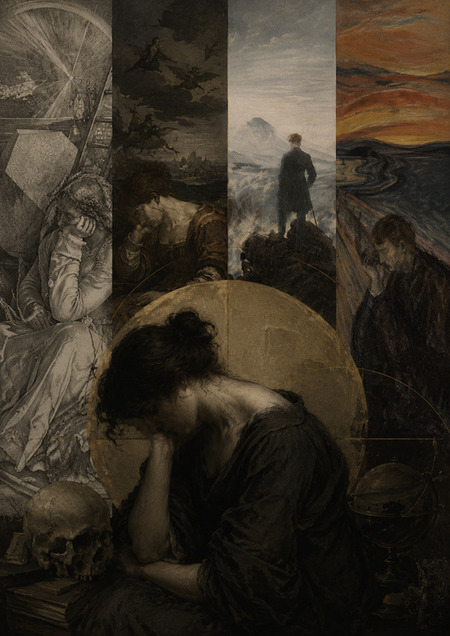
From Dürer’s engravings to the landscapes of Romanticism and Symbolist Expressionism
CATEGORIES
- Concept
- The Melancholy of Genius: The weight of knowledge as a gift and a curse
- The Melancholy of Transience: Skull, book, and frozen time
- The Melancholy of Solitude: Humanity before infinity
- Melancholy as Matter: When emotion becomes a plastic form
- CONCLUSION
- BIBLIOGRAPHY
- IMAGE SOURCES
CONCEPT
Why Melancholy? Rationale and Hypothesis There are states that do not require translation—you recognize them instantly from the tilt of the head, the lowered gaze, or the hands, clenched into fists or resting limply on the knees. Melancholy is one of them. Melancholy occupies a unique place in the history of European culture. For five centuries, from the Northern Renaissance through the turn of the 19th and 20th centuries, artists returned to this archetype again and again, reimagining it anew each time. It is not merely an emotional state captured on canvas or paper; it is a complex visual concept that transformed alongside the changing understanding of humanity—of the mind, creative nature, and one’s relationship to the world. This study focuses on the evolution of the visual image of melancholy in European painting and graphic art from the 15th to the 19th centuries.
Key Research Question
How has the visual «grammar» of melancholy—its corporeal embodiment, its object language, its color schemes, and its spatial context—changed from one era to the next, and what do these shifts reveal about how each century understood this state?
Research Hypothesis
The depiction of melancholy in European art undergoes a fundamental transformation—from the allegorical, intellectualized figure of the Renaissance to the Baroque meditation on the transience of existence, then to the Romantic sense of human solitude before nature, and finally to the expressive, almost physically palpable experience of the Symbolists. Throughout this evolution, the key visual motif remains the same—a figure with a head resting on or supported by a lowered arm—but its meaning and context change radically.
Material Selection Principle
The study includes works that directly address the image of melancholy—through explicit titles as well as established visual codes, such as a figure in a pensive pose, a dark color palette, and specific symbolic objects. Geographically, the research is focused on Western and Northern Europe—Germany, the Netherlands, Italy, and Norway—because this is where the concept of melancholy formed and transformed most consistently.
Structuring Principle
The research is structured both chronologically and thematically. Each section is dedicated to a distinct era and its corresponding «type» of melancholy. This structure allows, on one hand, to trace the historical evolution of the image, and on the other, to identify the internal logic of semantic shifts. The sections are connected not merely by temporal sequence, but by a conceptual chain. Each era responds to the previous one, reinterpreting its legacy.
Melancholy of the Genius: The Heaviness of Knowledge as a Gift and a Curse
When Albrecht Dürer created his famous engraving in 1514, the word «melancholy» meant something fundamentally different than it does today.
In the humoral theory, tracing back to Hippocrates and developed by Marsilio Ficino in his 1489 treatise On Life, melancholics were considered the «children of Saturn”—people predisposed to sciences, contemplation, and liberal arts. Melancholy was understood not as an illness, but as a specific creative temperament, a gift inseparable from suffering. It is in this context that the visual image, which would define all subsequent iconography, comes to life.
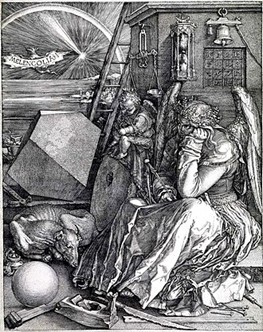
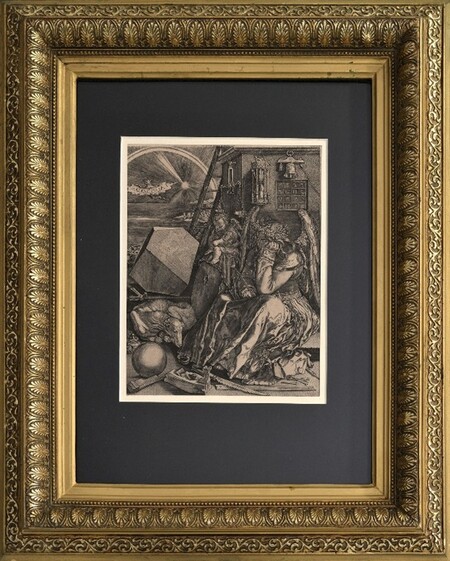
Albrecht Dürer «Melencolia I,» 1514. Paper, copper engraving, 23,8 × 18.6 cm. State Hermitage Museum, Saint Petersburg / The Metropolitan Museum of Art, New York
The winged figure is large, monumental, and sits in a posture of motionless contemplation: her head is supported by a clenched fist, and her gaze is directed somewhere beyond the viewer. Around her are scattered tools—a compass, scales, a plane, a polyhedron, a magic square—attributes of geometry, arithmetic, and architecture. However, none of them are in use; they all lie motionless. Dürer’s melancholy is the figure of arrested thought, of creative paralysis in the face of infinite knowledge. It is not inactivity born of sloth, but inaction stemming from an excess of understanding—the furor melancholicus, the «melancholic obsession» as a particular quality of creative genius.
Special attention should be paid to Dürer’s visual language. The engraving is executed in monochrome, and this achromatic quality is fundamental: color is deliberately omitted, leaving only light and shadow, only form and shade. The winged Melancholy is surrounded by a meticulously and symbolically composed object world: hourglasses count the time, a bat in the background bears the inscription «MELENCOLIA I, ” and a comet illuminates the scene with a cold, celestial light. The figure itself, despite its massiveness, seems weighed down—as if all energy has retreated inward.
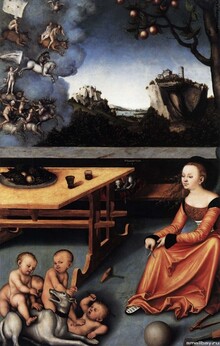
Lucas Cranach the Elder «Allegory of Melancholy, ” 1528. Wood, oil. 113 × 72 cm. National Gallery of Scotland, Edinburgh
Kranach adopts the same allegorical schema as Dürer but shifts it into a fundamentally different context: behind the seated, winged woman unfolds a demonic scene—a witch on a broomstick against a black cloud. For Kranach, a close friend of Martin Luther, melancholy takes on dangerous, almost devilish connotations. The anxieties of the Reformation permeate the image. There is neither admiration for creative genius nor tranquil contemplation here.
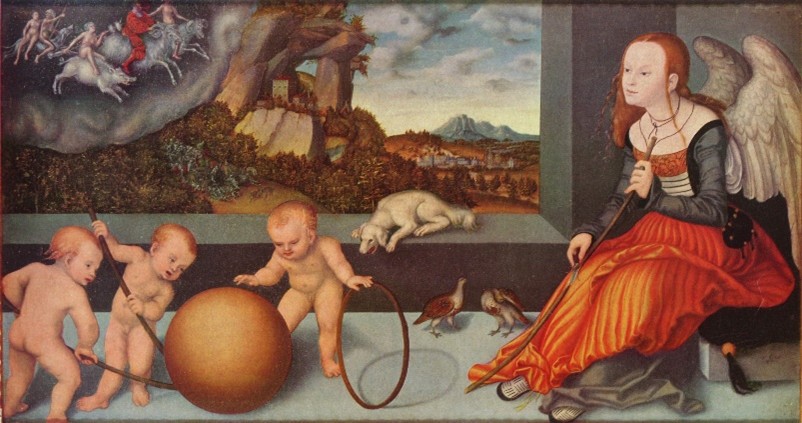
Lucas Cranach the Elder «Melancholy,» 1532. Wood, oil. 51 × 97 cm. National Gallery of Denmark, Copenhagen
Thus, within the scope of a single era and artistic context—the Northern Renaissance—we observe two fundamentally different interpretations of melancholy. For Dürer, it is a solemn allegory of the creative spirit; for Cranach, it is an ambiguous figure surrounded by anxiety. Both masters employ a similar visual language: wings (a legacy of ancient personifications), a dark, saturated background, and detailed subject matter. Yet, the mood differs fundamentally, and this difference foreshadows the subsequent evolution of the image.
Melancholy of Transience: Skull, Book, and Frozen Time
In the 17th century, melancholy loses its wings—literally. The allegorical winged figure gives way to a real, earthly woman immersed in contemplating the attributes of death.
Baroque art, with its cult of expression, sensuality, and the fleeting moment, adopted the theme of melancholy and radically reframed it. The abstract genius-melancholic gave way to a specific human figure—usually a woman—seated in a characteristic posture of reflection over a skull or an open book. Underlying this image is the philosophy of vanitas: «all is vanity, ” time is relentless, and knowledge does not save from death. The melancholy of the Baroque is not creative paralysis, but existential sorrow.
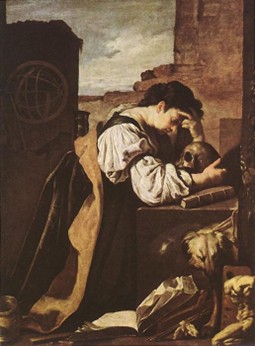
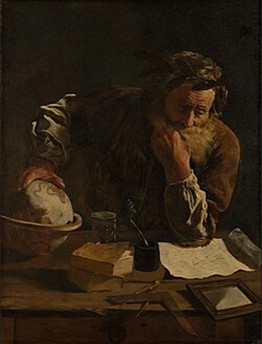
Domenico Fetti «Melancholy, ” circa 1620. Canvas, oil. Louvre, Paris
An Italian Baroque painter creates a pictorial allegory centered on a meditating woman, who bows her head and embraces a skull. Beside her are an open book, a compass, an armillary sphere, and a telescope (a reference to the scientific interests of the Gonzaga court in Mantua, where Fetti worked). The symbolism here is fundamentally dualistic: objects of knowledge coexist with attributes of death, and this juxtaposition forms the semantic core of Baroque melancholy. To know is to understand that everything is finite. Fetti’s painting is saturated with a warm, smoldering light reminiscent of Rembrandt, and this light, falling upon the figure from the darkness, only intensifies the introspective, contained mood.
«Melancholy is sadness, only stronger. A complex thoughtfulness induced not by laziness, but by a difficult task, a burden, a destiny.» — From the description of Dürer’s engraving, Kuban State University
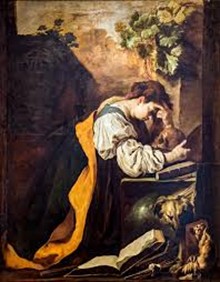
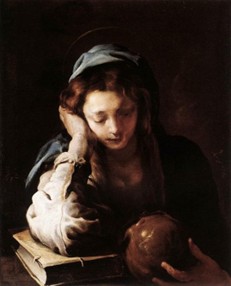
Dominico Fetti «Meditation» («Mary Magdalene in Thought»), c. 1618. Canvas, oil. 179 × 140 cm. Accademia Gallery, Venice
In a larger and more ceremonial version of the same image, Fetti places the figure of contemplation in a space bordering on religious ecstasy. The woman, perhaps a penitent Magdalene, bows her head so deeply that she almost hides her face. The skull lying before her is no longer merely a vanitas attribute but the subject of private, intimate contemplation. The light spilling down from above and the dark background create a Baroque drama without a single gesture—all movement turns inward.
In Baroque art, the color scheme of the image changes fundamentally. In Dürer, the melancholy is monochromatic—silvery-gray, devoid of color. With the Baroque masters, it acquires warm, saturated tones: ochre, umber, deep reddish-brown, the colors of a dying fire, of evening light. This warmth is paradoxical; behind it lies the cold theme of death. Such visual contradiction is a characteristic trait of Baroque aesthetics, which always seeks tension between opposites.