Navigation Menu
1. Concept 2. What does it mean to encompass scale 3. When detail supersedes pattern 4. What is visible only up close 5. Continuation beyond the frame 6. When the whole is discernible 7. Conclusion
Concept
The study examines how Andreas Gursky’s photographs present the viewer with the difficulty of grasping scale. In «Paris, Montparnasse,» the façade is immediately recognizable by its grid of floors and windows. Upon closer inspection, details such as open casements, curtains, and objects behind the balcony railings become visible [15]. This level of magnification weakens the connection between an individual window and the entire façade grid. This transition links the photographic analysis to Kant’s question regarding how imagination unifies sequentially perceived parts into a whole [1, pp. 89–90].
Research Question: Which techniques does Gursky employ to amplify the gap between sequential apprehension of parts and the attempt to grasp them as a whole? How does this gap relate to Kant’s description of the mathematically sublime?
The theoretical foundation is drawn from Sections 25–27 of «Critique of Judgment, ” translated by M. I. Levina. Kant distinguishes between greatness, which can be assessed using a measure, and the absolutely great [1, pp. 86–89]. In Section 26, he describes how the imagination reaches its limit. The gaze can still transition from one part to another, although the imagination finds it difficult to hold them simultaneously [1, pp. 89–90]. In Section 27, this limit is revealed through the relationship to reason, which demands the contemplation of an absolute whole [1, pp. 95–98]. Pyramids help illustrate the function of imagination, while Kant seeks the pure case of judging the sublime in wild nature [1, pp. 90–91]. In this research, this reservation defines the boundaries of comparison between philosophical description and the work of art.
The research hypothesis posits that tension arises when a photograph provides the eye with a point of support—a repeating element, outline, or landmark—and the sequential viewing or change in scale reveals the limit of that support. The mind seeks to conceptualize this set as a whole, yet the imagination reaches its limit when trying to perceive it in a single glance. If the individual parts relate easily to the object’s boundary, the effect diminishes.
For the examination, we have selected photographs by Gursky from 1987–2016 that feature repetition, the human figure, or a boundary serving as a reference point. We compare instances where this reference point helps maintain the integrity of the whole against cases where the connection to the whole weakens. The theoretical prologue, «What Does It Mean to Encompass Magnitude, ” introduces Kantian concepts. Four sections sequentially explore repetition, shifting distance, the extension of space beyond the frame, and cases where the whole remains visible.Peter Gallassi’s catalog is used to analyze how Gursky constructs photographic space, including how he connects multiple vantage points [2, p. 38]. Marion Ackerman and Nora Dirani relate the viewing distance of his prints to Kant’s pyramid example [3]. The works are compared in full reproductions and in fragments, where the precise scale of details is crucial. Information regarding the prints, montage, and shooting is cross-referenced with museum and exhibition publications listed in the bibliography. The analysis of visual materials verifies what can be perceived at a glance, which details require sequential viewing, and whether the boundary used to construct the whole remains visible.
What does it mean to encompass a magnitude?
In § 25, Kant distinguishes between magnitude, which can be determined relative to a chosen measure, and the absolutely great, which surpasses all comparison. In the judgment of the mathematically sublime, the disproportion between the sensible estimation of magnitude and the idea of the whole posited by reason comes to the forefront [1, pp. 86–89].
Andreas Gursky. Paris, Bogrenel. 1988
On the site in Bogrenel, you can compare the height of the supports with the figures at the bottom. The familiar height of a person provides an approximate measure; the fence and the open space of the site remain discernible even when looking at the towers. Here, the comparison helps to build an understanding of the relationship between the scales.In Section 26, Kant refers to Savary’s description of pyramids. From a great distance, the stone rows lose their distinctiveness. Up close, they can be examined sequentially, but previously viewed sections begin to elude perception before the gaze reaches the apex. Kant distinguishes two functions of imagination: grasping by parts and uniting these parts in a single contemplation [1, pp. 89–90].
Barcex. Great Pyramid of Giza. 2008. CC BY-SA 3.0
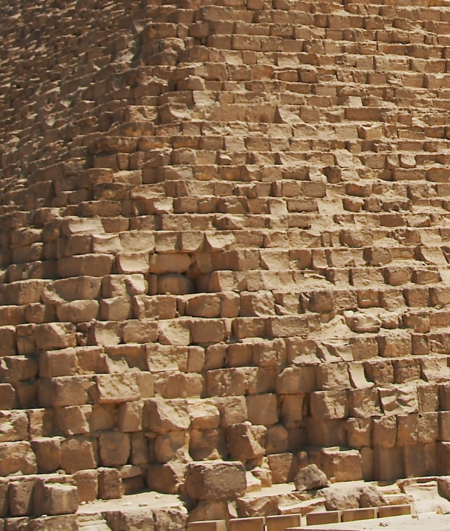
The base and apex are visible in the full frame. A close-up of the masonry reveals the joints and projections of the stones. The apex falls outside the frame due to the cropping of this same shot. To approach Kant’s example, follow the rows of stones from the bottom up in the full frame. As the gaze reaches the apex, check how clearly the rows at the base are still discernible. Kant describes precisely the weakening of the representation of previously viewed parts as the gaze grasps the next [1, p. 90].
Andreas Gursky. Kamiokande. 2007
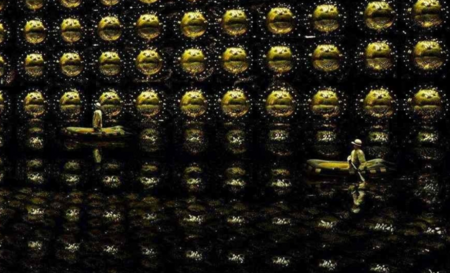
In the full frame of «Kamiokande,» a golden pattern on the wall is read first. In the lower edge fragment, two boats and one person in each are visible [7]. The figures provide a scale reference for the nearest row of spheres. As the gaze moves up the curve of the wall, the boats fall out of focus, and relating them to the entire expanse of the hall becomes more difficult.
In Section 27 of Critique of Judgment, Kant argues that the limits of imagination cause displeasure. From this same experience arises pleasure, because the inadequacy of sensory measure allows one to perceive the superiority of reason, which is capable of thinking the absolute whole [1, pp. 95–98].
Visual examples help break down the part of the reasoning that assesses magnitude. Further analysis examines how the composition itself creates difficulty in joining the parts. Kant’s example of a purely affirmative judgment on the sublime connects it to wild nature [1, p. 91].
When the count yields to the pattern
Andreas Gursky. Paris, Montparnasse. 1993
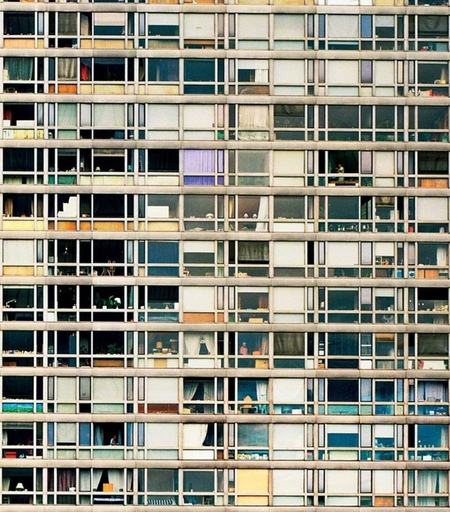
The facade fills almost the entire frame horizontally. A band of sky and a dark line of trees separate the building at the top and bottom, while the grid terminates on the sides. Galassi describes how Gursky shot the left and right halves of the facade from different vantage points and combined them into a single image [2, p. 38]. The resulting frontal composition provides the eye with a simple path along the floor.
The close-up highlights the area slightly to the left of the building’s center. In the upper portion of the fragment, a dark opening and a shutter interrupt a row of light rectangles. Below, there are a pinkish-lilac curtain, light drapes, and windows divided by mullions. In this enlargement, these differences can be compared against each other. In the full frame, the same windows quickly resolve into uniform modules that guide the viewer’s gaze further.
Andreas Gursky. Prada I. 1996
In «Prade I,» two illuminated shelves span edge to edge. Each row of shoes has a clear beginning and end, allowing one to easily discern which portion of the row has already been viewed within the niche. This serves as a comparison for the next frame, where a similar layout principle fills a much larger part of the image.
Andreas Gursky. 99 cents. 1999
In the full shot, colored product packages form ribbons that run through the hall. If you look closely at fragments, you can make out price tags and shoppers' heads between the aisles. On a print version of the photograph, roughly 3.37 meters wide, like the SFMOMA example [5], one can imagine how the ribbons of products and individual price tags become discernible from different distances. However, with sequential observation, a similar effect arises, one Kant described using the example of pyramids: as we look further and further down the aisles, we can no longer hold in our imagination what we first saw in the foreground. The reflection in the upper portion of the full frame adds a second row where the eye searches for the boundary of the retail space, which intensifies this effect.
Andreas Gursky. Amazon. 2016
In «Amazon,» the rear shelving units establish a large grid, while the objects in front of them are repeated on a much smaller scale. The Broad notes that there are no workers in the frame [9]. In the «Prada I» display, one row corresponds to the contour of a niche. In the warehouse, the gaze moves from small packaging to a large cell, re-establishing scale.
In «Prade I, ” the edge niches help to relate a single pair of shoes to the entire shelf. In Monopartnas and „99 Cents, ” the gaze also moves along the row, but the connection between an individual window or price tag and the whole composition weakens as one gets closer.
What is only visible up close
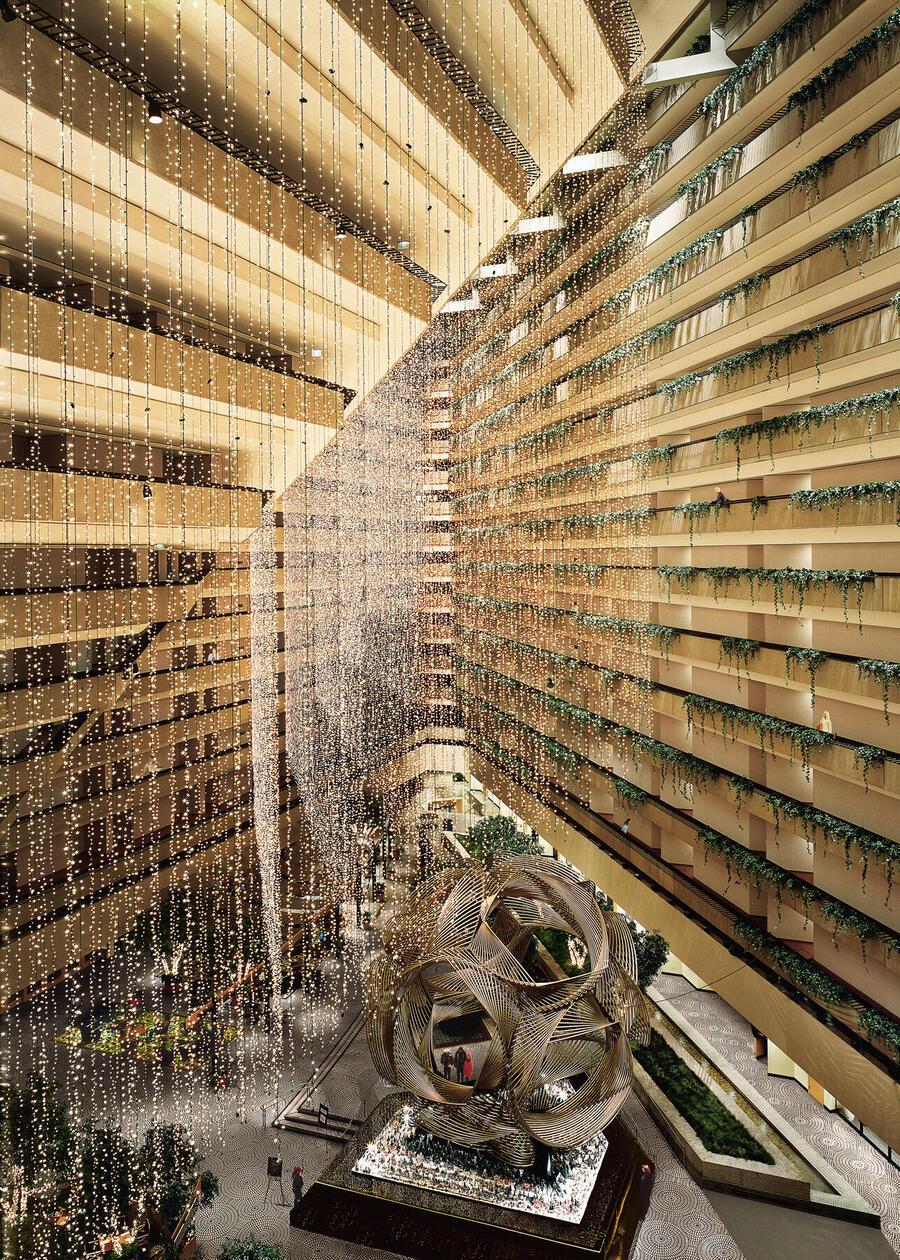
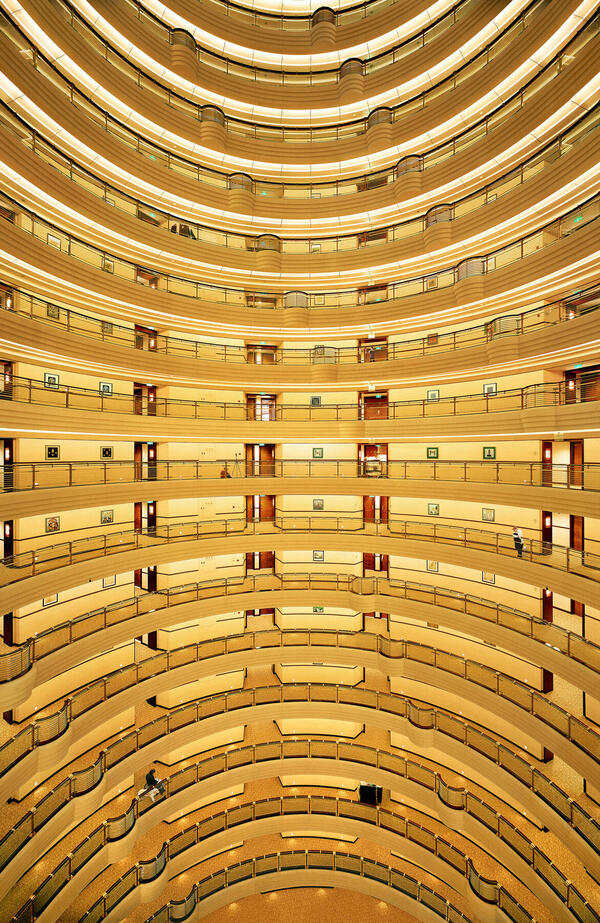
On the left — Andreas Gurski. San Francisco. 1998 On the right — Andreas Gurski. Shanghai. 2000