Rubricator:
1. Concept
2. Inherited Image
3. Man vs. Serpent
4. Between Embrace and Grasp
5. Where Does Humanity End?
7. Conclusion
8. Bibliography
9. Sources for the Conclusion
Concept
For ages, the serpent has been one of the most persistent motifs in art history. It appears in mythological, religious, and allegorical narratives, yet its meaning cannot be reduced to a single interpretation. The reptile may symbolize threat, healing, rebirth, desire, or supernatural power. In the art of the 20th and 21st centuries, these meanings persist. Artists recontextualize them through various depictions of the body, performances, and art objects.
This visual study analyzes the relationship between humans and snakes in 20th and 21st-century art. The analysis focuses on how artists, across different periods, convey diverse meanings through bodily contact and composition—ranging from fear to intimacy.
In this work, it is necessary to trace the transformation of the snake’s image and identify how the nature of its interaction with the human body influences the perception and meaning of the artwork. Based on this, the question arises: how do artists re-examine the boundaries of the human body in nature through the relationship between humans and snakes?
The principle for selecting necessary material was governed by the following factors:
- Adherence to the research timeframe, as a complete analysis requires works created in the 20th–21st centuries. It was important that the period allowed for the examination of both traditional conceptions of the relationship between humans and snakes, as well as modern reinterpretations of these characters within the context of new artistic directions.
- The presence of direct interaction between humans and snakes, as this is the core component of the analysis. Preference is given to works where the snake is not merely a decorative element but plays a significant role in the perception of the human figure.
- The possibility of comparative visual analysis. Therefore, when selecting images, it is important to consider the presence of visible characteristics that allow works to be compared against one another.
When gathering imagery, I favored verified sources, because the necessity of comparative analysis underscores the importance of high-quality visuals.
Principles used for selecting textual materials:
The selection of source materials was based on the works of four authors: E. H. Gombrich, Steve Baker, Gillian Rose, and Erwin Panofsky. Their research allows for a comprehensive examination of the relationship between humans and snakes.E. H. Gombrich’s book provides information for studying the cultural symbolism and historical continuity of the snake motif. Steve Baker’s work contains data for analyzing human-animal interaction in contemporary art. Gillian Rose’s methodology serves as the foundation for comparative visual analysis of composition, gestures, and bodily contact, while Erwin Panofsky’s iconographic approach helps uncover the historical and symbolic meanings of artistic representations. The combination of these approaches will allow for a well-supported test of the proposed hypothesis.
Hypothesis: The decisive factor in images featuring a human and a snake is not the mere presence of the animal, but the nature of the physical interaction. The reptile’s positioning relative to the human allows the artist to convey relationships of power and subordination; the same coiling gesture, for example, can signify either capture or embrace.
Inherited Image
The relationship between humans and reptiles, long before the 20th century, forged a stable system of artistic imagery rooted in temptation, physical confrontation, and the unification of human and animal bodies.
Lucas Cranach the Elder. «Adam and Eve.» 1526.
In the Courtois gallery, the painting «Adam and Eve» is displayed, depicting the moment of the Fall. You can notice the serpent’s positioning relative to the human figures. The reptile does not attack any of the people or coil around their bodies. It is physically distanced from the characters, yet its presence is what reveals the essence of the work. The influence of the animal is expressed through the characters' gestures and the unfolding of the biblical narrative.
Caravaggio. «Medusa.» 1597.
Unlike Cranach’s painting, here the boundary between human and snake disappears as the reptile becomes part of the human body.
El Greco. «Laocoön,» c. 1610–1614
The creator of this work references the ancient myth of the Trojan priest Laocoön and his sons, upon whom snakes sent by the gods attack. The painting depicts the moment of a deadly struggle. It can be observed that the human bodies and the forms of the reptiles are rendered using similar, winding lines. The deliberate elongation of the human figures contributes to a distortion of natural proportions, which evokes a sense of suffering. These works demonstrate that the placement of the snake relative to the human has been used in preceding eras to express various semantic relationships.
Man Versus Serpent
Now that you have reviewed past works, you can move on to the art of the 20th–21st centuries and trace how artists reinterpret the familiar motifs of human-snake interaction.
Franz von Stuck. «Inferno.» 1908.
In this piece, the reptile possesses a massive scale disproportionate to the human body. Its coils surround the female figure, and the cool blue color sets the animal apart from the dark and reddish tones. The artist seems to symbolize a dominant snake—yet its threat is inseparable from some form of temptation or desire.
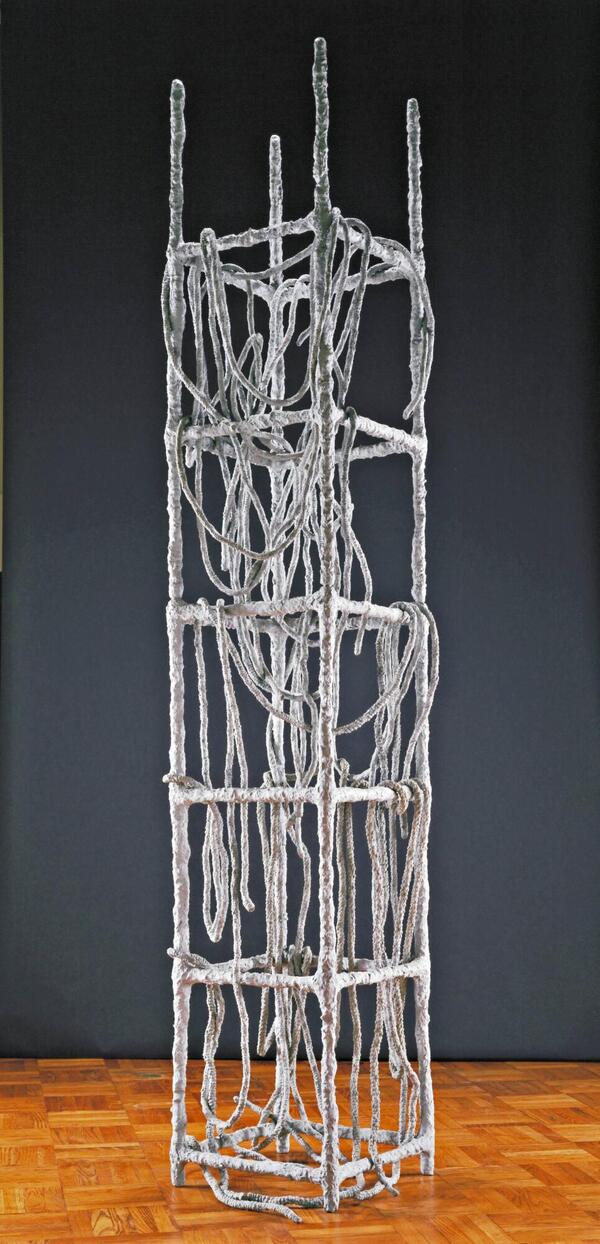
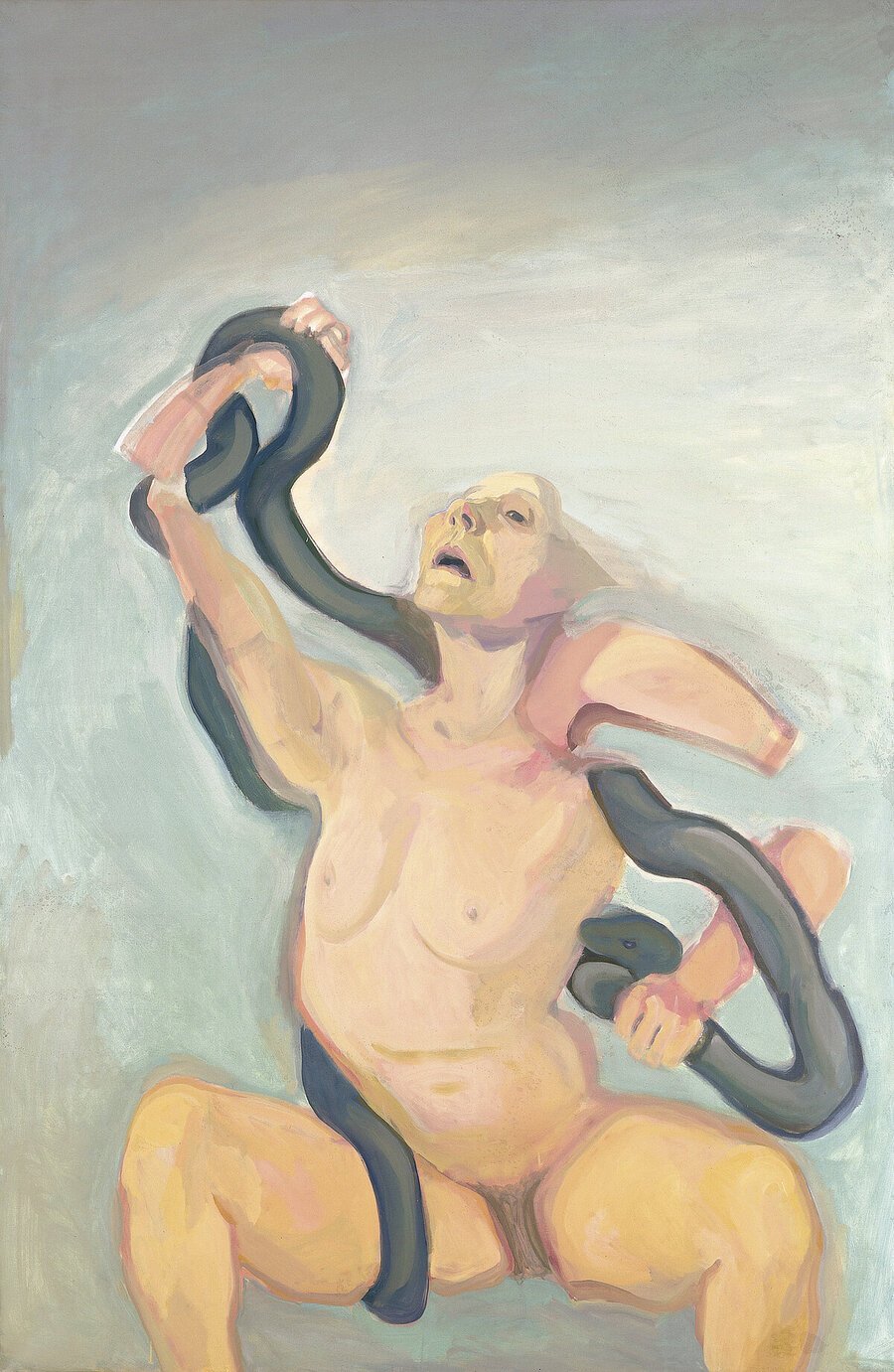
Eva Hesse. «Laocoön.» 1966. Maria Lassnig. «The Woman Laocoön.» 1976.
In these works, the artists reinterpret the ancient motif of humanity struggling against serpents, yet they employ diverse artistic approaches. Hesse dispenses with the human figure, conveying the confrontation through the contrast between a strict geometric structure and chaotically intertwined serpentine forms. Lassnig, conversely, places the female body at the center, transforming the mythological struggle into an expression of personal corporeal experience. Thus, both artists demonstrate that the ancient image of resistance can exist both in an abstract form and through the direct depiction of human vulnerability.
Keith Haring. «USA 19-82.» 1982.
At the center of the painting is a red human figure. A two-headed, serpentine form passes through an opening in its torso. The contact is presented not as a superficial touch, but as an intrusion into the silhouette’s boundaries. The absence of facial expression prevents us from knowing whether the character is in pain, resisting, or accepting what is happening. In this way, Haring proposes another way to depict violence: not through the collision of two bodies, but through the violation of bodily integrity—and therefore, the serpent ceases to be an external threat.
Between embrace and grip
The central idea of this chapter is that the degree of physical proximity does not define the nature of the relationship between a person and a snake. Even when the bodies are in direct contact, it is impossible to definitively establish who is controlling the situation, who is feeling fear, or who is striving for contact.
Marina Abramović. «Dragon Head.» 1990.
In the Abramović performance, she sits motionless among blocks of ice while pythons coil around her body. This stillness of the human body is contrasted with the continuous movement of the animal, while the blocks of ice restrict the performance space, and the artist’s open face makes her state a critical part of the unfolding event. Thus, we observe a paradox of control: the artist creates the conditions for contact herself, yet cannot fully control the movements of the living creature.