Research Concept
The topic selection is driven by an interest in how the Great Geographical Discoveries of the 15th–17th centuries changed Europeans' perceptions of the surrounding world and influenced the development of collecting.
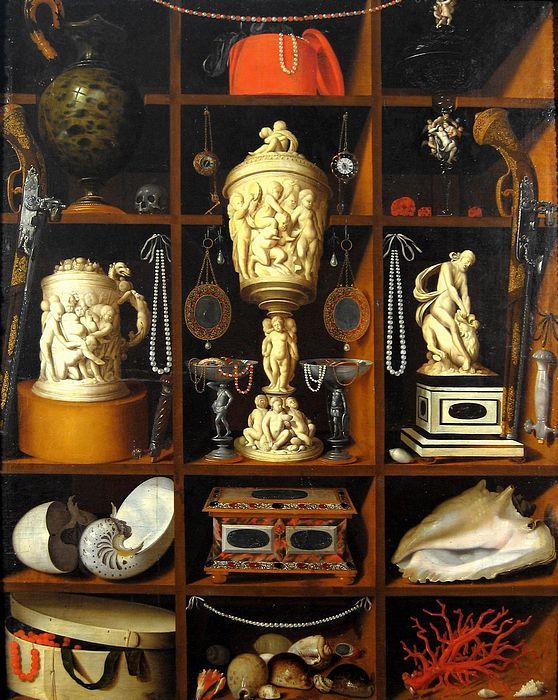
The topic of study was chosen because cabinets of curiosities became a significant phase in the history of collecting and the study of the world around us. They reflected humanity’s drive to gather, preserve, and explore unusual objects, shaping an interest in the unknown and broadening perceptions of nature and the cultures of other countries. Furthermore, these collections served not only educational and aesthetic functions but also acted as a means to display the owner’s wealth, high social standing, and cultivation. Studying cabinets of curiosities allows us to trace how curiosity, the desire for knowledge, and the wish to assert one’s status combined into a unique collecting culture.
The selection of materials for the visual study will focus on engravings, interior images, collectible objects, and catalogs. These will allow for the analysis of spatial organization, the combination of natural and human-made elements, and the presence of objects from various regions of the world. Key examples will include Ferrante Imperato’s study (1599) and Ole Worm’s collection (1655). (ADD STUDIES)
For the analysis of textual sources, scholarly research on the history of collecting and museum culture, historical catalogs and collection descriptions, as well as contemporary works, will be utilized. Key sources include Dell’Historia Naturale of Ferrante Imperato (1599), Museum Wormianum by Ole Worm (1655), Paula Findlen’s work Possessing Nature: Museums, Collecting, and Scientific Culture in Early Modern Italy, and the collection The Origins of Museums: The Cabinet of Curiosities in Sixteenth- and Seventeenth-Century Europe, edited by Oliver Impey and Arthur McGregor. These sources will enable an examination of collection composition, their organizational principles, and their significance for the development of scientific knowledge.
Key research question: How did the rare book cabinets of the 16th–17th centuries reflect the European drive during the Age of Discovery to collect, study, and visually represent an expanding world?
The research hypothesis is that cabinets of curiosity were not merely collections of unusual objects, but rather unique visual models of the world. By combining natural specimens, works of art, and objects from distant regions, collectors sought to create a miniature representation of reality within a single space. Furthermore, the composition and organization of these collections reflected not only curiosity and the drive for knowledge but also the owner’s aesthetic preferences, social status, and worldview.
Research Outline: — Concept — The Expanding World — The Cabinet of Curiosities as a Model of the World — Wonders and Exotic Items — The Collection as a Tool for Knowledge — The Collection as Prestige, Power, and Appropriation — Conclusion
Chapter 1. The World Expands
Chapter 2. The Collection Space
Chapter 3. Curiosities and Exotic Elements
Chapter 4. The Collection as a Tool for Knowledge
Chapter 5. Collection as Prestige, Power, and Appropriation
Conclusion
The study examined how the Age of Discovery influenced the development of European collecting practices during the 16th and 17th centuries. The expansion of geographical knowledge, the dissemination of maps, travelogues, and engravings fostered an interest in unknown territories, their natural environments, and cultures. This gradual visual exposure to distant lands eventually evolved into a desire to collect and preserve tangible objects.
The analysis of cabinets of curiosity revealed that these rooms were unique spaces where natural specimens, works of art, scientific instruments, and objects from various regions of the world were brought together. Collections simultaneously served to display unusual items, study the surrounding reality, and emphasize the owner’s status.
Thus, the research hypothesis is confirmed: cabinets of curiosity were not merely assemblies of peculiar objects, but rather visual models of the world, integrating knowledge, aesthetics, prestige, and the pursuit of rare items. They reflected the worldview of people in their era regarding the environment and represented a significant stage in the history of museum culture formation.
Bibliography
17.ICESCO. ICESCO Strategy for Supporting Museums in the Islamic World [Electronic Resource]. — Rabat: ICESCO, 2024. — Access mode: https://iwh.icesco.org/wp-content/uploads/2024/11/ICESCO-Strategy-for-Supporting-Museums-in-the-Islamic-World-1.pdf. — Date of access: 11/27/2025.
Image Sources