Navigation
1. Concept 2. Composition and Artistic Language 3. Iconography and Symbolism 4. Historical Context and Political Imagery 5. Conclusion
Concept
Jacques-Louis David’s painting, «The Death of Marat,» created in 1793, holds a significant place in the history of French Neoclassicism. Unlike the grand historical canvases for which the artist became famous in the pre-revolutionary years, this work depicts an event of recent memory tied to the life of an individual personally known to the author.
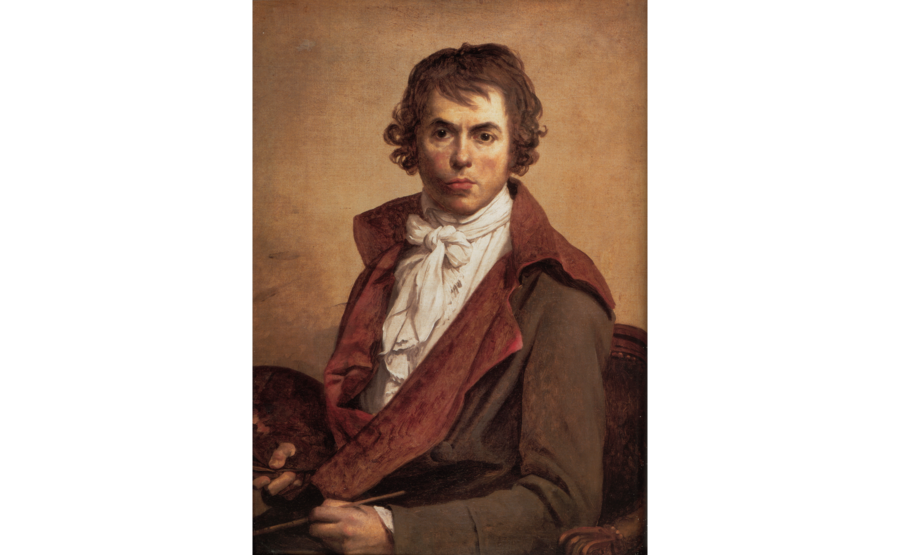
Jacques-Louis David, Self-Portrait, 1794
Jean-Paul Marat, one of the most prominent figures of the French Revolution, was assassinated by Charlotte Corday on July 13, 1793. David examines the circumstances of his death, retaining recognizable details of the setting, but fundamentally altering the character of the image. The hero appears before the viewer in isolation, his body illuminated against a nearly empty space.Choosing «The Death of Marat» as the central piece for this study is motivated by the opportunity to trace how artistic form influences the perception of a historical event. David portrays a political figure whose views sparked sharp disagreements among his contemporaries. Moreover, the deceased’s face is devoid of any expression of suffering. The painting retains features of portrait likeness, yet it transcends the conventional representation of a historical personality. We will analyze the work in relation to Neoclassical conceptions of the heroic figure and European iconography of death.
Visual materials were selected based on the principle of direct connection to the artistic features of «The Death of Marat.» The works of David’s predecessors and contemporaries are used to explain specific compositional decisions. Joseph-Marie Vien’s «The Vendor of Amors» and Anton Raphael Mengs’ «Parnassus» allow for an examination of the artistic principles of Neoclassicism established prior to the creation of the painting. Comparison with David’s own works helps identify the characteristics of his individual style. Special attention is given to Anatole Devos’ sketch of the lost painting «Le Pelletier on His Deathbed» and the comparison of specific fragments of Marat and Hector. These materials allow us to transition from general stylistic analogies to concrete connections between the artworks.
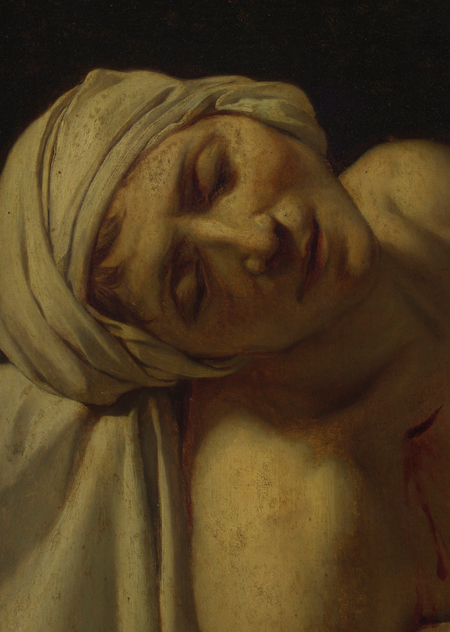
Jacques-Louis David, «The Death of Marat,» 1793 (Exhibition of the Royal Museums of Fine Arts of Belgium, general view) // Jacques-Louis David, «The Death of Marat,» 1793 (Exhibition, close-up)
Iconographic analysis is based on comparing the figure of Marat with depictions of the deceased Christ. For this, Caravaggio’s «Entombment» and Ann-Louis Girodet’s «Pietà» are used. Comparison with the iconography of «Do Not Weep For Me, Mother» is considered an additional visual analogy. The historical section includes works related to Marat’s assassination and his posthumous veneration. The depiction of the event by Jean-Jacques Houwer, revolutionary memorial graphics, and Paul Bodry’s later painting help establish how the artistic perception of one historical event evolved.The structure of this research is based on a sequential progression from form to content. The first chapter is dedicated to the artistic language of the painting. The second examines the iconographic sources of Marat’s image and the symbolic meaning of the objects. The third chapter connects the results of the visual analysis with the circumstances of the French Revolution and the work’s original purpose. Combining formal analysis with the iconographic method allows for a gradual transition toward iconological interpretation.
The research’s textual foundation consists of scholarly works dedicated to the creativity of David and the theme of heroism in European painting. Special attention is given to studies of French Neoclassicism and the artistic methods used to depict revolutionary figures. Additionally, the results of a technical examination of the original are utilized to determine the compositional changes David made during the working process. Historical evidence is drawn upon to verify the circumstances of the painting’s creation and its original public purpose.
The central research question is how Jacques-Louis David transforms the depiction of a real political assassination into the idealized image of a revolutionary martyr through artistic means.
The artist appears to be engaging with established European traditions of depicting heroic death, while simultaneously infusing the scene with historically recognizable details from Marat’s assassination. The compositional restraint and the idealization of the human form lend the scene a commemorative quality. Testing this hypothesis requires comparing the painting with historical artistic precedents and examining it within the political context of 1793.
Composition and Artistic Language
Jacques-Louis David, «Death of Marat, ” 1793
The majority of the canvas, «Death of Marat, ” is dominated by a dark background, almost devoid of spatial reference points. In the lower half of the composition, the figure of the deceased, submerged in a bath, is positioned. His head tilts toward the left edge of the canvas, his right arm hangs loosely downward, and his left arm is stretched alongside his body. The horizontal lines of the bath are balanced by the verticality of the wooden crate on the right. The structure lends the image a sense of stability, despite the asymmetrical placement of the figure.
David largely foregoes any interior setting. The room’s space is indefinable in terms of scale or depth, with the primary focus centered on Marat’s body. Soft light highlights his face and bare shoulders, gradually receding into shadow. The warm tones of his skin contrast sharply with the green fabric and the cooler areas of the background. A white drape forms a bright vertical line, guiding the viewer’s gaze toward his lowered hand. The small traces of blood become especially noticeable and vivid against such a subdued color palette.
Joseph-Marie Vien, «Mistress of Amours, ” 1763
This compositional clarity is linked to the aesthetic of Neoclassicism, which gained prominence in the second half of the 18th century. In Joseph-Marie Vien’s The Merchant of Amors (1763), David’s teacher, figures are arranged in a shallow space bounded by architectural elements. The crisp silhouettes and serene gestures make the scene easily legible. David adheres to a similar certainty of form, only reducing the number of characters and simplifying the background.
Anton Raphael Mengs, «Parnassus, ” 1761
In «Parnassus» (1761) by Anton Raphael Mengs, the composition is also characterized by its clear structure. The central figure of Apollo organizes the placement of the surrounding muses, whose movements adhere to a shared rhythm. David achieves a similar order through different means. The sole human figure becomes the primary compositional focal point, and the empty space on the canvas enhances its expressiveness. This comparison reveals how the artist develops the Neoclassical drive toward clarity, pushing it to a point of extreme conciseness.
In David’s historical works, the human figure serves as the compositional center.
Jacques-Louis David, «The Death of Marat, ” 1793 // Anatole Dawozh, „Le Pelletier on His Deathbed, ” 1793
This principle is particularly evident in «Death of Marat,» where the human body dictates the placement of all other elements. The composition is perceived through the angle of the deceased’s head and the direction of his arms. The surrounding objects are subservient to the figure, and the negative space enhances its visual prominence.
Direct compositional parallels can be found by comparing «The Death of Marat» with the lost painting «Le Pelletier on His Deathbed» by David (1793), which is known through Anatole Devos' drawing. In both works, the deceased is depicted separately from the surrounding people. Their bodies are positioned almost horizontally, and the composition focuses on conveying the state of death. Despite the difference in poses, the images share a similar spatial organization. This resemblance is also explained by the shared memorial function of the paintings.
Jacques-Louis David, «Death of Marat, ” 1793 // Jacques-Louis David, „Andromache Mourning Hector, ” 1783
Another connection to David’s earlier work is found in the position of Marat’s right hand. This can be compared to the hand of the deceased Hector in the painting «Andromache Mourning Hector» (1783). As the fragment of Hector’s hand is rotated approximately forty degrees, a similar curve in the forearm and a relaxed position of the hand become noticeable. It is interesting to examine how the artist employs a plastic solution familiar to him in a work with a completely different subject.
Jacques-Louis David, «Death of Marat, ” 1793 // Jacques-Louis David, „Death of Marat“ (infrared reflectogram), 1793 // Jacques-Louis David, „Death of Marat“ (radiogram), 1793
The technical study of «The Death of Marat» indicates that the final compositional decision developed gradually. Initially, the deceased’s eyes were depicted more open, and the placement of some objects differed from the finished version. During the work process, David refined the facial expression and the arrangement of the writing implements. The painting should be analyzed as the result of a sequential selection of details, which grants the domestic scene a unique compositional rigor.
Iconography and Symbolism
Marat’s head is bowed to his shoulder, eyes closed, with a serene expression on his face. The artist avoids depicting rigor mortis or muscle tension. Soft light highlights the face, which contrasts with the dark background. The way Marat is portrayed evokes associations with traditional depictions of the deceased Christ.