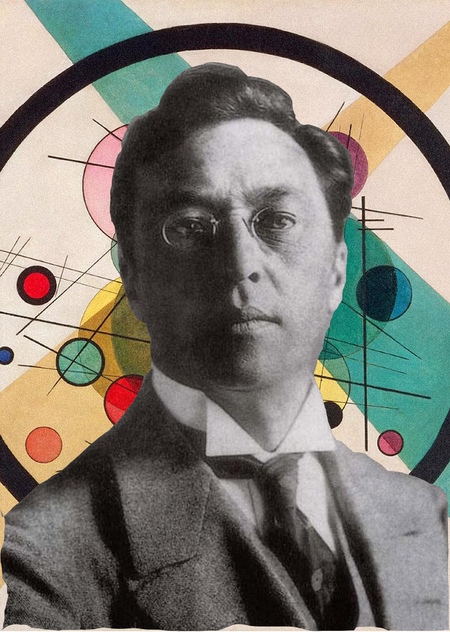
RESEARCH CONCEPT
Kandinsky at the Bauhaus: Shaping the Language of Abstraction
Working on this topic, I aim to understand how Kandinsky transformed the simplest visual elements—the dot, the line, and the plane—into a complete artistic language. I am particularly interested in his period at the Bauhaus (1922–1933) because that is where his abstraction becomes maximally systematic. If the early Kandinsky often worked intuitively, based on spiritual ideas and an inner «necessity, ” then the Bauhaus Kandinsky functions almost like a researcher, constructing a new way of communicating visually.
The choice of this topic is connected to several important factors present in the Bauhaus: — the need to teach the fundamentals of composition; — the school’s general orientation toward the constructive analysis of form; — Kandinsky’s dialogue with architects and theorists; — the artist’s own need to systematize their ideas.
Dmitry Sarabyanov wrote that Kandinsky’s work at the Bauhaus «not only developed his artistic method but also completed his theoretical project, which began back in the 1910s.» This observation is particularly significant: the Bauhaus became the place where the theory of «Point and Line on the Plane» ceased to be an abstract reflection—it became a working tool influencing painting, diagrams, instructional tables, and compositions.
In his book «Point and Line on the Plane, ” Kandinsky writes:
«A point is the highest tension of repose.» «A line is the result of the movement of a point.» «A plane is a living entity with its own inner resonance.»
These phrases are not merely metaphors. During the Bauhaus period, they became guiding principles for constructing works: the point transforms into the circle, the point-circle into a system of circles, the line into a set of trajectories, and the plane into an active space where each area possesses its own weight and energy.
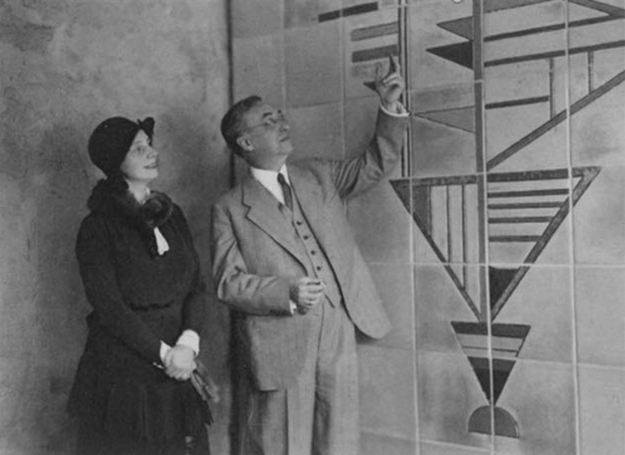
Kandinsky and Bauhaus
RESEARCH QUESTION
How did Vasily Kandinsky transform elementary visual forms—the point, the line, and the plane—into a systematic language of abstract composition during his time at the Bauhaus (1922–1933)? And how did this language manifest simultaneously in his painting and in his pedagogical methods, including instructional schemas and tables?
The principle guiding material selection in this research is that the visual sequence must systematically unfold the elements of abstract language. Therefore, the study will be divided into major thematic blocks: the point, the line, the plane, and composition. Each section will feature works that most fully demonstrate the meaning of the element under discussion—for example, circular compositions from 1923–1926 for analyzing the point, diagonal structures and trajectories from 1925–1927 for the line, or rectangular segments from the late 1920s for the plane.
In organizing the research, I operate from the logic of moving from theory to practice: first, I examine the key concepts, and then I show how they manifest in painting. This structure aligns with the Bauhaus methodology, where Kandinsky first provided an analytical deconstruction of form and only afterward offered exercises in compositional building. Sarabyanov noted that it was the analytical work with students that compelled the artist to refine their own concepts—hence, theory and practice exist in parallel here.
For analyzing textual sources, I use: — Kandinsky’s books («Dot and Line on the Plane, ” „On the Spiritual in Art“), — Sarabyanov and Avtonomova’s monograph, — Bauhaus catalogs and archival materials.
HISTORICAL CONTEXT AND KANDINSKY’S BAUHAUS YEARS
(1922–1933)
Introduction to the Bauhaus Context
When Kandinsky arrived at the Bauhaus in 1922, the school had already established itself as an experimental platform where art, craft, architecture, and the theory of form converged. For the artist himself, this marked a new phase—a transition from Expressionistic emotionality to the analytical study of visual language.
I examine this period because it is precisely here that Kandinsky first encountered the task of explaining his abstraction to students. This didn’t just change his approach; it compelled him to systematize what had previously been expressed intuitively. His theory and practice converged for the first time into a unified method.
The Bauhaus underwent a period of refinement in the 1920s: Walter Gropius aimed to transform the school into a genuine laboratory for visual thought. In this environment—one that was rigorous, rational, and construction-oriented—Kandinsky’s theory resonates with particular relevance. His focus on the interplay of elements—points, lines, and planes—fits perfectly within the overarching concept of the universal principles of composition.
Kandinsky’s Position within the Bauhaus Structure
At the Bauhaus, Kandinsky led the course on «Form Theory» (Formenlehre). His objective was to analyze image structure, identify universal elements, and teach students that «seeing» and «analyzing» are skills just as vital as the ability to draw.
Kandinsky wrote:
«Every element of a form possesses an internal power that affects the viewer regardless of whether the object is recognized.»
This idea became key to his Bauhaus studies. His classes required students to view composition not as a depiction of the external world, but as a system of interaction between the simplest elements. This was a shift from mimesis to the abstract «construction of meaning.»
How Kandinsky’s Artistic Method Evolves
Before the Bauhaus
Early Kandinsky was emotional, expressive, and «spiritual.» Form emerges as a result of internal experience.
In the Bauhaus
Form is a structure that can be analyzed and constructed. His painting becomes «laboratory-based»: color is calculated, form is geometric, and composition is meticulously planned.
Sarabyanov notes that the Bauhaus period was «the moment of Kandinsky’s final formal self-determination.» Indeed, comparing his compositions from the 1910s and the 1920s shows how intuition gradually transformed into a systematic approach.
Examples of Work as a Transition to Systems Analysis
Below, I will present key works from 1922–1933 that allow us to see how Kandinsky uses the point, line, and plane as independent elements.
Composition VIII, 1923
This is one of the most renowned examples of how Kandinsky utilizes geometric shapes as autonomous elements within a composition. Here, circles, lines, arcs, and diagonals exist as independent «force» elements, interacting with each other according to the laws of internal tension.
Kandinsky wrote that «lines pointing in different directions create different movements, ” and in this painting, we literally witness the collision of these trajectories.
The principle he would later name „energy of direction“ is first manifested here.
Circles within Circles, 1923
This painting is a perfect example of the realization of the «point» category from his theory. The circles (as a manifestation of the point) form a concentrated system. The entire composition is an «inner universe» placed within a large circular plane.
White II, 1923
This work is important for the analysis of the plane. Kandinsky wrote:
«White is silence, but a silence full of possibilities.» Here, the white plane truly functions as a «breathing space, ” in which lines and shapes are arranged to create rhythm between them.