Navigator
1. Concept 2. Compositional Balance 3. Light 4. Contrast 5. Proportion 6. Impression 7. Conclusion
Bibliography Image Sources
1. Concept
I first saw Rockwell Kent’s paintings at the Hermitage Main Headquarters. Among the entire exhibition, they were the ones that made the biggest impression on me: that astonishing sensation of pausing before the absolute of the landscape, as if I were witnessing it live, even though it is only a piece of canvas—a canvas whose dimensions are incomparable to the original scale of natural objects and barely exceed a meter by a meter.
In Immanuel Kant’s «Critique of Judgment, ” significant space is devoted to the discussion of the phenomenon of the sublime. For Kant, the sublime should not be called a „object, but a spiritual disposition evoked by some representation that engages the reflective faculty of judgment.“ The feeling of the sublime is closely connected to the concept of greatest magnitude, though not a mathematical one, since mathematically, magnitudes (numbers) are infinite. However, when the subject (me, viewing Rockwell Kent’s paintings) regards the perceived (the northern landscapes in these paintings) as an absolute measure beyond which it cannot subjectively exceed, it is this aesthetically absolute magnitude (which does not mathematically exceed a square meter) that evokes a stirring and a shock to the soul.
This stirring was the feeling of the sublime.
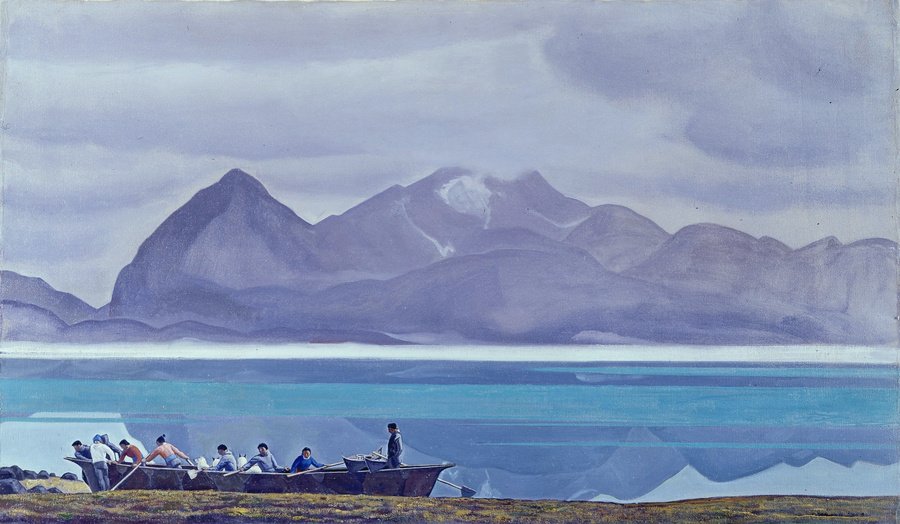
Greenland. People, Dogs, and Mountains. 1935. Canvas, oil
As has become apparent, the feeling of the sublime did not arise from the actual, measurable magnitude of the object. Furthermore, mountain ranges, oceans, and glaciers belong to the world of illusion, as they are merely an imitation of physicality and space on a flat plane. So, why did I subjectively decide that these mountains and glaciers in the brushwork of Rockwell Kent are absolute and sublime? This question became my research interest. How did the artist, within the modest dimensions of the painting, convey the feeling of natural sublimity that exceeds the scale of the painting by hundreds of times? Through what elements is the foundation for this feeling created on the canvas?
I identified four techniques that help evoke a sense of the sublime: compositional precision and clarity, light, proportion, and tonal contrast. I then grouped the landscape paintings from northern regions according to which technique, in my opinion, is dominant in each piece. In some works, several techniques contribute to the feeling of the sublime; in those cases, I will categorize the painting under the technique that, in my view, initiates the sublime feeling most primarily.
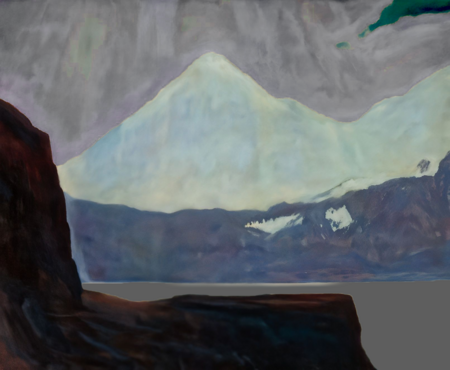
To determine the leading technique, I modified its characteristics and compared the resulting visual impact—examples of this comparison will be provided in the study. The first image will be the original, and the second will be the painting altered without the technique deemed most important.
Compositional Balance
Kent Rocaille’s style is often labeled realistic, yet the realism in his paintings is not inviting. Instead, it creates distance, forging a mythological, distant world disconnected from our actual surroundings. Frequently, his landscapes resemble theatrical sets—they are not depictions of reality, but are entirely controlled by the artist, including in the highly precise organization of both content and form.
Artist. Greenland. 1935. Canvas, oil
The painting above is an example of this mythologized realism. The subject depicted on it is hardly real: the main figure—an artist with a touch of the romantic hero—stands in the middle of what is likely an inaccessible icy wilderness, accompanied by several dogs, passionately painting an ice mountain on canvas. This artificial, yet charmingly romanticized subject reflects a profound sense of the sublime—the feeling of nature’s powers superseding the power of the human soul—and stimulates its emergence.
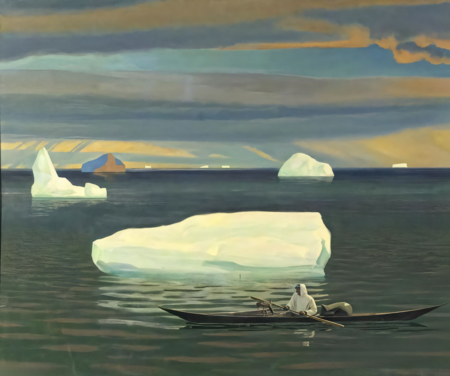
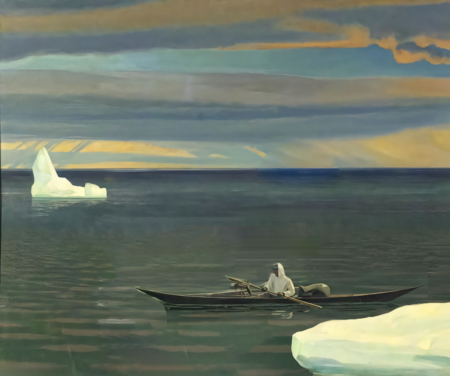
Eskimo in a kayak. Greenland. 1933. Canvas, plywood, oil
Kent’s painting, «Eskimo in a Kayak. Greenland,» vividly illustrates the subordination of the artist’s will to the formal aspects of the composition. All the glaciers and the Eskimo are placed in deliberate locations, forming a rather artificial image that is compositionally similar to notes strung on a staff. To demonstrate the significance of this specific compositional structure in establishing a sense of the sublime, I altered the placement of elements and removed some of them. The sense of nature’s organization—an arrangement actually devised by the artist—vanishes, and with it, the feeling of the landscape’s sublimity weakens, allowing the character and his solitude to come to the foreground.
Return of the Hunters. Northern Greenland. 1933. Canvas, plywood, oil
Another conceptually crafted painting—"The Return of the Hunters.» The situation itself is quite natural: the hunt is over, and the people are returning. However, their interaction with the environment appears unusual: their hands are clasped over their stomachs, there are no bags, weapons, or spoils visible, and their gaze is directed straight at the viewer. They resemble wild northern animals, completely unified with the landscape. The majesty of nature is emphasized and amplified by the characters who are in perfect harmony with it and are positioned within the composition.
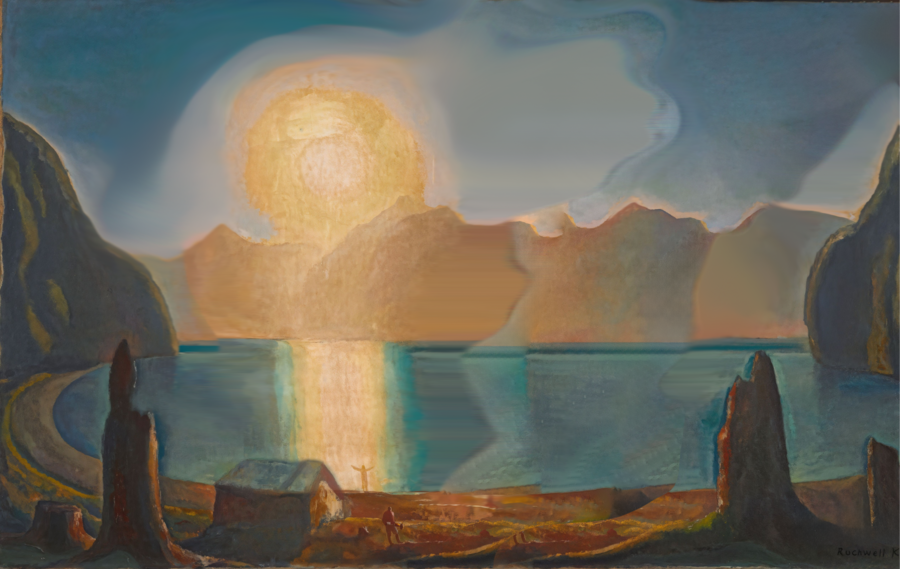
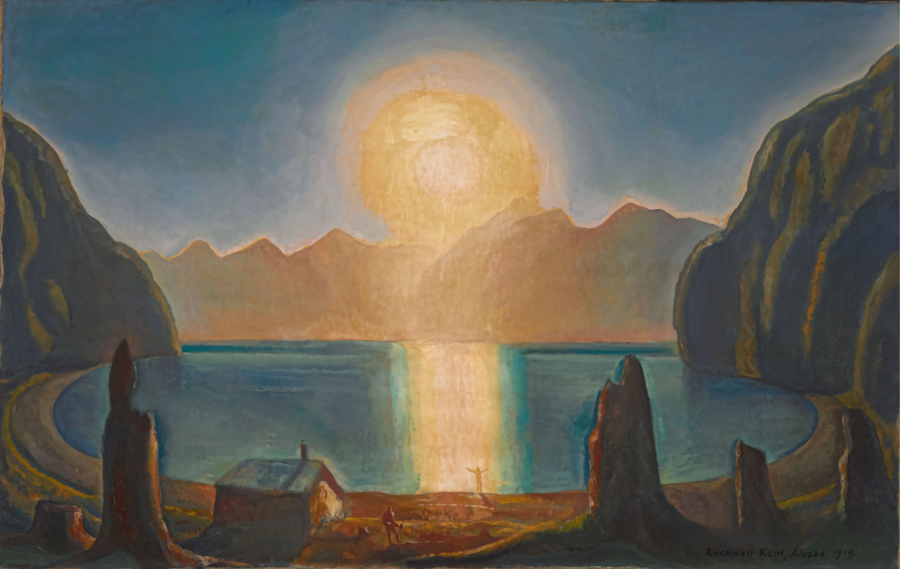
Pioneers. 1919. Canvas, oil
«Pioneers» looks very naive and impressionistic, but what strikes you most is perhaps the almost absolute symmetry of the composition—something barely possible in nature. Everything converges toward the center, toward the Sun: the figure’s outstretched arms, the perfectly level cove, the symmetrical, uniformly near-voluminous rocks—everything directs the gaze to the middle, intensifying a sense of sublimity.
However, if the symmetry is broken and the composition is made more natural, correct, and realistic, the effect fades. The naivety of the brushwork and forms comes to the forefront, but they fail to evoke a feeling of the sublime.
To summarize this section, we can say that Rockwell Kent’s meticulously crafted compositional and thematic decisions in his paintings allow him to guide the viewer’s emotional response, and thereby stimulate the feeling of the sublime.
3. Light
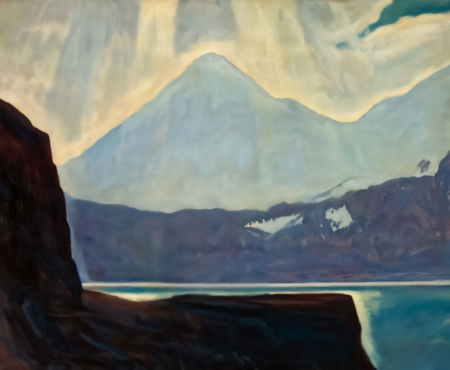
As mentioned previously, Kent’s paintings resemble theatrical set designs, and in theater, the lighting design crafted by the director is equally crucial. Light, much like the compositional decisions, becomes a tool for creating a sense of the sublime from the landscape—much as a spotlight directs the viewer’s attention and suggests an internal feeling.
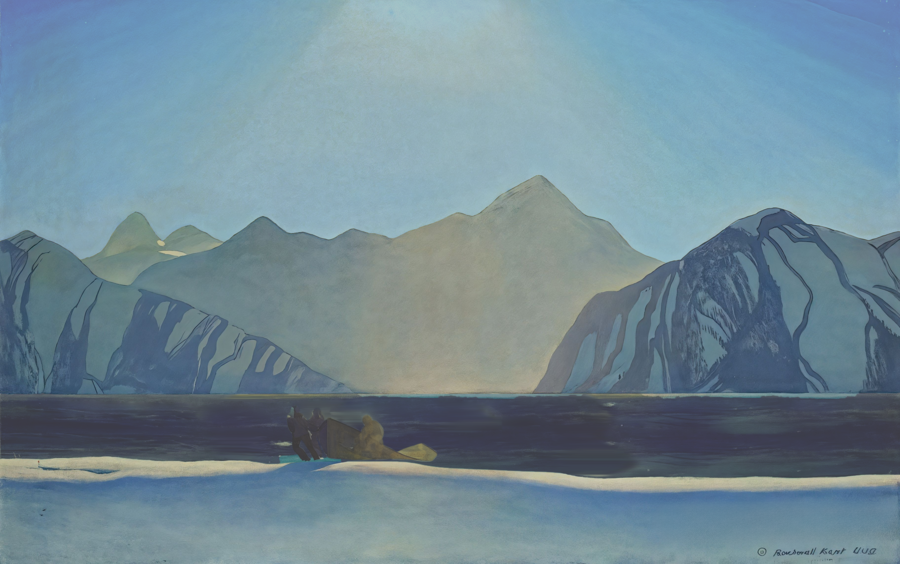
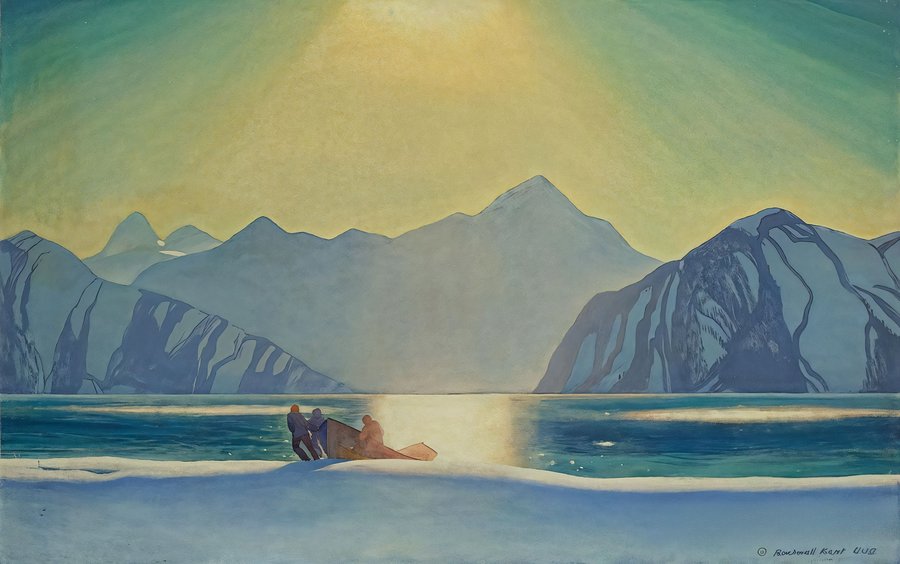
Sunshine glare. 1919. Canvas, plywood, oil
Alaska. 1927. Canvas, oil
Starl. Ireland. Donegal. 1927. Canvas, oil
The primary lighting in the paintings is indeed spotlight-like: a downward beam falls onto the «shoulders» of the mountains and the surface of the water. This museum-like, somewhat unnatural illumination (which occurs in life but is deliberately chosen and manipulated by the artist for the canvas) subconsciously makes the viewer feel the majesty of the landscape. It softly and naturally suggests: «Look here—this is what deserves your contemplation and sensual attention.»
Seal Hunter. Northern Greenland. 1933. Canvas, plywood, oil
Kent also utilizes outline lighting. The artificiality of the subjects and composition creates a sense of separation among the elements, while the outline light «cuts out» the landscape, making it an independent part of the painting rather than merely a backdrop for the person and their activities.
So, light is another tool for Kent to guide attention and emphasize important accents. The artist manipulates the light to something magical, divine, somewhat mythological. The sublime is not ignored by the ray; it is bathed in sunlight and highlighted—yet none of this appears overly contrived—after all, what landscape is without light?
4. Contrast
After light, it makes sense to examine the importance of contrast in conveying a sense of the sublime, as they are quite closely related. However, in the chapter dedicated to light, we treat it as a discrete form, whereas with contrast, we examine the planes upon which the light acts.
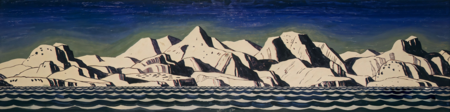
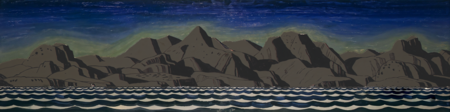
Mountains of Greenland and Sea, 1930. Wood, oil