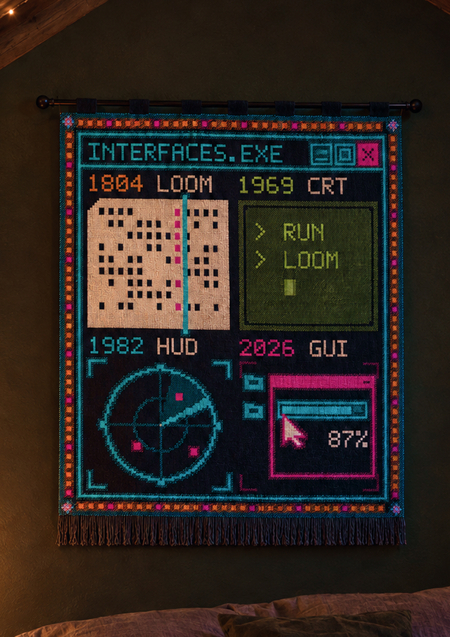
INTERFACES.EXE — a Jacquard tapestry on the evolution of interfaces. It continues my thesis project and explainer, «The Evolution of Interfaces, ” where I investigate how the visual language of human-machine interaction has changed in science fiction and reality.
For this topic, the tapestry is not a random medium. The Jacquard loom (1804) was controlled by punched cards: a hole in the card determined whether a thread would be raised. It is considered one of the ancestors of the computer, and the pattern on the fabric is one of the first programs. My tapestry closes this loop: the digital interface returns to the weaving of threads from which it once grew.
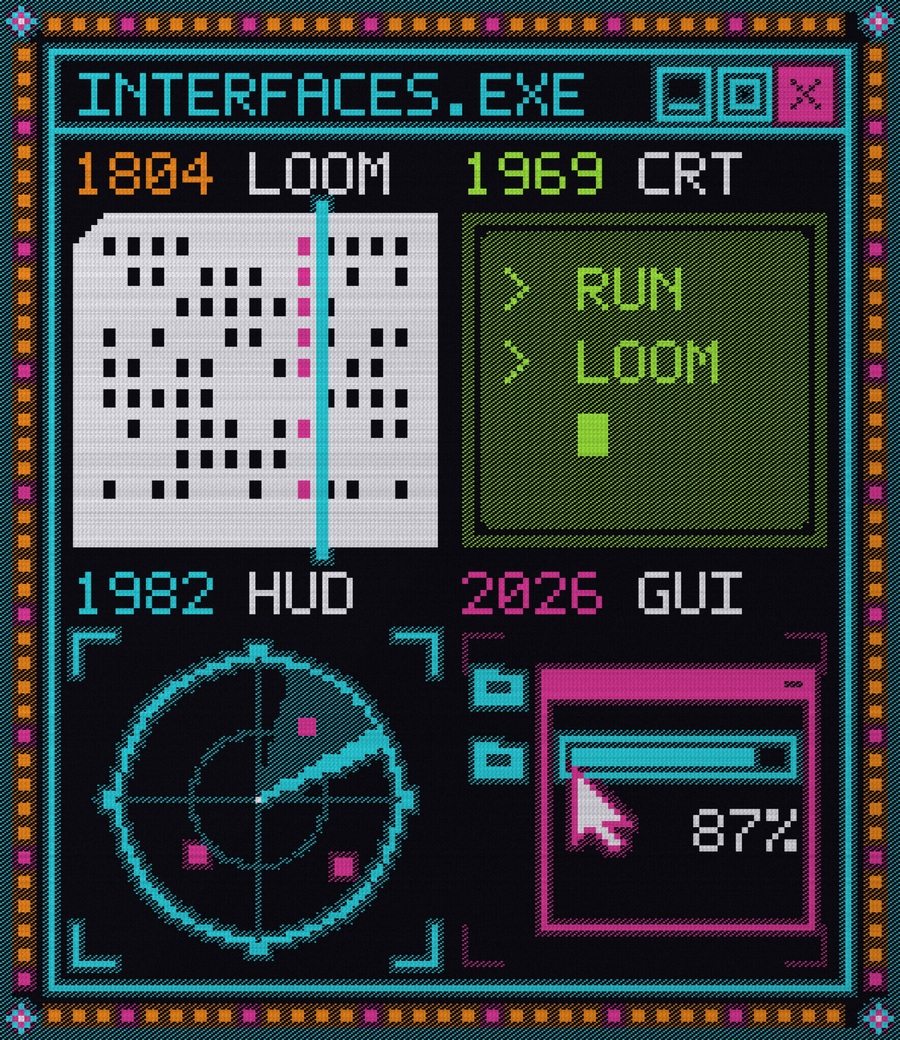
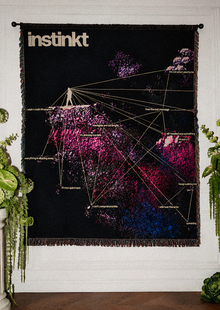
The composition is styled as a window from the INTERFACES.EXE program. Inside, there are four epochs of the interface:
- 1804 LOOM — Jacquard punch card; a laser line «reads» it, and the detected holes illuminate.
- 1969 CRT — a green terminal displaying the command RUN LOOM.
- 1982 HUD — a sci-fi interface radar with target markers.
- 2026 GUI — a window with an 87% progress bar: the fabric seems to still be loading.
The frame is a ribbon of punch card holes running along the entire perimeter.
Styling—a dark sci-fi interface: a black background accented with neon cyan, magenta, acid green, and orange. The cotton does not glow; instead, the luminescence is created by the weave itself: a colored thread alternates with black within the diagonal twill structure surrounding bright lines, which the eye perceives as a halo. Up close, you see the fabric; from a distance—a screen.
The tapestry is designed for the wall of an office space, media library, or technology museum. From a distance, it functions as a large «screen» above a desk or sofa, but upon closer inspection, it reveals itself as a textured fabric.
The production file was prepared in the master file for the 123 × 142 cm format.
AI for Interior Visualization: Nano Banana