
01. Concept
The sand person interests me because their body must simultaneously appear as a human figure and as a granular material. The shape of the face and body helps to identify the character, while the crumbling sand particles indicate what they are made of. I want to understand how these two challenges were addressed in the films Spider-Man 3: Villain in Reflection (2007) and Spider-Man: No Way Home (2021). Fourteen years separate the two films, but that alone does not mean that the new version is inherently more convincing than the old.
How have the technologies that allow the Sand Person to maintain a recognizable form while remaining granular evolved?
For comparison, I will select frames where the face, silhouette, and body surface are clearly visible. I will separately examine the human-sized character and its gigantic version. I will compare similar states: the assembled body, its formation, and its decay. I will supplement film clips with breakdowns and images of intermediate stages. The difference in shot scale or scene objective will be taken into account during the comparison.
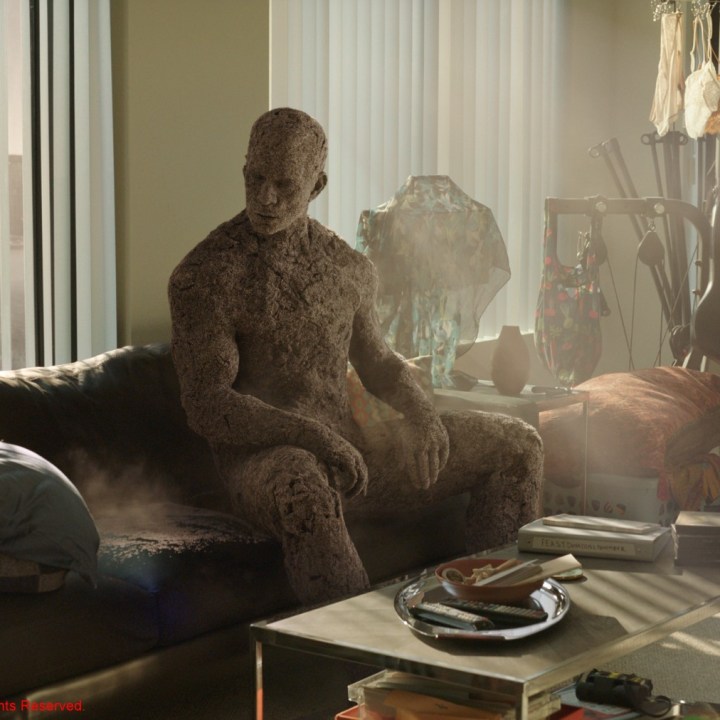
The research will be structured around technical problems. First, I will examine how the body form is defined and connected to the movement of the sand. Next, I will explore how facial features and expressions are preserved despite the constantly changing surface. The final section will focus on a giant version of the character: here, it is crucial to understand how the flow and shedding of the sand are made noticeable. In each section, I will compare two films and note what explains the difference in the resulting effect.
The technical foundation will be drawn from Jodie Duncan’s article in Cinefex, publications from Sony Pictures Imageworks, and interviews with the effects creators. I will select materials that explain the process used on a specific scene and name the responsible specialists. I will compare the information from the sources with the footage. Since the algorithm or software cannot be determined by visual inspection, such data will only be presented with a citation.
My hypothesis is that the persuasiveness of the Sand Person depends on the consistency between its body form and the movement of the sand. The development of tools offers more possibilities to control this combination, but the result must be assessed individually in each scene.
02. Body Form and Sand Movement
Sony Pictures Imageworks. The Giant Sandman. Spider-Man 3: Venom, 2007. VFX Supervisor—Scott Stockdick; Giant Character Design—Terrence Thornberg. Source: How to Build a Sixty Foot Man of Moving Sand [1].
The article in Cinefex regarding the 2007 film specifically mentions VFX Supervisor Scott Stockdick and Special Effects Supervisor John Fraser. The team shot tests using real sand, which served as a benchmark for the computer-generated material [2]. This allowed them to verify the result based on the observed behavior of the sand, rather than solely on the shape of the digital model.
In the 2007 version, the giant was not composed solely of freely moving grains of sand. The model’s surface was maintained beneath them, and the sand flows were calculated separately and mapped onto the animated body. This allowed the simulation to be reused across different frames. The authors also increased the material’s visibility by incorporating rocks and larger particles: grains of sand at actual size were lost on such a massive body [1]. In this frame, a solid silhouette combines with loose edges and inclusions of construction debris.
Sony Pictures Imageworks. «Spider-Man: No Way Home, ” 2021. Model wireframe, in-progress shot, and final frame. Studio VFX Supervisor — Chris Wagner; Film VFX Supervisor — Kelly Port. Source: befores & afters [3].
In this series, it is easy to separate the character’s form from the surrounding effects. On the model, the open mouth, eyes, and head tilt are already discernible. In the final frame, part of the surface is obscured by sand, but these landmarks remain. This observation applies to the presented stages of a single frame and does not prove that all film scenes were created in the same way.
At these stages, it is clear that the facial structure is established even before the detailed sandy surface appears. In the finished shot, the contour becomes less defined, but the facial expression remains recognizable.
Chris Wagner explains that initially, the team aligned on a simplified animation before progressing to more complex effects. In the final version, the Sandman functions both as a body and as a sandstorm—he gathers material around himself and then expels it. Faster rendering allowed for more frequent iteration testing and refinement of the movement [3]. It is impossible to ascertain which specific algorithms changed compared to 2007 based on single frames. Therefore, here I compare the confirmed workflow with the visible result.
03. How the Body is Built from Sand
Sony Pictures Imageworks. The Birth of Sandman: creation stages. «Spider-Man 3: Venom, ” 2007. VFX Supervisor — Scott Stockdick. Source: The Birth of Sandman [4].
These four images illustrate the stages of creating a single character state. They should be viewed as a technical breakdown, not as a sequence of movement in a film. The top row helps visualize volume without a final surface, while the bottom row shows the distinction between individual particles and the assembled image.
In the character creation scene from 2007, several calculation methods were employed. The primary motion was driven by animation, while individual tools were responsible for the surface dusting and sand movement. Interacting particles in the form of spheres were used for larger grains. Finer particles could move along a pre-calculated velocity field. Detailed grain interaction was primarily required where the sand fell or was featured in a close-up shot [4]. This demonstrates that within a single scene, the material was not calculated using one uniform method.
In the intermediate images, the body still resembles a smooth mass. The grainy surface alters the perception of the material, though the overall form is already recognizable.
Rendering is a separate component of this task. The publication «Rendering Tons of Sand» describes a method for adding particles during image construction. Distant and near grains of sand were represented differently—from points to polygons. This technique allowed for the visualization of a dense, granular surface without storing all the detailed geometry in memory simultaneously. The authors cite a maximum of 480 million rendered particles per frame [5]. This figure pertains to the image; it does not mean that the movement of every particle was calculated individually in the simulation.
Having many grains of sand in the frame is not the same as having many independently calculated grains of sand. To compare technologies, it is important to distinguish between these two numbers.
Sources
[1] Pilgrim J., Tornberg T. How to Build a Sixty Foot Man of Moving Sand. Sony Pictures Imageworks, 2007. URL: https://www.imageworks.com/sites/default/files/2023-10/how-to-build-a-sixty-foot-man-of-moving-sand.pdf (Accessed: November 17, 2026).[2] Duncan J. The Enemy Within // Cinefex. 2007. Issue 110. URL: https://archive.org/download/cinefex-021/Cinefex%20Magazine%20PDF/Cinefex-110.pdf (Accessed: November 17, 2026).[3] Failes I. When you have to craft not one Spider-Man, but three // befores & afters. January 24, 2022. URL: https://beforesandafters.com/2022/01/24/when-you-have-to-craft-not-one-spider-man-but-three/ (Accessed: November 17, 2026).
[4] Ammann C. [et al.]. The Birth of Sandman. Sony Pictures Imageworks, 2007. URL: https://www.imageworks.com/sites/default/files/2023-10/birth-of-sandman.pdf (Accessed: November 17, 2026).[5] Allen C., Bloom D., Cohen J. M., Treweek L. Rendering Tons of Sand. Sony Pictures Imageworks, 2007. URL: https://www.imageworks.com/sites/default/files/2023-10/rendering-tons-of-sand.pdf (Accessed: November 17, 2026).
Image Sources
Giant Sandman, 2007. Sony Pictures Imageworks. Image from the publication How to Build a Sixty Foot Man of Moving Sand: https://www.imageworks.com/sites/default/files/2023-10/how-to-build-a-sixty-foot-man-of-moving-sand.pdf (Accessed: November 17, 2026).
Three Stages of the Giant’s Creation, 2021. Sony Pictures Imageworks. Images from an interview with Chris Wagner: https://beforesandafters.com/2022/01/24/when-you-have-to-craft-not-one-spider-man-but-three/ (Accessed: November 17, 2026). This montage of three images was assembled for research.
Four Stages of the Birth Scene, 2007. Sony Pictures Imageworks. Images from The Birth of Sandman: https://www.imageworks.com/sites/default/files/2023-10/birth-of-sandman.pdf (Accessed: November 17, 2026). The composition was prepared for research.