Navigator
— Concept — Introduction (Where Arabesque Originated) — Byzantium and Early Islamic Architecture — Persia: Islam and Everything Around It — How Arabesque Reached Europe — Moorish Influence: Borrowing or Reinterpretation? — What Happened Next — Conclusion
Concept
When we received the assignment, I wanted to use Persian ornamentation, but I quickly realized that Iran alone wasn’t sufficient for a course on the history and theory of style. Arabesques proved more suitable: they are connected to Persia yet they bridge antiquity, Islam, and Europe, meaning I could test several course theories simultaneously using them. Moreover, they are simply fascinating to look at—the same scroll appears on a Roman altar, in an Isfahan mosque, and in pages of European pattern books.
I want to trace the trajectory of the vegetal scroll—from the Greek acanthus to the Islamic arabesque, and subsequently back to Europe in the form of mavresques. It seems to me that the arabesque is not some «foreign Eastern ornament, ” but rather a link in a long historical chain where form transitions from one culture to another, evolves, and acquires new meaning each time. For a visual study, this is an ideal case: one can literally map the sequence across images to see precisely where the form breaks and transforms.
My hypothesis is that arabesque did not emerge in place of ancient ornament, but rather evolved from it. The Greek palmette and Roman acanthus gradually transformed into an abstract pattern that grows infinitely and is detached from any real plant. When this pattern reached Europe, its artisans did not simply copy it; they reinterpreted it through their own tradition. Therefore, the European moresque resembles the Islamic original, yet it exists distinctly. In short, I propose that we cannot speak of either pure borrowing or entirely independent invention here.
To test this hypothesis, I am seeking answers to several questions. What precisely did Islamic masters take from late antiquity and Byzantium, and what did they invent themselves? How does the Persian islimi differ from other versions of arabesque? By what routes did the pattern enter Europe: through Spain, Venice, books, or textiles? And most importantly—whose logic can explain this history: Regiomontanus, who believed in the development of form according to its own laws, or Alberti, who linked it to material and technique?
The research follows a trajectory of patterns: antiquity, Byzantium, and early Islamic architecture; Persia; the road to Europe; Moorish influence; and late history. Each chapter represents a step on this journey, and in the conclusion, I synthesize the findings and answer the questions posed by this concept.
Introduction (Where the Arabesque Grows)
First, let’s talk about the terminology, because this can easily become confusing. Arabesque is an intertwined, vegetal pattern that branches and repeats without a beginning or an end. In Persia and Turkey, similar motifs are called Islimi, and in 16th-century Europe, they were known as Moresque, meaning «Moorish» pattern. They are close relatives, but not synonyms, and I will go on to explain how they differ. There are two classical perspectives on the origin of ornamentation in general. Gottfried Semper, in the 19th century, believed that form emerges from material and technique—weaving, braiding, metalwork. Alois Riegl, in Questions of Style (1893), disagreed with him, arguing that ornament develops according to its own internal logic. I will test both theories using the images.
Let’s begin with the acanthus, a spiky Mediterranean plant that the Greeks transformed into a hero of architecture. Its leaves became the basis for the Corinthian capital. According to the Roman architect Vitruvius, the idea was observed by the sculptor Callimachus after he saw a basket overgrown with acanthus. It is likely a beautiful legend, but it effectively illustrates how a plant evolves into an architectural form. However, the acanthus was not the only ancestor. The palmette—a stylized fan made of petals—was already widespread in Greece, used to decorate temples, vases, and gravestones. The Greeks learned to assemble these motifs into continuous ribbons, where one swirl flows seamlessly into the next. This is the fundamental blueprint for the future arabesque: a pattern that can be continued indefinitely. The Romans took this idea to a grand scale. The lower panels of the Altar of Peace in Rome (9 BCE) are covered with enormous acanthus shoots from which flowers grow, interspersed with birds and small animals. This is no longer mere decoration on a single element, but an entire surface overgrown with vines. It is this density that Byzantium and Islam later adopted.
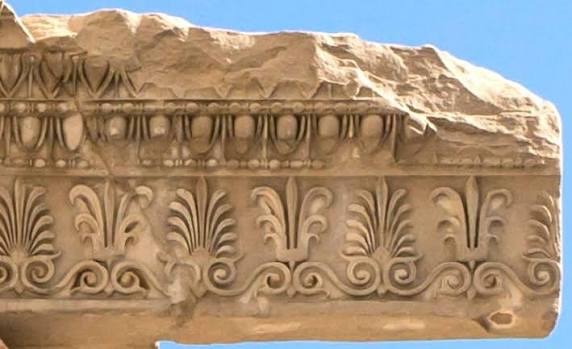
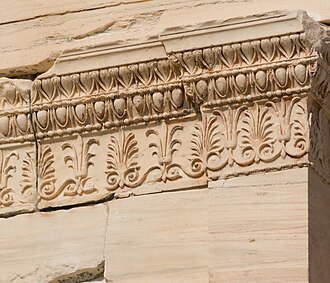
Marbled panel from the Epikrateia (frieze with Antemion) of the Erechtheion, Athenian Acropolis (Athens, Greece), c. 421–406 BCE.
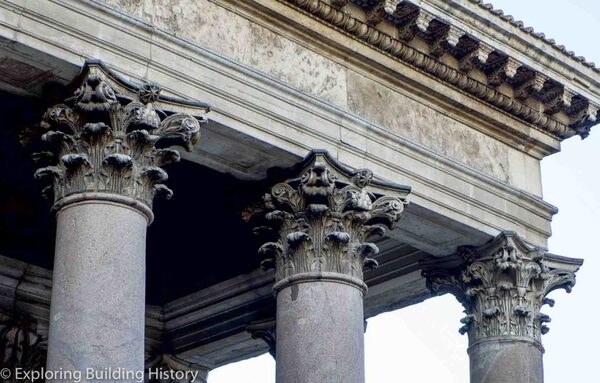
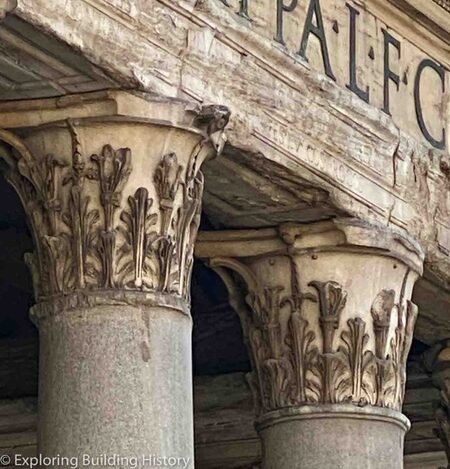
Pantheon (portico of the main facade), Rome (Italy), c. 118–128 AD.
Upper section of the marble funerary stele of Callidemos, Attica, Greece (now in the Metropolitan Museum of Art, New York), c. 350–325 BCE.
Rigel theorized that a straight line connects the palmette and the acanthus. According to his version, the Greek master did not invent the acanthus from scratch, but rather re-envisioned an old palmette, making it softer and more volumetric. If you place the palmette from a tomb stele next to the acanthus leaf from a capital, you can compare the rhythm of the petals visually. Important: this is a theory, not a proven fact. Other researchers believe the acanthus was simply copied from a real plant. For my topic, something else is more important: form transforms from one species to another, rather than emerging from nothing.
Byzantium and Early Islamic Architecture
By the 7th century, the acanthus and vine were ubiquitous—on Byzantine churches, in mosaics, and on textiles. When the first Islamic structures appeared in the Middle East, the artisans worked with the same techniques and according to the same models. The patron, however, had changed: mosques did not require figures of humans or animals, but plants remained an ideal motif. In this chapter, we examine how the familiar vine gradually begins to transform away from its traditional form.
In the Rock Dome in Jerusalem (late 7th century), the mosaics appear almost Byzantine: a golden background, vases from which sprout shoots, precious stones, and crowns. Only people are missing. In the Great Mosque of Damascus (early 8th century), the mosaics depict trees, rivers, and ethereal buildings—and again, no living beings. It’s like the Byzantine language, but with the figures removed.
Interior of the Dome of the Rock (Qubbat as-Sakhra), Temple Mount, Jerusalem, 691–692 AD (with later restorations)
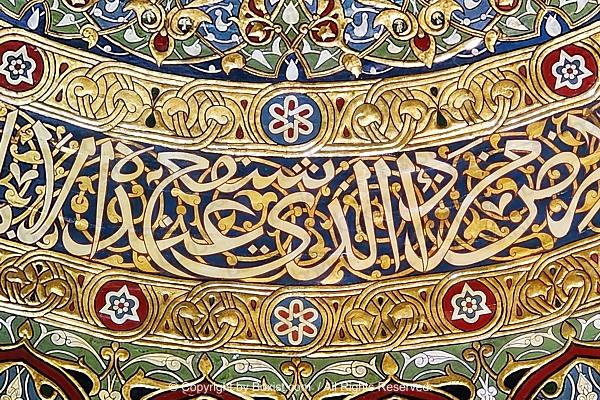
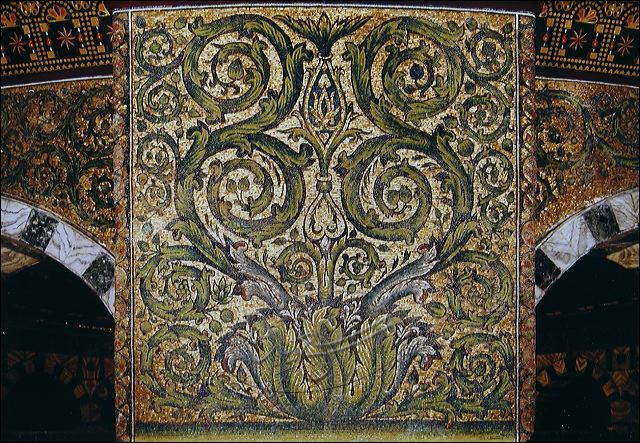
Fragment of painting and molded ornamentation featuring a calligraphic inscription («Ayat al-Kursi») and a mosaic panel depicting vegetative shoots and acanthus leaves on the column of the inner arcade, Dome of the Rock (Qubbat as-Sakhra).
The facade of the Umayyad Palace at Mshatta (circa 743 AD, Jordan) is now housed in the Pergamon Museum in Berlin. It is entirely covered in a zigzag pattern, with a rosette inside each triangle, and vines bearing leaves and bunches grow around it. The design is already highly symmetrical, almost like fabric stretched across the wall. Here, you can clearly see how the plant transforms into rhythm.
In Samarra, the capital of the Abbasids since 836, stucco panels were carved using molds. Researcher Ernst Herzfeld divided the local decor into three styles, and in the third, the «beveled» style, the leaves barely resemble natural forms. The lines became sharp and fluid, as if the plant grew according to geometric rules. It seems to me that this is the most tangible example of Rigby’s idea about ornament evolving by its own logic.
Persia: Islim and Everything Around It
In Persia, arabesque received a second name and a second character. Here, the scroll is called islimi, and it became the main figure in books, carpets, and mosque facades. Persian masters favored density and rhythm—the pattern expands so much that the background almost disappears. Another important development is that after the Mongol invasions, Chinese motifs entered Iran, causing islimi to interact with the lotus and peony. In this chapter, we examine how this develops into the recognizable «Persian script.»
In Isfahan, at the Friday Mosque, there is the Uldzhait Mirab (1310): the entire niche is covered in carved stucco, where the islimi spirals over the inscriptions. Nearby, there are Timurid manuscripts standing side-by-side. In Herat and Shiraz during the 15th century, book headings and Quran pages were decorated with ornaments: gold, lapis lazuli, and the finest scrolls within frames. Here, arabesque functions almost like jewelry on the page.
Ardabil Carpet (1539–1540, now in the Victoria and Albert Museum) is an excellent example of how a pattern lives on fabric. At the center is a huge star medallion, and around it, vines and flowers bloom, with the design appearing to grow from the center outward to the edges. Here, Tempera is easily verified: the carpet is made on a loom, and the technique itself suggests symmetry and repetition.
In Isfahan during the reign of Shah Abbas I (late 16th–early 17th centuries), ornamentation expanded to encompass an entire city. Sheikh Lotfollah Mosque and Shah Mosque are covered in tiles: the dome, vaults, and portals are painted with colors and scrolls on a blue and turquoise background. The artisans used tiles of various colors, cut to fit the design’s shape, which is why the pattern looks so rich and vibrant. For my topic, this is the point where Islamic art reaches its peak.
If you lay everything out side-by-side, one pattern becomes evident: the pattern is almost independent of the material. The same paisley grows on plaster, paper, wool, and glazed tile, only changing in scale and density. However, the Zumper doesn’t fully work here: the technique refines the details (there is more symmetry on the rug, more color on the tile), but the pattern itself comes from elsewhere. This is rather an argument in favor of Riegel and my hypothesis: form has its own logic, and the material only adapts to it.