
Introduction
«Lapochka» is a Russian brand of natural sugar—free lemonades. The philosophy of founder Anton Balyklov is to create a delicious and healthy drink that children and adults will not consider «harmful.»
Features: — Ingredients: Water, juice, carbonation + functional additives (vitamins, herbal extracts, CBD, L-glutamine). — Audience: Health-conscious people, parents, bar/restaurant patrons. — Channels: Online ordering, events, social media. — Tone: Friendly, with an emphasis on transparency and usefulness.

Elaboration Likelihood Model (ELM)
ELM — probability theory of information processing (Petty and Cacioppo). Identifies two ways of persuasion: — Central: deep consideration of arguments (requires motivation and ability). The key is the quality and strength of the arguments. — Peripheral: surface perception through heuristics (emotions, sympathy, authority, beauty). The key external signals.
Why is ELM suitable for a «Lapochka»? The brand combines both ways, saving the audience’s cognitive resources.: — The central way is for thoughtful healthy lifestyle consumers: direct facts («100% natural», «no sugar»), detailed composition (L-glutamine, beta-glucans), appeal to the expert (the founder’s story about children). — The peripheral path is for impulse buyers in cafes/bars: the name «Lapochka» (evokes warmth, trust), aesthetic jar, social proof («celebrate @lapochka.drinks»).
The result: the consumer can quickly choose a drink because of its «cuteness» and design (the periphery), and then rationally justify the choice with a useful composition (the central way). This reduces cognitive dissonance and increases loyalty.
Communication Channels
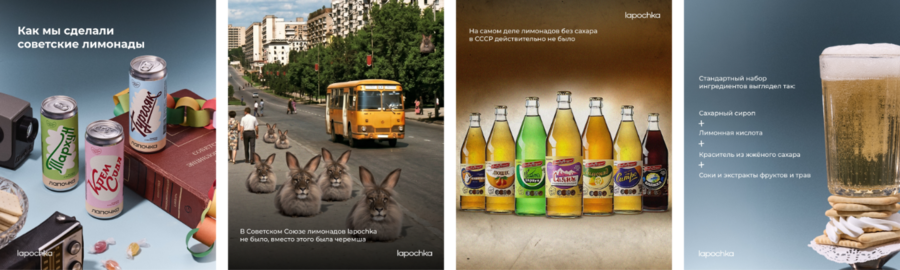
The brand «Lapochka» is represented in three digital platforms: Instagram*, VKontakte group and Telegram. Each of them performs its own communicative role and allows you to reach different segments of the audience.
Despite the differences in audience and platform interface, Instagram* and the VKontakte group «Lapochka» publish content that can be combined into several key categories. Together they form a multi-layered brand image.
The processes of creating new flavors are published on both platforms. Such behind-the-scenes content demonstrates transparency. From the point of view of the probability of comprehension model (ELM), it activates the central path of persuasion for an interested audience who is willing to delve into the details, and such deep information strengthens their trust in the brand.
Humorous videos and memes occupy an important part of the content. Humor works as a powerful peripheral signal of sympathy (ELM): the audience genuinely laughs at the brand’s content, it transfers positive emotions to the product itself.
- Lemonade recipes are regularly published: posts on how to use the drink to make cocktails, desserts, marinades, and pastries. By providing practical benefits, the brand transforms the product from just a drink into a universal ingredient. According to communication theory, such content satisfies the audience’s needs for monitoring and distraction from routine. 4. Stories about employees are published on both sites. These are small notes, interviews, or videos that show the people behind the brand: their personalities, hobbies, and their attitude to the product. From the point of view of dialogical theory, such content creates reciprocity and empathy.


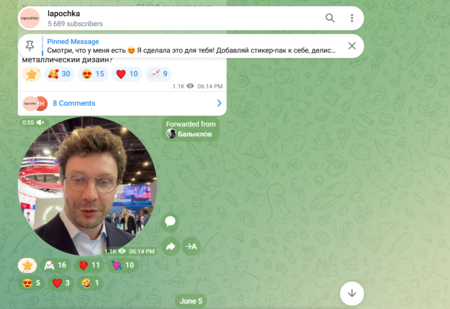
Telegram occupies a special place in the brand’s communication ecosystem. Unlike Instagram* and VKontakte, where the content is more formal and aimed at a wide audience, Telegram is used for personal involvement of the creator.
Here, the founder or key employees share thoughts, backstages, personal stories, conduct surveys, and communicate with subscribers almost in the format of friendly correspondence. This channel creates a sense of intimacy, trust and exclusivity.

PR Strategy: Mixed Type
In real PR campaigns, especially in social media, pure strategies are rarely found — only the central path or only the peripheral one. More often, as practice shows and research confirms, successful companies use a mixed strategy, combining both types of persuasion.
The central signals in the communication of the «Lapochka»: — Detailed posts about natural ingredients — The story of the brand’s creation
The peripheral signals in the communication of the «Lapochka»: — Liking: aesthetic pastel Instagram* feed, cozy photos, collaborations with your favorite bloggers — Social proof: reposts of customer reviews and photos, a large number of subscribers and likes — Scarcity: limited series, seasonal flavors — Reciprocation: free order stickers, promo codes for regular customers, polite and personal responses to comments
Central route
The central path of ELM is persuasion through deep consideration of arguments.
The consumer following this path is motivated to analyze information and is able to do so. He is looking for answers to the questions: is what they promise true? Is the product reliable? Why should I believe him? The «Lapochka» creates the conditions for the central path through several specific techniques.
1. Providing complete and verifiable information about the composition The brand publishes a detailed composition for each taste on its website. Specific substances are listed (for example, L-glutamine, alpha-lipoic acid, vitamin B8, molybdenum).
How it works for the central pathway: — The consumer can check each ingredient independently (through search, scientific articles, consultation with a doctor). — It leaves no hidden areas — the composition is «unpacked» completely, and not hidden behind common words («herbal extracts», «vitamin complex»). — This creates trust through vulnerability: the brand is not afraid that the consumer will find something controversial in the composition.
2. Personal responsibility of the founder as a signal of reliability Founder Anton Balyklov is named by name, his story is listed on the website: he created lemonade for his children so that they would not be afraid to hear «it’s harmful.»
How it works for the central way: — A rational consumer asks the question: «Who is responsible for this?» An anonymous brand arouses suspicion, a specific person reduces the risk. — A public name means that the founder incurs reputational losses in case of fraud. This is a rational signal of honesty. — The motive «for their children» is perceived as more reliable than «for profit» — it reduces suspicion of marketing tricks.
3. Lack of emotional exaggeration («facts instead of promises») On the website, the brand does not write «the drink will strengthen the immune system,» «reduce anxiety,» «cure the liver.» It just lists the components.
How it works for the central way: — If a brand made big promises, a rational consumer would start checking them and easily find reason for doubt (clinical studies are needed, the effects are individual). — The absence of exaggeration paradoxically enhances trust. The consumer thinks, «They don’t promise me anything, so they’re not trying to manipulate me. I’ll decide for myself whether it’s useful or not.» — The brand behaves like a data provider, not a seller of wonder—and that’s exactly what the central way values.
Peripheral route
1. Social proof: «the brand already has its own people» In «Lapochka» communication, social proof works through the «everybody’s doing it» effect — the feeling that other people are already choosing the brand. For the consumer, this becomes a quick reference point: if the brand has active subscribers, reactions, marks on social networks, reviews and user-generated content, then «Lapochka» does not look like an unknown product. What matters is not that the audience explains in detail why they choose the brand, but the very fact of visible activity around it: people are buying, photographing banks, and celebrating the brand.
Example: «Lapochka» enhances this effect by addressing the audience as «lapochki». Such an appeal not only sounds cute, but creates a sense of belonging: subscribers seem to become part of a common circle of people who understand the brand’s style. Therefore, marks, reposts, and comments work as visual confirmation: the brand already has «its own» ones, which means it’s easier for a new consumer to trust it without in-depth analysis.
Lapochka merch can be considered an additional element of social proof. If consumers buy, wear, or post merch, it works as social proof: people do not simply try the product, but want to publicly associate themselves with the brand.