Skull Instead of a Face: The Human in Skeleton Imagery in Painting and Graphic Art
What remains of a human when a skull replaces a face? This study collects paintings and graphics from various eras: self-portraits by James Ensor, Mexican calaveras by Manuel Manilela, José Guadalupe Posada, and Leopoldo Méndez; skeletons by Kavanabe Kyosai; works by Edvard Munch, Frida Kahlo, and Jean-Michel Basquiat. The works are compared based on what the artist leaves behind in the human figure: clothing, pose, occupation, or setting. They are also compared based on the moment the figure ceases to be human and becomes an image of Death.
In art, the skull usually evokes death. But there are special cases: the skull appears not in a person’s hands or near them, but where their face should be. Such a figure is difficult to label merely a symbol. It possesses a costume, a pose, an activity, and sometimes even a name. This study is dedicated to such images—portrayals of a human rendered as a skeleton.
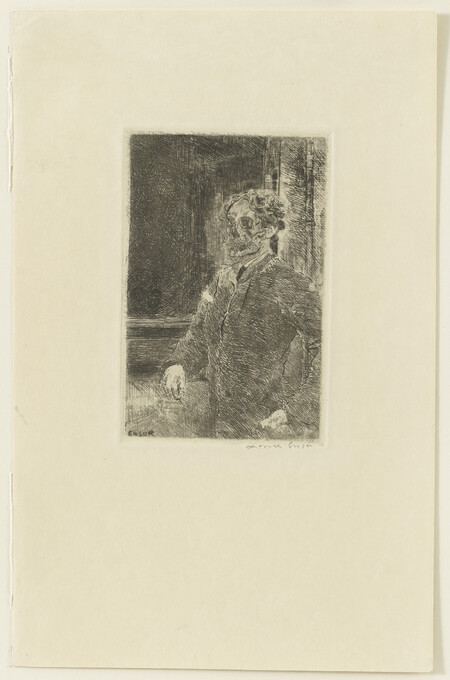
The starting point is James Ensor’s etching, «My Portrait in the Image of a Skeleton» (1889) [1; 2]. It is based on a photograph taken outside the Russo family home in Brussels: Ensor stands by a window, one hand rests on the windowsill, and the other is in his jacket pocket [1; 3]. The first state of the etching closely replicates the photograph. In the second and third iterations, the artist «removes» his face. Only hair remains on the skull, yet the gaze, like in the photograph, is directed at the viewer [1]. Xavier Tricot sees this substitution as a reminder of death [4].
When the photograph and the etching are placed side-by-side, one can see how much of the person remains. The pose, the jacket, the hairstyle, and the hands are identical. The face has vanished, but Ensor himself has not: we are still presented with a specific person at a specific window.
A year earlier, Ensor was already presenting himself as a skeleton. In the etching «My Portrait in 1960» (1888), he lies in a grave—a century after his birth in 1860 [4; 5]. Here, even less of the person remains: neither the suit nor the window, only an elongated skeleton. Yet, strands of hair sprout from the skull, and the title refers to it as a portrait.
This leads to the core question of the research. What remains of a person when an artist replaces their face with a skull or transforms the body into a skeleton? And at what point does such a figure cease to be human and become an embodiment of Death?
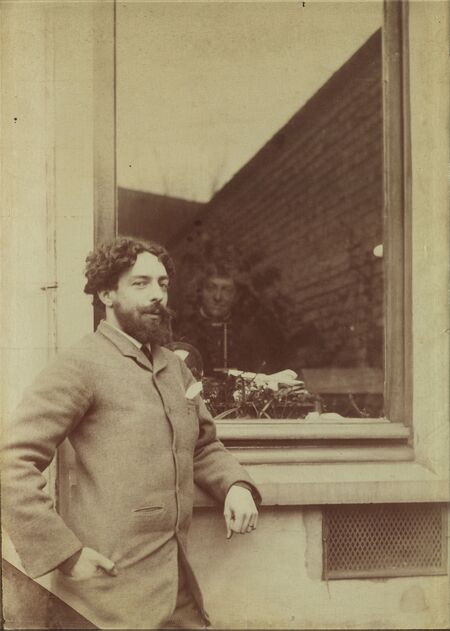
Ernest Rousseau Jr. (after Xavier Tricot). James Ensore by the Rousseau family home in Brussels. 1888 or 1889. Photograph. Mu.ZEE, Ostend, BA000209.
James Ensor. «My Portrait in the Image of a Skeleton.» 1889. Etching, third state. Museum of Modern Art (MoMA), New York, 590.1954.
Working Hypothesis: The skull itself does not erase the person. When the face is absent, the character transfers to everything else—clothing, posture, objects, activity, environment, and sometimes even the signature. The more of this is preserved, the closer the figure is to a portrait or a recognizable social type. The less, the closer it is to allegory.Death in these images does not disappear. Ensor’s etching functions simultaneously as a self-portrait and a reminder of death. Therefore, the study does not examine the choice between «human or Death, ” but rather the ratio: how many human characteristics must remain for the skeleton to still be depicted as a person.The hypothesis may not be confirmed. In Félix Rousseau’s painting „Death at the Ball“ (c. 1865–1875), the skeleton is dressed in a long gown, but the title explicitly names it Death [6]. If it turns out that the clothing and activity do not maintain the human quality, the conclusion will have to be drawn differently.There is another boundary: works where the face remains a face but begins to resemble a skull. This is George Gross’s „Metropolis“ from 1917 [7]. In Salvador Dalí's „Face of War“ from 1940, the skull and snakes reference the horrors of war, according to the museum description [8]. In such works, the focus shifts from a specific individual to what is happening to people.
George Grosz. Metropolis. 1917. Canvas, oil. Museum of Modern Art (MoMA), New York.
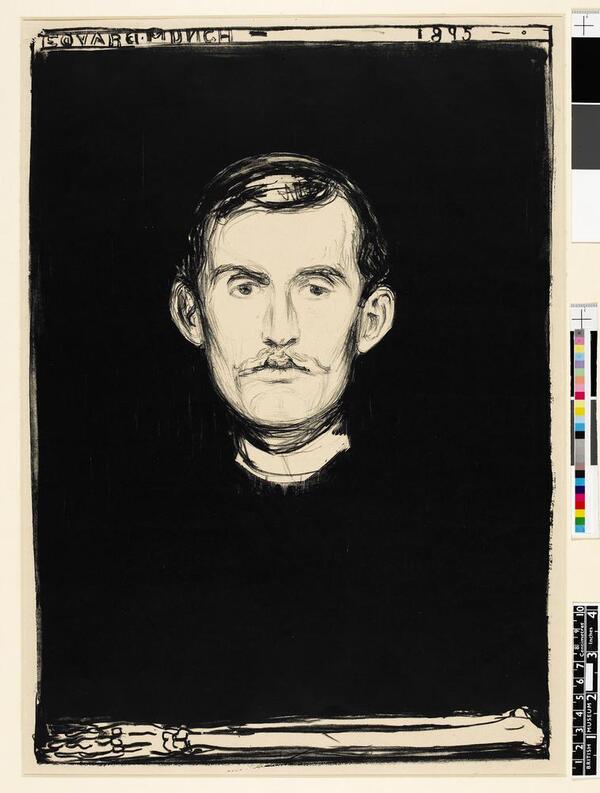
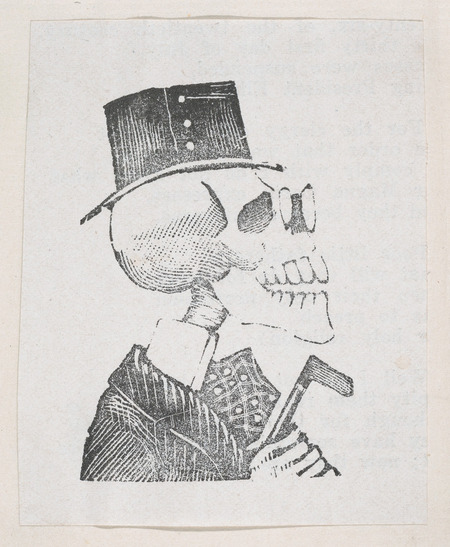
The scope of this project transcends any single nation or historical era, leading to a broad collection of material. The core focus is on Ernst and Mexican printmaking, specifically the calaveras of Manuel Manile, José Guadalupe Posada, and Leopoldo Méndez. To this are added Japanese skeletons by Kawanabe Kyosai, self-portraits by Edvard Munch, Lovis Corinth, and Jean-Michel Basquiat, works by Frida Kahlo and Diego Rivera. A piece is included in this selection if the skull or skeleton becomes part of the human figure or helps define the theme’s boundary. Another criterion is that the specific version and the museum housing it must be known.The structure follows a guiding question. The introduction sets our case apart from neighboring examples: the skull held by a human figure and Death standing beside it. The «Face» section explores what is lost. Ernst transforms existing imagery; in his painting «Skeleton Gazing at a Chinoiserie, ” circa 1888, the seated figure acquires a skull [9]. Munch, conversely, retains the face while adding a bone arm to the bottom [10].The „Clothing and Objects“ section details what remains: the top hat and spectacles of publisher Vanegas Arroyo on Posada’s work [11], a skeleton in a top hat, frock coat, and glasses from the sheet „Cupid’s Calavera“ [12], and a skull mask on a girl by Kahlo [16]. The „Skeleton at Work“ section addresses occupations. Posada depicts a skeleton trading cheese [13], while on another sheet, skeletal craftsmen are engaged in their trades [14]. On Manile’s sheet of the Guadalajara skeleton, the skeleton, dressed in a hat and suit, sits at a table with a glass [15]. Kyosai depicts skeletons competing in sumo and playing the shamisen [17]. The „Own and Foreign“ section discusses whom the artist renders as a skeleton—themselves, their critics [18; 19], artists, and politicians [20]. The final section compiles border-case examples.Sources include museum cards, catalogs, and scholarly articles. These are used to verify the version, date, and identity of the depicted subject. Museum interpretations are kept separate from the visual evidence in the image. The conclusions relate only to the analyzed works; commentary on viewer reception is offered only where documentation exists.
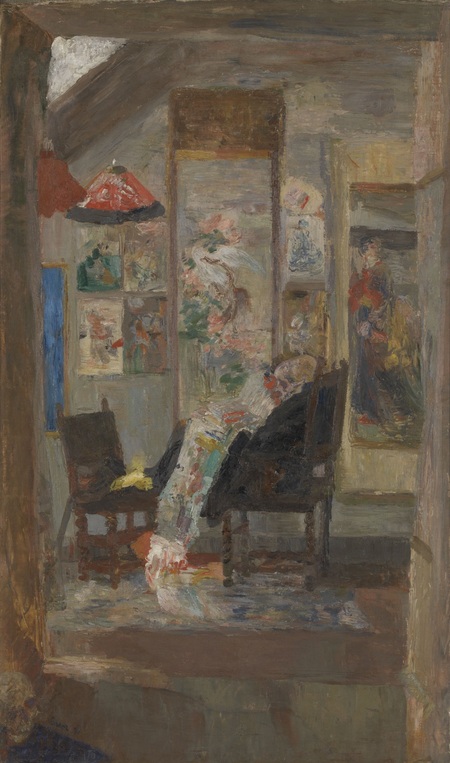
James Ensore. «Skeleton Gazing at Chinoiserie.» 1885, c. 1888. Museum of Fine Arts, Ghent, 1995-A.
Edvard Munch. «Self-Portrait with Skeleton Hand.» 1895. Lithograph. British Museum, London, 1949, 0411.4872.
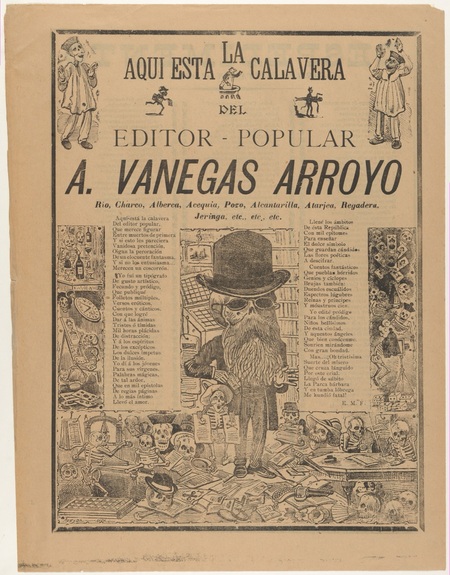
Jose Guadalupe Posada. «Skeleton of the People’s Publisher» (Antonio Vanegas Arroyo). Engraving. Metropolitan Museum of Art, New York, 46.46.293.
José Guadalupe Posada. Skeleton in a top hat, frock coat, and glasses. Sheet from «La Calavera de Cupido, ” published by Antonio Vanegas Arroyo. Circa 1892. Metropolitan Museum of Art, New York, 30.82.44.
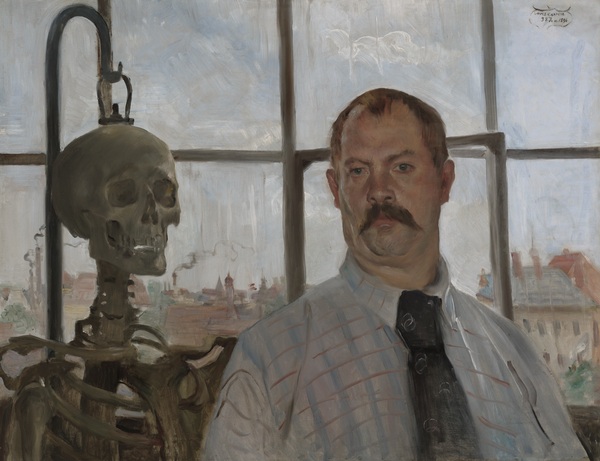
In a portrait, the skull is an old trope, and most often, it remains an object. In Mikhail Koksi’s portrait, painted around 1560 or later, the man places his hand on the skull [21]. Who is depicted is unknown. Based on the coat of arms, the museum suggests he is from Brussels, Leuven, or their vicinity [21]. The skull is separate from the man: the face, clothing, and coat of arms tell us who is before us, while the skull adds a contemplation of death.More than three centuries later, in 1896, Louis Corinth paints himself by a studio window next to a suspended skeleton [22]. The museum describes the skeleton as a studio prop and a symbol of transience. It notes that this juxtaposition was particularly timely in 1896: in 1895, Röntgen discovered his rays, and the first X-rays presented to the public showed the human skeleton, which says nothing about a person’s «inner values» [22]. The man and the skeleton stand side-by-side, but they do not merge.In 1978, Andy Warhol created several series of self-portraits featuring skulls [23]. In one such work from the ARTIST ROOMS collection, a skull is placed next to his face [24]. The National Galleries of Scotland link Warhol’s interest in death to the assassination attempt on him in 1968 [23]. Here, the skull is a neighbor, not a replacement for the face.
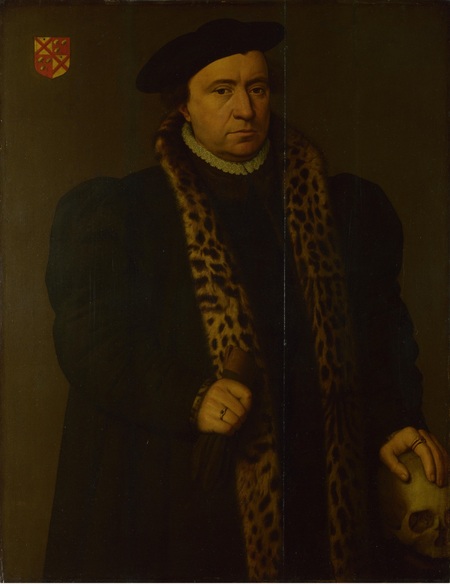
Mikhail Koks. «Man with a Skull.» c. 1560 or later. Wood, oil. National Gallery, London, NG195.
Lovis Corinth. «Self-Portrait with Skeleton.» 1896. Canvas, oil. Lenbachhaus, Munich, G 2075.
The second adjacent case is Death as a distinct character. Around 1526, Hans Holbein the Younger painted the series «Dance of Death.» Hans Lutzelburger cut the wood panels, and the book was published only in 1538 [25]. The skeleton claims people from all social classes. In the «Old Man» plate, it plays a string instrument and leads the elderly man with a cane to an open grave [26]. In the «Merchant» plate, it confronts the trader among bales against a backdrop of ships [27]. In the «Count» plate, the skeleton even has remnants of a cloak, but it does not become human because it is the one who has come for the human [25].This schema lives on three centuries later. In Thomas Rowlandson’s «English Dance of Death» from 1814, the skeleton appears from behind a curtain over an old husband, beside whom sits a young wife [28]. Alfred Rethel brought Death to a masquerade in 1850. According to the Cleveland Museum, the engraving «Death-Strangler» references the first outbreak of cholera at a masquerade ball in Paris in 1831 [29]. Death, in a cloaked hood, plays on bones as if on a violin, while guests in masquerade costumes lie around.Arnold Böcklin painted himself with a brush and palette in 1872, while a skeleton plays the violin behind his shoulder [30]. The museum interprets the painting not as a memento mori, but as a memento vivere—“remember life.» Death does not take the brush away from the artist; instead, it becomes his inspiration [30]. The artist and Death are two different characters in the same scene.The third case is the one to which this study is dedicated. The skull no longer lies nearby or stands behind. It appears in the place of the person’s own face, as in Ensor’s work. What is important next is to understand what happens to everything else—the clothing, the posture, the action, the identity. This is where the first section begins.