«The highest art consists in concealing itself» [14] Denis Diderot
Concept
One of the most ancient ways of «fixing» a person in time is the portrait. Visually, art has traditionally relied on depicting the face not merely as a physical likeness, but as a method to demonstrate the hero’s inner world—a symbol of their individuality, personality, social status, and emotional state. However, starting in the 19th century, a noticeable trend emerged in artworks: the abandonment of direct facial depiction or the conscious concealment of the face. Artists increasingly strip the subject of their primary marker of identity—the figure turns its back, dissolves into shadow, hides behind a mask, or sometimes the head is entirely cropped from the canvas.
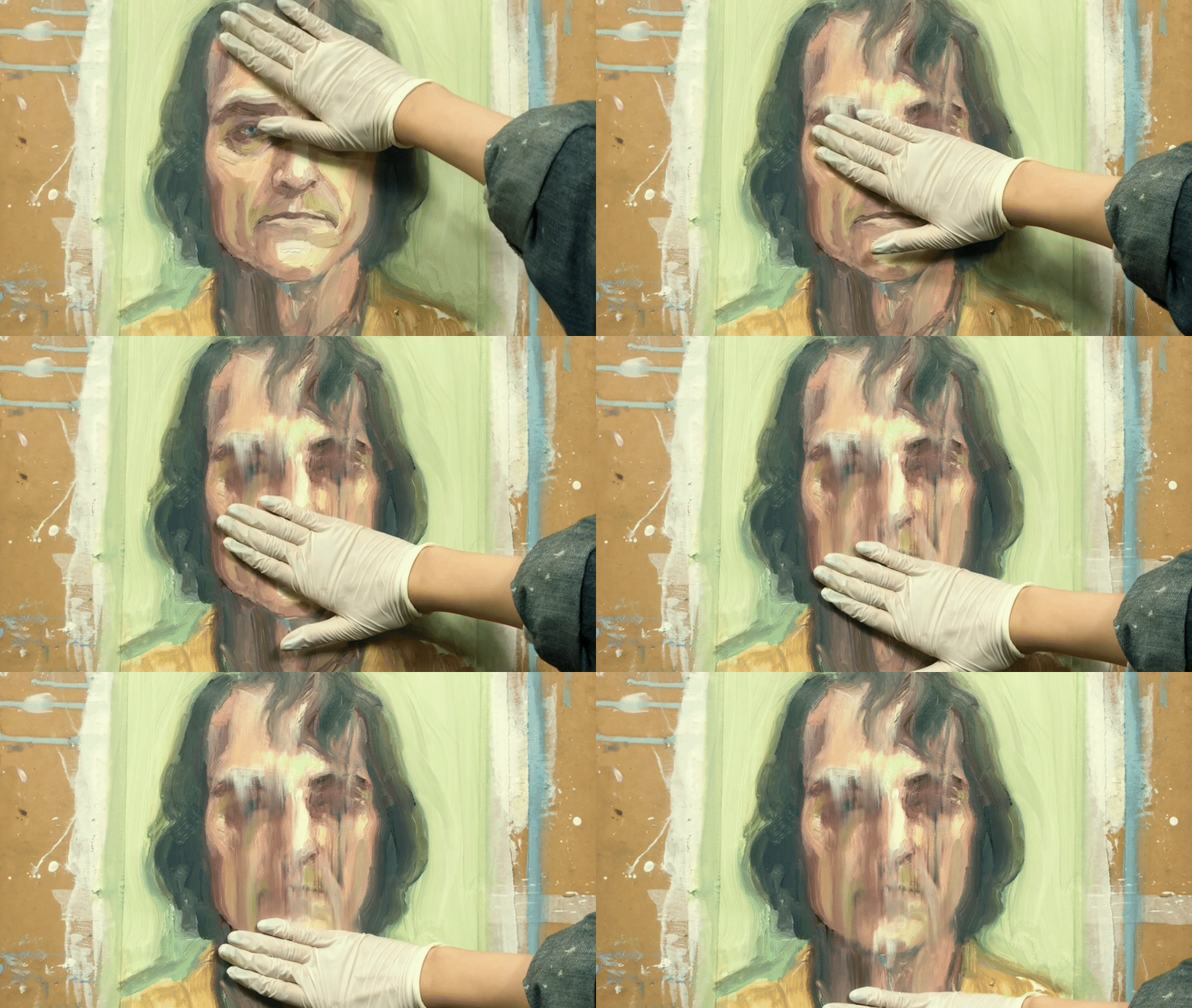
Carmine / Joker / 2019
In the age of social media, where one’s persona can be compared to a commodity, the question of what it means to be «seen» acquires an existential sharpness. Today, individuals exist in a space where they are easily identifiable (as a digital profile) yet invisible (as an anonymous unit within the vast virtual web). The digital era, mass culture, and globalization challenge traditional methods of self-expression and the perception of the individual. Therefore, in a modern world where issues of identity, privacy, and social masking are highly significant, the theme of the absence of direct representation of the self becomes particularly relevant.
What meanings are embedded in the conscious concealment of faces, and through what visual techniques do artists manage to depict them? These questions form the foundation of this research.
Having studied various ways of depicting distorted figures, one can conclude that the distinguishing features of their representation are not only artistic means but also the cultural and philosophical meanings they carry, as well as their psychological impact on the viewer. Thus, this phenomenon becomes more than just an aesthetic component or a provocation—it functions as a multifaceted symbol with a complex visual language through which creators attempt to express the inner conflicts of people and their era. A specific rendering of form allows the viewer to focus on the idea, emotion, or sociocultural context within which the key stages of identity deconstruction are examined.
Caspar David Friedrich / Wanderer Above the Sea of Fog / 1818
Based on this, a diverse selection of painting and graphic works from the 19th–21st centuries was chosen for a comprehensive analysis. These pieces allow us to trace various methods of facial distortion and the meanings associated with them. The material spans a wide chronological range and a variety of representational styles, which enables a deeper exploration of the theme and a better understanding of the visual techniques artists employed to convey their unique worldview, as well as the identification of possible patterns in the creators' work.
The geographic scope of this research encompasses the works of artists from various countries around the world, allowing us to examine the universality and diversity of methods used to represent the individual through the technique of obscured faces. The most significant and widely recognized artworks from different cultural and historical contexts were selected for analysis, reflecting the global nature of this visual phenomenon.
Francis Bacon / Three Sketches for a Portrait of Lucien Freud (Triptych) / 1969
The structure of this work is built upon typological categorization, which is based on isolating symbolic meanings. Each chapter explores a distinct aspect or motif underlying the absence of form in the work, allowing for both the systematization of visual material and the revelation of the phenomenon’s complexity. The analysis incorporated diverse sources of information to provide a credible and high-quality interpretation of the symbols, including scholarly works on art history, portrait theory, symbolism, and the philosophy of image, as well as research from museums and articles from open internet resources.
Chapter 1. The Symbol of Solitude and Contemplation
Gerhard Richter / Reading / 1994
The depiction of a hidden face in a portrait is often perceived as a metaphor for the inner world and introspection. This technique shifts the viewer’s focus from external features to a state of contemplation, reflecting the solitude and melancholy that become universal experiences in every person’s life. The gesture of withdrawing from visibility demonstrates a state of detachment and the eternal yearning for self-analysis. Artists whose work expresses this symbol often turn to images of a turned away figure, concealment by shadow, or dissolution into space, allowing the viewer to become a participant in the stillness, feeling detachment and pondering the unattainable.
Edward Hopper / Night Watch / 1942
Edward Hopper cultivates an atmosphere of urban solitude in his work. A brightly lit bar space isolates his figures against the backdrop of a vacant, unremarkable street. The rhythmically structured lines of the landscape and interior create an illusion of the characters being «caged» within a confined space, reminiscent of a cage, which underscores the contrast between the «inner» and «outer» worlds.
The artist evokes a sense of a frozen moment through the painting’s lack of pronounced depth and dynamism. Although all the characters are physically proximate, there is no emotional connection among them. The author deliberately separates the characters using color, placement on the canvas, and objects between them, revealing the symbolism of longing within a crowd.
Wilhelm Hammershøi / Interior with a woman by the window leaning on a chair / 1901 // Interior with a woman in an open doorway / 1913 // Interior with a young woman standing with her back to the viewer / 1904
Many artists have repeatedly turned to the motif of the faceless figure. For instance, Wilhelm Hammershøi creates numerous works depicting the same heroine, viewed from the back within a domestic interior, and this repetition of the subject transforms the anonymized figure into a symbol of contemplation and reflection.
The muted tones of the surroundings highlight the heroine’s contrastive, almost silhouette-like form, but the concealment of her face compels the viewer to look at the room itself. This minimalist, bright interior is also characterized by vertical lines and a lack of dynamism, rendering the composition geometric. The woman seems to become part of this environment, «dissolving» into it. On one hand, through this visual focus, the artist emphasizes themes of solitude; on the other, it creates a sense of subtle unease pervading the spacious emptiness, thereby allowing the viewer to project their personal thoughts and emotions onto the image.
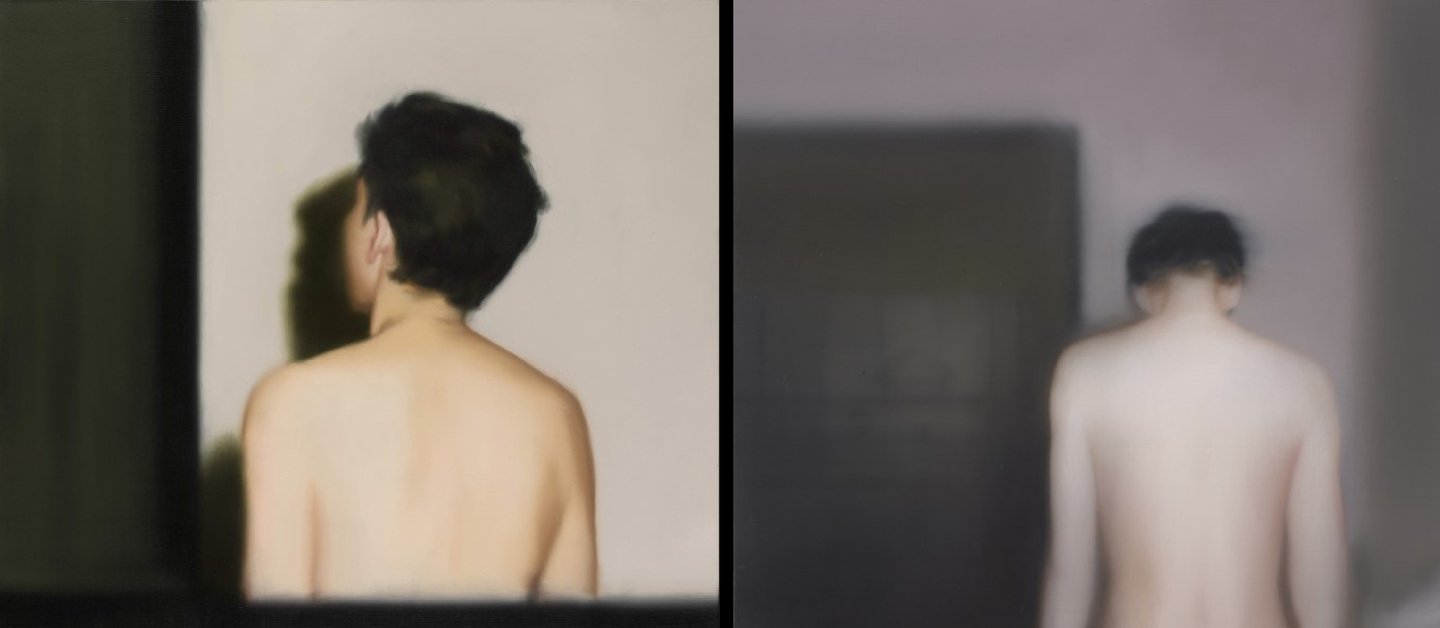
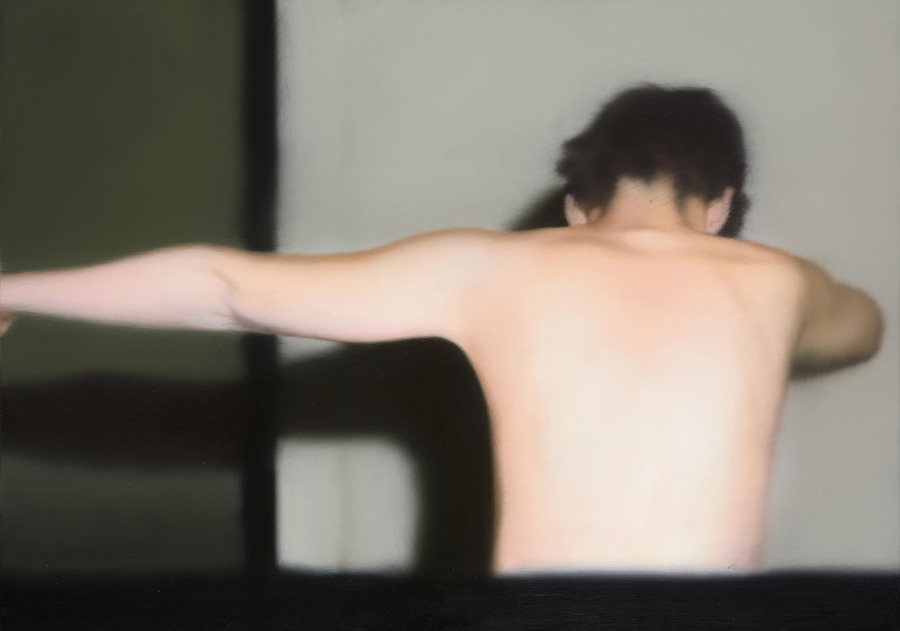
Gerhard Richter / I.G / 1993 / Series of Works
Richter also creates a series of works depicting the hero’s back. However, unlike previous artists, the artist brings the figure closer to the viewer, yet the viewer still cannot precisely discern the character’s emotions.
The paintings are dynamic, and the changes in the boy’s posture are clearly visible on each canvas. Working with loose, soft brushstrokes, Richter avoids creating sharp contours, conveying a calm and relaxed atmosphere.
The hidden face—a turned away pose, dissolution within an interior, or a light brushstroke—creates space for the viewer’s deep emotional projection. Rather than a definitive portrait, the identity of an enigmatic character prompts the audience to fill in the visual «blanks» with their own reflections and emotions.
Chapter 2. The Symbol of Vulnerability and Self-Defense
In exploring the theme of intrusion into personal space, artists also turn to the practice of avoiding direct depiction of physical forms. Various visual metaphors demonstrate the fragility of the human psyche. The creators employ fragmentation, masking, or deformation to illustrate a desire to hide from a judgmental society. Such images convey defense against intrusion and an attempt to maintain intimacy—a figure retreating into darkness, a face covered by hands, a lowered head, or a falling veil.
Ferdinand Hodler / Shepherd’s Dream / 1896 // Ferdinand Hodler / Shepherd’s Dream / 1896 / Fragment
In Hodler’s «Shepherd’s Dream,» the character’s vulnerability is emphasized by his posture—the shepherd is completely relaxed, his body is not tense, and his face is lowered onto his hand, which appears as a conscious refusal of defense. By highlighting the fragility of the human condition, the artist surrounds him with rounded, natural forms, a quality amplified by the pale, pastel color palette.
Gerhard Richter / Betty Obernürn / 1988 // Gerhard Richter/ Betty / 1977
Continuing to employ the technique of obscuring form, Gerhard creates portraits of his daughter. Although the subject matter is the same in both, the execution differs: in the first version, the viewpoint shifts, whereas in the second, the emphasis is placed on blurring details. The theme of vulnerability is underscored in both works through a muted, natural palette and the absence of sharp contours. In «Betty, ” the misty features create an impression of fragility and ephemerality, while in „Betty Wrapped, ” the pose reveals a sense of childlike innocence and immersion in her own „inner“ world—one that does not perceive surrounding reality.
Andrew Wyeth / Christina’s World / 1948
Artists, by expressing shame, fear, or trauma on canvas, transform the portrait into a visual metaphor dominated by the theme of unspoken things, often reflecting global human issues. When the viewer confronts these works, they assume the role of an intruder into personal boundaries, which intensifies the observer’s perception of the piece.
In the work «Christine’s World, ” Andrew Wyeth expresses symbolism through the contrast between fragility and tenacity: the expansive field emphasizes the defenselessness and isolation of the miniature girl, while the house becomes a metaphor for the unattainable. By meticulously rendering the surroundings—and especially the sharp grass—the artist reminds the viewer of the obstacles encountered along the path, and the overhead perspective further heightens the sense of vulnerability.
Chapter 3. The Symbol of the Mask-Persona and Social Role