Topics
- Concept
- Global Context
- How the Video Persuades
- What the Video Lacks
- Conclusion
- Bibliography
- Image Sources
Concept
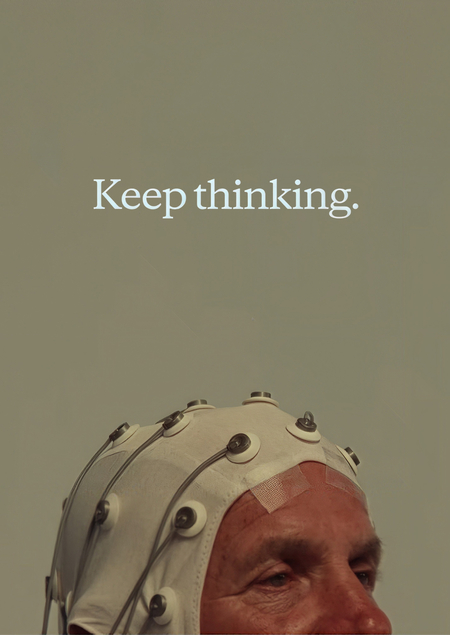
In September 2025, Anthropic launched its first major advertising campaign for Claude. At the heart of the campaign was the 90-second spot, «Keep thinking with Claude, ” produced by the London agency Mother and directed by Daniel Wolfe. Prior to this, the company had primarily grown through word-of-mouth, and the AI market was oversaturated with offerings. Therefore, this first campaign illustrates the message the brand chose for its audience from the many possibilities available.
The promotional video for this technology is unusual: it addresses a problem and its solution rather than simply listing product benefits. It is built around a single plot twist that instantly shifts the viewer’s mood. I remember this video from the first time I saw it—both for its visuals and its slogan, «Keep thinking"—which is why I decided to analyze it and break down how such a short advertisement achieves such a powerful effect.
All visual material was sourced from a single origin—the promotional video itself. For the long-form piece, I selected only the shots that best illustrate the technique being described, such as text overlays, key scenes, and final credits.
The primary source is the commercial video itself—the entire analysis is built upon it, and I verify every conclusion using it. To understand the context in which the video was released, I refer to secondary sources: the company’s website, professional critiques, the project description, and other materials related to the advertising campaign.
The analysis moves from the general to the specific: first, the video is placed within the context of the market and the company itself, and then it is dissected internally. The central element of this deconstruction is the main technique—the contrastive transition. The other techniques are grouped not chronologically, but by the role they play alongside the central transition: some prepare for the transition, others help it land effectively at the right moment, and a third group reinforces the impact. This structure allows the video to be perceived as a cohesive system that affects the viewer’s emotions. A separate chapter is dedicated to the video’s weak point: I examine what the advertisement omits and what that might mean for the brand. The evaluation is placed at the end of the visual analysis so that the critique of the techniques does not become intertwined with the analysis itself.
Why does this video have such a strong impact on the viewer, and what techniques did the creators use to achieve this?
My hypothesis is that this commercial is effective due to its contrasting transition. The transition itself lasts about one second, and the viewer’s mood abruptly shifts from anxiety to hope. The other visual and audio effects in the spot either set up this transition or reinforce its impact. I will attempt to confirm or refute this in my visual study.
f