Concept
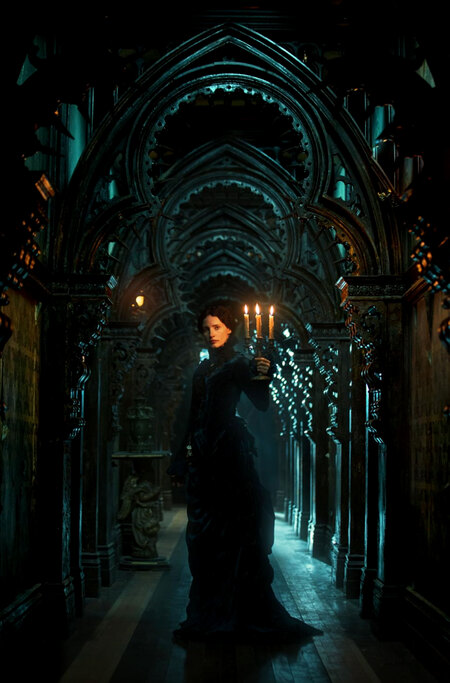
«Crimson Peak» by Guillermo del Toro presents an interesting subject for visual analysis due to the close connection between its aesthetic design and narrative. The story of Edith, who finds herself in the antique Sharpe estate and gradually uncovers its secrets, unfolds through color, costume, architecture, and framing. These elements guide the viewer’s attention, shape the initial perception of the characters, and allow the audience to feel a sense of threat before its origins become apparent. The film was chosen because it offers an opportunity to trace how distinct visual details coalesce into a cohesive story about concealed violence, family memory, and dependence on the past.
The study focuses on the interplay between three components of the film’s visual language: the color palette, costume, and space. Considering them together allows us to establish connections between the characters' outward appearance and their surrounding environment. The comparison between Edith, Thomas, and Lucille becomes particularly significant: the heroine’s arrival in Allerdale Hall allows for an exploration of how imagery signifies belonging to the house or estrangement from it. Color contrasts, clothing silhouettes, fabric textures, and recurring shapes can serve as markers of these relationships, shifting alongside the viewers' perception of the characters.
Navigation:
• Concept
• Color Dramaturgy
• Character Image Through Costume
• Alderdale Hall: Home as Body and Carrier of Family Trauma
• Conclusion
Key research question: How do color, costume, and space in «Crimson Peak» reveal the hidden relationships between the characters and transform the family past into a visible threat? A secondary question relates to the sequence of information disclosure: Which details become significant upon the first viewing, and which only become clear after the Sharp family’s secret is uncovered?
The working hypothesis posits that the color palette, costumes, and architecture form a unified system of visual cues that foreshadow the unfolding of the plot. It is presumed that the contrast between life and decay, as well as the visual alignment of the Sharps with their mansion, helps convey the past’s dominion over the characters. In this system, the house becomes the material expression of the family history—its decay, confinement, and hidden spaces correspond to the relationships of its inhabitants. The research must determine how consistently this connection manifests in the film and how it evolves as Edith progresses toward solving the mystery.
The analysis will involve contrasting wide shots, which establish the characters’ spatial placement, with close-ups that reveal details of costumes or interiors. Color will be examined in relation to lighting, the size of the color patch, and its surroundings. When studying costumes, attention will focus on silhouette and the symbolism of the ornamentation. The house analysis will cover architectural forms, the state of surfaces, and the organization of space through composition, angle, and camera movement.
Color Dramaturgy
The color palette of «Crimson Peak» is built upon the interaction of golden, blue, greenish, and red hues. Their combinations signify differences between spaces and characters, generate tension, and connect events spread across time. Cinematographer Dan Laustsen notes that the saturated orange, steel blue, and cyan tones were part of the initial concept. The warm, directional lighting and the cool nighttime illumination were developed even before filming and remained largely unchanged during post-production. Thus, the film’s color organization was shaped directly through the lighting and the artistic composition of the frame. [6]
Two Spaces: Buffalo and Allerdale Hall
Guillermo del Toro, «Crimson Peak» (2015)
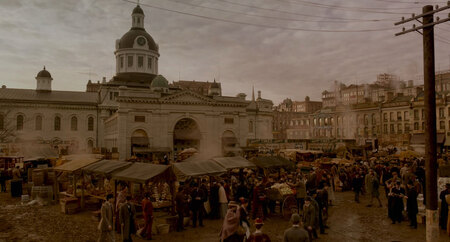
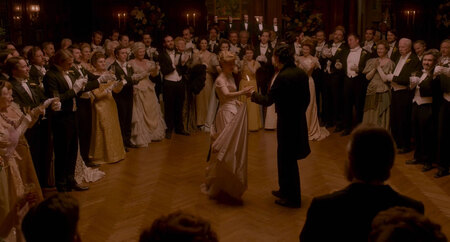
The difference between Edith’s life in Buffalo and her time at the Sharp estate is expressed through the shift in color environment. Golden and amber tones hold a prominent place in the domestic and social interiors of Buffalo. The warm light unites faces, fabrics, and furnishings, creating an impression of a lived-in space. In this setting, Edith’s light-colored clothing is perceived as an integrated part of her surroundings.
Guillermo del Toro’s «Crimson Peak» (2015)

Guillermo del Toro, «Crimson Peak» (2015)
However, as Edith’s father began uncovering the dark secrets of the Sharp family, the color palette shifted to something more unsettling and frightening. In the shot where the father reads information from the detective, Edith’s bright, warm figure in the background is masterfully depicted as the sole ray of light, while the father’s figure is drenched in a cold cyan-green light with a red reflection.
Guillermo del Toro, «Crimson Peak» (2015)
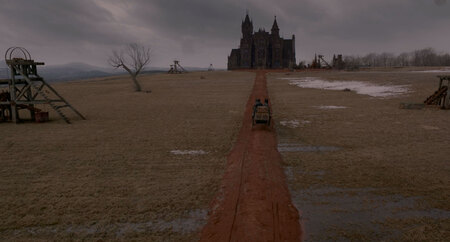
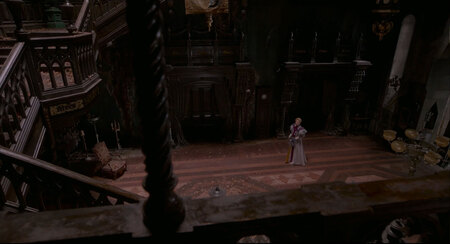
After moving into Allerdale Hall, the relationship between the figure and the background shifts. The dark surfaces, cold light, and blue-green hues of the interior amplify the contrast with the heroine’s warm palette. Edith becomes a distinctly visible color patch within the large space. This isolation can be interpreted as a sign of her foreignness to the home—she is present in it, but visually does not belong to its world.
Guillermo del Toro, «Crimson Peak» (2015)
Guillermo del Toro, Crimson Peak (2015)
Color as a signifier of life and belonging
The golden and yellow tones of Edith’s character take on added meaning through their recurrence. Costume designer Kate Howell links the heroine’s warm, vibrant colors to life and abundance. Lucile, in contrast, is conceived as a figure visually connected to the bleak, sterile environment of Allerdale. This juxtaposition allows the character palette to be viewed as part of the broader conflict between vital force and decay.In the estate, the yellow of Edith attracts the eye not only through its saturation but also by its placement amidst the cooler, darker areas of the frame. It helps keep the heroine in the center of attention even when the architecture dominates the image. Meanwhile, the small scale of the vibrant figure relative to its surroundings makes her isolation particularly palpable. The color simultaneously emphasizes Edith’s vitality and her vulnerability.
Guillermo del Toro’s «Crimson Peak» (2015)

Guillermo del Toro’s «Crimson Peak» (2015)
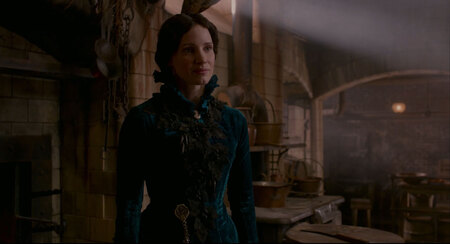
Lucile’s dark blue clothing, by contrast, integrates her with the interior. A smaller color distance develops between the figure and the background, causing the heroine to be perceived as an extension of the home. This relationship precedes the full revelation of her story: the viewer does not yet know all the circumstances, but already sees that Lucile and the estate form a single entity.
Guillermo del Toro, «Crimson Peak» (2015)

Guillermo del Toro, «The Crimson Peak» (2015)
However, the characters' color palettes are not static. Lucille appears in Buffalo in a red dress, which makes her a striking figure in high society. In Allerdale, dark clothing reveals another facet of her persona—her belonging to her family’s insular world. Changes in the color environment allow for a reinterpretation of the protagonist’s initial impression.
Red: From Attraction to Violence
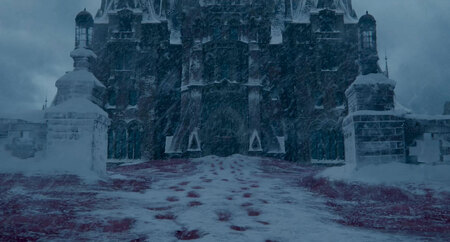
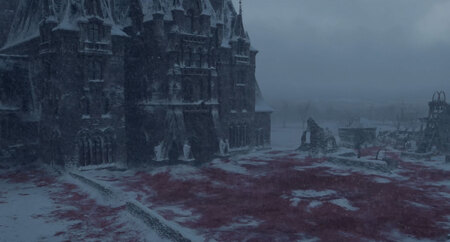
The color red plays a fundamental role in the film, unifying several key elements: Lucille’s dress, the clay on the estate grounds, the blood, and the ghostly figures. Appearing across different materials, it establishes a visual connection between the human, the architecture, and the house’s hidden history.
In Lucille’s initial appearance, red is incorporated into an image of aristocratic luxury. The saturated fabric sets the protagonist apart, imbuing her presence with expressiveness. At this stage, the color can be interpreted as representing allure, power, and emotional tension. Later, as red is more insistently linked to violence and its consequences, the initial image takes on a sinister undertone. The meaning of the detail shifts as the viewer’s understanding evolves.
Guillermo del Toro, «Crimson Peak» (2015)
Guillermo del Toro, «Crimson Peak» (2015)
Red clay plays a particularly significant role. Within the narrative, it explains the unusual appearance of the estate and the surrounding land, yet its color and fluidity simultaneously evoke associations with blood. The house takes on a semblance of physical trauma: red seeps through the surfaces, as if what is hidden inside can no longer be contained. This interpretation links the physical decay of the building to the gradual uncovering of a family secret.
Guillermo del Toro’s «Crimson Peak» (2015)