Navigation Menu
Research Concept Three Ways to Age a Face «Dracula» (1992) «The Curious Case of Benjamin Button» (2008) «Then. Now. Next» (2024) Comparison Conclusion
Research Concept
Aging faces—one of the most challenging tasks in cinema. Viewers see faces every day and quickly detect artifice, yet the actors are often much younger than their characters. Over 32 years, film has transitioned through three methods of simulating age: prosthetic makeup, digital de-aging, and AI-driven face replacement.
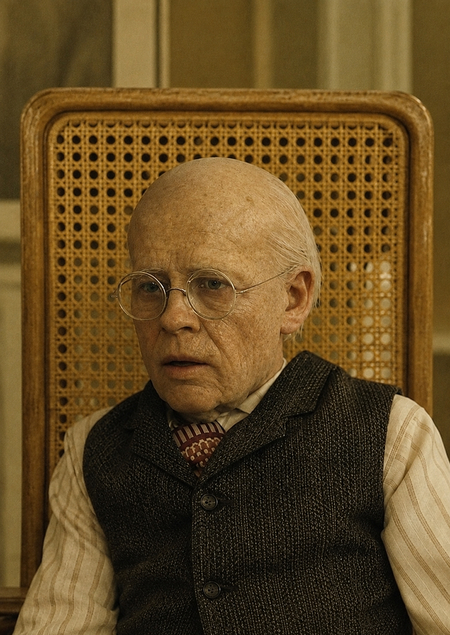
In Francis Ford Coppola’s Dracula (1992), the character’s age was achieved using physical prosthetics applied to the actor’s face. In David Fincher’s The Curious Case of Benjamin Button (2008), Brad Pitt’s head was digitally replaced across 325 frames. In Robert Zemeckis’s Then. Now. Next. (2024), an artificial intelligence network alters the actors' faces, and the results are visible directly on set.
There is a 16-year gap between these films, but the core challenge remains the same: to portray a character in a close-up who is significantly older or younger than the actor portraying them. This allows for a clear examination of what each technological shift accomplished.
The visual material includes only footage where the age is created via effect, as well as tests and intermediate stages of the process that explain the final result. Plot, costumes, and set design are not discussed.
Initially, the overarching objective of the films is presented. Subsequently, each film is analyzed using a single framework: the objective, the method used to achieve it, the result in the footage, and any lingering issues. Finally, the films are compared based on shared criteria.
The foundation of this research consists of relevant English-language publications and interviews with the individuals responsible for the effects. Where sources contradict each other, all versions are presented. A complete list of sources is provided at the end of this work.
Key Question
How have character aging technologies evolved?
Hypothesis
Each new technology solved the problems of the previous one, but introduced its own. Makeup required hours of work every shoot day and poorly conveyed skin depth. The digital head isolated the actor from their scene partners. The neural network returned the actor to the frame, but it makes mistakes with age and gaze. Therefore, makeup didn’t disappear—it became the foundation for digital refinement.
Three Ways to Age Your Face
Stills from the films «Dracula» (1992), «The Curious Case of Benjamin Button» (2008), and «Then. Now. Next.» (2024).
The task is the same in all three shots. You need to show a very old person in a close-up, played by a much younger actor. The shots are similar but created using different materials: foam latex, a digital model, and an AI-generated image.
Stills from the films «Dracula,» 1992, «The Curious Case of Benjamin Button,» 2008, and «Then. Now. Next,» 2024.
In 1992, a young person’s face needed little alteration to look youthful. In 2008 and 2024, age correction has become a distinct digital challenge because it requires removing age from an already captured image.
The scale also differs. The original Dracula required about 20 days of daily makeup application. In «The Benjamin Button,» the digital head spans 325 frames, approximately 52 minutes. In «Then. Now. Later.,» the complete face replacement accounts for 53 «character minutes» across four actors, with individual shots lasting up to four minutes. Twenty days of makeup application is manageable for one actor, but dozens of minutes of screen time require a production pipeline.
«Dracula» (1992)