Random Art…
Abstract Expressionism is an international art movement that does not prioritize beauty or realism. Instead, it seeks to show the presence of emotion itself. It emerged in the United States in the 1940s, gave New York the status of an art capital, and changed the very idea of fine art: in this movement, a painting is not a window onto reality, but a mirror of the artist and a record of the act of creation.
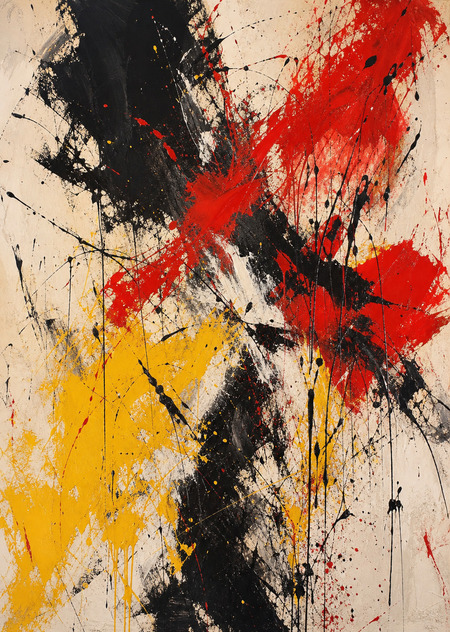
The main focus of Abstract Expressionism is emotion. It hardly matters what the image looks like. An Expressionist painting may consist only of drops and splashes of paint, like the works of the famous Jackson Pollock. These pieces of art bypass the conventional sense of beauty and trigger something deeper — subconscious feelings and a crystallized connection with the artist. Instead of a traditional feeling of beauty, these works appeal to a completely different impulse: a deep, primal attraction to chaos.
Another key aspect of Abstract Expressionism is randomness. In earlier periods, artists tried to depict reality as it was; randomness was considered a mistake and a sign of poor skill. In Abstract Expressionism, however, randomness becomes a feature. Emotion is chaotic by nature. It is impossible to create two identical works using Expressionist techniques such as dripping. One reason for this embrace of randomness was the invention and development of photography. Why bother creating a photorealistic painting if the camera already exists?
…for Random People
Number 1A, 1948 by Jackson Pollock — a central figure in Abstract Expressionism — is not a painting in the traditional sense, but a record of an inner moment. His drip-painting technique removes the distance between the artist and the canvas. He does not simply paint; he acts within the painting. It is like watching an inner, tormented child. He radicalizes the idea of painting and turns it into a performance.
In contrast, Orange, Red, Yellow (1961) by Mark Rothko seems almost still. But this stillness is deceptive: the large fields of color begin to work on the viewer’s perception and create a state close to meditation or inner anxiety. It is not an image of color, but its psychological pressure. This type of work is often called Color Field painting. Rothko works differently: he slows the viewer down and asks them to enter the color. His paintings are often seen as spiritual experiences, but there is also a hidden severity in them, because they demand prolonged and sometimes exhausting attention.
Woman I (1950-1952) by Willem de Kooning, a pioneering Dutch-American artist and one of the leading figures of Abstract Expressionism and the New York School, shows that even the human figure can survive in this abstract chaos — but only in a deformed and tense form. The image does not disappear; it becomes something almost monstrous.
Conclusion
But if we like, love random drops of paint on canvas and prey on them, do we need an author anymore?
Гринберг, К. Искусство и культура: статьи о модернизме и авангарде / К. Гринберг. — Москва: V-A-C Press, 2024. — 320 с. (объем условный, подставь реальный).
Rosenberg, H. The Tradition of the New / H. Rosenberg. — New York: McGraw-Hill, 1965. — 320 p. (объем условный, подставь реальный).
Abstract Expressionism [Электронный ресурс] // The Metropolitan Museum of Art. — Режим доступа: https://www.metmuseum.org/essays/abstract-expressionism (дата обращения: 01.06.2026).
Google Images