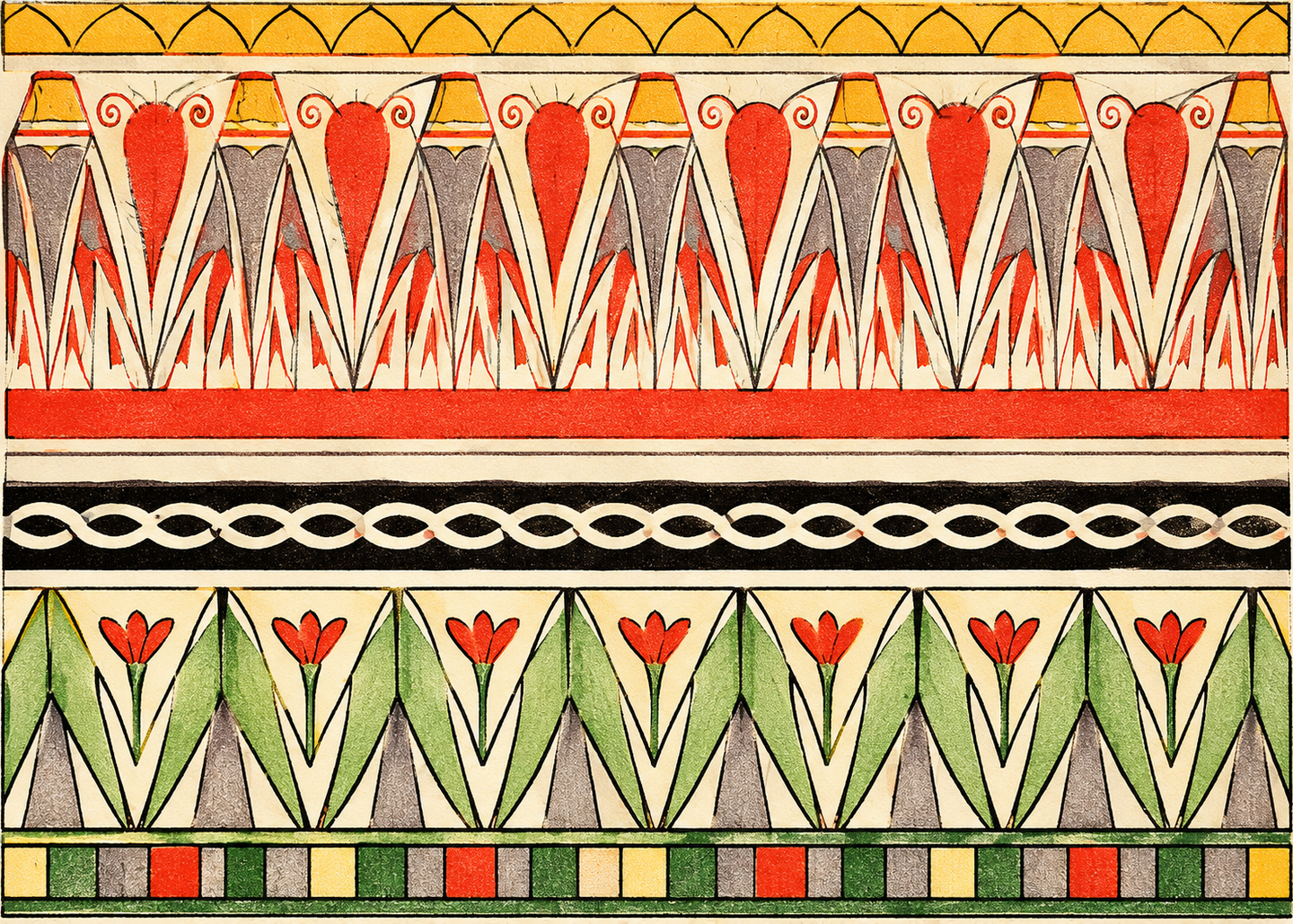
Визуальный язык древнеегипетского орнамента
Природные и предметные истоки
Navigation
1. Concept and Hypothesis 2. Sources of Ornamental Forms 3. Contour, Line, and Motive Structure 4. Rhythm, Symmetry, and Repetition 5. Ornament and Decorated Surface 6. Motif Comparison and Conclusions 7. Bibliography and Image Sources
Concept
Ancient Egyptian ornamentation is intriguing due to the combination of recognizable natural motifs and a strict compositional organization. While one can see a connection to the plant world in the colors, buds, and leaves, these forms within the decorative composition are governed by symmetry, repetition, and alternation. The curve of the stem acts as a connecting line, the petal as a repeating element, and the opened flower as the center of the symmetrical composition.
I am interested in how this transition occurs: which characteristics of the original form are retained, which are simplified, and how an individual motif becomes part of the larger pattern. Special attention in the research will be paid to the contour, the direction of the lines, the internal division of elements, and the spaces between them. This approach allows the ornament to be examined through specific visual solutions that compose its design. The research also addresses the relationship between the ornament and the surface it adorns. A single motif can exist as a standalone image, repeat along the edge of an object, or be incorporated into a composition that fills a large plane. Comparing these variations will help determine how the arrangement of the pattern relates to its scale, direction, and rhythm.
Hypothesis
It is suggested that the connection between ancient Egyptian ornamentation and its sources manifests not only in the superficial similarity of individual images but also in the principles of their composition. In plant motifs, the characteristic silhouette of the flower, the direction of the stem, and the arrangement of petals may be preserved. In motifs related to the material environment—the joining of parts, the structure of sheaves, fringes, or the sequence of decorative elements. When these forms are transformed into ornament, some features are emphasized, others are simplified, and the elements are subordinated to symmetry, repetition, and the boundaries of the surface. Therefore, even a stylized drawing can retain the characteristics of its natural or material source.
1. Sources of Ornamental Forms
Ancient Egyptian ornament evolved under the influence of the natural environment, the distinctive characteristics of the culture, and the artistic concepts of the ancient civilization. Among the earliest decorative elements were simple geometric shapes and stylized depictions of the surrounding world. Gradually, plant motifs began to dominate the ornament, with the lotus, papyrus, and palm holding particular significance.
Ancient Egyptian ornament with motifs of flowers and buds
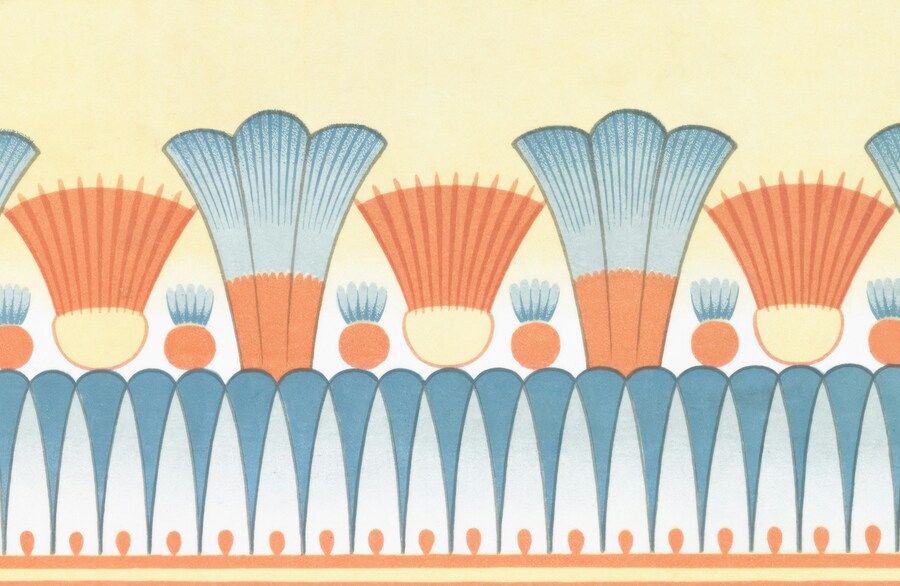
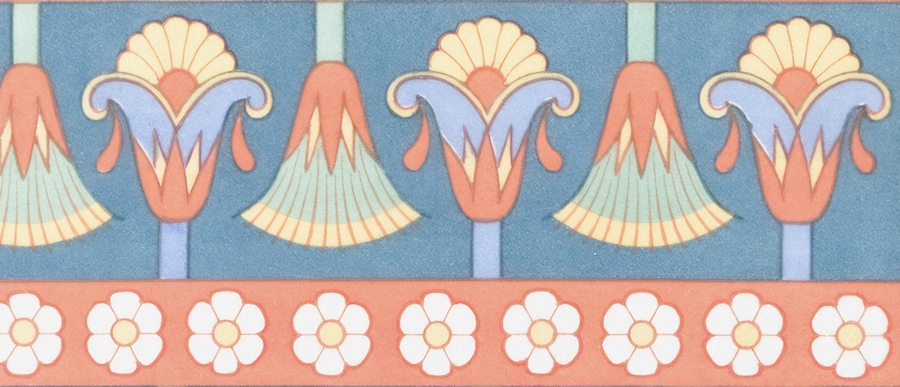
Floral pattern with lotus blossoms
Ornament
Ornamentation
Ornament
Ancient Egyptian ornamentation developed under the influence of the natural environment, cultural particularities, and the artistic concepts of the ancient civilization. Early decorative elements included simple geometric forms and stylized depictions of the surrounding world. Gradually, plant motifs began to predominate in the ornamentation, with the lotus, papyrus, and palm holding a special place. The first compositions were characterized by simplicity and linearity. Individual elements were arranged sequentially, forming decorative bands. Over time, these motifs began to combine, become more complex, and form more diverse compositions.
Nature became one of the primary sources of inspiration for Egyptian decorative art. The flora of the Nile Valley provided numerous forms that gradually evolved into enduring ornamental motifs. Special attention was given to the lotus, papyrus, and palm. Plant characteristics—leaflet shape, stem curvature, and leaf arrangement—were simplified and transformed into decorative elements. Natural representations gradually lost their realism, acquiring a more stylized and organized character. Individual motifs could be repeated, alternated, and connected to one another, forming complex botanical compositions.
In ancient Egyptian art, geometric, vegetal, animal, and combined types of ornamentation can be identified. Their distinguishing characteristics were a clear organization of space, symmetry, rhythm, and the repetition of elements.
The ornamentation gradually grew in complexity through the combination of various motifs. Individual flowers, leaves, and geometric shapes evolved into cohesive compositions. Linear structures, decorative bands, and borders played a significant role. Even with intricate patterns, a distinct sense of order and visual harmony was maintained.
Stylization held particular significance—the transformation of real forms into simplified, decorative images. This allowed natural motifs to become independent elements within the artistic system.
Ornament was utilized across various disciplines of ancient Egyptian art: architecture, mural painting, ceramics, jewelry, and household object design. Decorative motifs adorned the columns, temple and tomb walls, ceilings, vessels, furniture, and ornaments.
However, the character of the ornament depended on the material and the object’s form. On architectural surfaces, large plant compositions and extended decorative bands appeared, while jewelry utilized smaller, more detailed elements. The same motif could change depending on how it was depicted and where it was placed.