Genetic (Pink) Lake
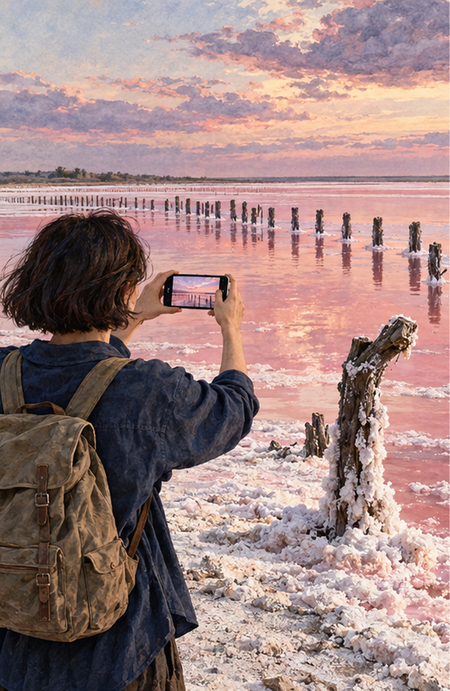
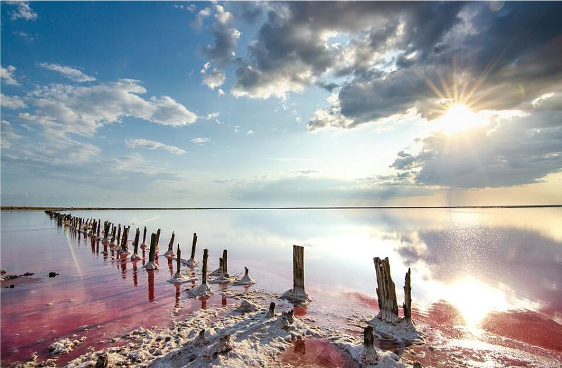
— Genicheskoye Lake—the largest in the Genichesk group, covering 9.2 sq km, is located in the north of the Arabatskaya Spit, near the Priozyornoye settlement. In the summer, the water turns pink due to the microalgae Dunaliella. Since 1840, a salt mining operation run by General Meshkov has been active here: producing up to 50 thousand tons of salt and employing up to 2,000 seasonal workers annually. The wooden posts in the water are remnants of the salt basin enclosures.
Essay
The Genichesky Lake has a main character, and oddly enough, it isn’t the color. Although the color, one must admit, makes an effort: in the summer, the water here is genuinely pink, without filters. The secret lies in the Dunaliella salina microalgae, which lives in the brine and accumulates beta-carotene—the same kind found in carrots. The lake is the largest in the Genichesk group, covering 9.2 square kilometers. It is located in the north of the Arabatskaya spit, near the village of Priozernoye, and people come here primarily for one shot: the pink water, the white salt, and the rows of wooden pilings encrusted with crystals.
And a question almost no one asks: who erected these columns? In 1840, General Meshkov established the largest salt works in the district on the lake. Local historian Vitaliy Pixulya writes that the general’s hydraulic structures and the layout of his pools are still considered exemplary. Up to fifty thousand tons of salt were extracted here, and samples were transported to exhibitions in Brussels. History has carefully preserved the general’s name. Then Pixulya adds a line that I, to be honest, stumbled over: «not counting permanent workers, up to 2,000 seasonal workers were employed in salt extraction in some years.»
Two thousand people! They came for the summer, breaking salt, loading it into carts, and rolling across wooden planks. And not a single name. There is one general, and he exists, but there are two thousand of them, and they don’t. Or rather, they do exist—you just have to look elsewhere.
In the mid-20th century, a new saltworks was built in Priozernoye. It operated until the early 2000s, and now only the factory ruins remain. The remnants of the wooden racks—the barriers for the salt basins—still stand in the water. Those are the posts from the postcards. It turns out the most popular backdrop for photos along the entire Strelka is the trace of someone’s workday.
So, when you get to the lake, do one thing before taking out your phone. Go up to the row of pillars—but don’t break the salt formations—and walk along it from the first to the last, counting out loud. That’s the route for one car. Only then should you start shooting, but title the shot not «pink lake, ” but „this is where the work was done.“
Legend
The Genetic Lake is located in the north of the Arabatskaya Spit, near the settlement Priozernoye, and it is pink in the summer. Not merely «slightly rosy at sunset, ” but truly pink—like diluted cranberry juice. Its shore is white and crunches underfoot, much like March frost, but this is not snow—it is salt—and the scent here is not of the sea, but something pharmaceutical, iodized, which causes a slight tickle in the throat. The water is ankle-deep, yet it seems bottomless because the sky lies entirely within it. And stretching across everything, from the shore to the horizon, are rows of wooden posts thickly encrusted with salt, as if they had been dipped in sugar glaze. People come here for these posts. Lida came for them too.
She needed twelve images for her first-ever photobook. The layout was due to the print shop at nine in the morning, but she had already printed the cover—it was on thick cardboard and already displayed «Lidia Orlova. Pink, ” even though there weren’t any interior pages yet. I know, I know, that’s not how you do it. But you should have seen how beautifully the name looked.
One road led from the stop to the water—a road that crossed the entire village, passing by low, white houses and fences bleached by the sun. At the last gate, thirty steps from the shore, an old woman in a headscarf sat at a small table, selling salt in jars. The salt was coarse and pinkish, resembling crushed quartz. Lida picked one up for the shot, and as she counted out the change, she nodded toward the water:
— Why are there those columns? Did you put them there just for looks? The old woman looked at her in a way that made Lida regret asking. — For aesthetics. You’d say the same. Sit down, the tea is getting cold. Her name was Marfa. Her tea was from a pot wrapped in a towel—dark and sweet—and it came with cookies that you just couldn’t refuse.
«We used to get salt here, ” Marfa said. „A long time ago, back when the general was around, about two hundred years ago. It was the biggest industry in the entire area. Every summer, up to two thousand seasonal workers would come. They stood there, knee-deep in brine, harvested it, and loaded it onto sleds to carry it to the shore. And these posts of yours—they’re left over from their enclosures.“
She pulled a yellowed photograph with a torn corner from under the paper. A crew on the oil field: trucks, wooden decking, more than twenty people squinting against the sun.
— My grandmother, Ulyana. Prokhor, with his tied finger, was talking about him. Darya, the neighbor, was on the right. There were twenty-three people, but I only know three. In the office, you see, they wrote full names and surnames, but nobody wrote these people’s names. On the back, the names were written in pencil, and a corner was torn off. — Marfa flipped the card over. Only the beginning of the word survived at the torn edge: «Ste…» — This is about him, the one with the cart, fourth from the left. And nothing else.
— And what happened to them after that? — Lida asked, more out of politeness. She looked over Murphy’s shoulder: the light above the lake was becoming low and warm, the very light she had driven to see.
The columns were perfectly straight, like drawn with a ruler, but one—the nearest one—was crooked and thickened with growths, leaning to the left and ruining the entire row. Lida took the shot, opened the editor, and deleted it with a single swipe of her finger. It was perfect. Behind her, a wheel creaked.
Lida picked up her phone and became frustrated. The lake was pink in person—there was no arguing with that. But on the screen, it looked either brown or gray, like tea into which milk had been accidentally poured. She cycled through the settings, increased the saturation, and selected a filter. The pink appeared, but it looked kind of artificial, like something from a store. «Okay, I’ll fix it at home, ” she decided and started working on the composition.
Lida smiled the way people smile when they don’t want to argue, thanked her for the tea, and slung her backpack over her shoulder. — Don’t be mean to Stolbiki, — Marfa said to her back.
«But nothing has changed. They are here.» Marfa nodded toward the water as if she were discussing neighbors. «Salt preserves everything. It preserves fish, it preserves cucumbers—and it preserved them. We say this here: if you haven’t logged someone, they haven’t gone anywhere; they stand in the lake by their little marker. As long as the marker is in place, they are at rest. But if you offend the marker, rip it out, or do anything like that, it will come onto the shore and wander until sunset, looking for where it was taken.»
By evening, the wind subsided, and the lake became as smooth as glass. Near the shore, where the water was shallow, it was transparent, revealing a white bottom fractured with small cracks. Further out, the color deepened, and by the center, the pink turned almost crimson. Each column stood on its own reflection, which made the rows appear twice as long. It was so quiet that one could hear the crackling of the drying salt crust.