Research Concept.
Sculpture holds immense significance in the world of art. It preserves memory, conveys emotion, and, most importantly, functions as a symbol, shaping the identity of different eras and cultures. Nok culture sculpture allows us to understand that art existed in Africa in deep antiquity. Its meaning lies not only in beauty but also in demonstrating how humans sought to imbue figures with symbolic meaning—to communicate about their society and traditions. This study is dedicated to examining the symbolism, proportional characteristics, material, and the place of Nok sculpture within the world of art.
Research Question and Hypothesis.
Key Question: How did the Nok culture sculptors employ geometry, distortion of anatomical proportions, and material characteristics to create evocative human figures, and how can these principles be reinterpreted in contemporary sculpture?
Hypothesis: It can be proposed that the visual aspect of Nok sculpture is based not on correct anatomy, but on the conscious distortion of proportions, geometric simplification, and the detailed rendering of individual body parts, in order to establish a unique plastic language that conveys the identity, character, and distinctiveness of the people.
The research is divided into several parts. First, I plan to examine Nok sculpture in terms of its visual characteristics and technique. Then, I will study the sculpture’s symbolism. Finally, I will look for parallels and compare the Nok sculpture with other figures.
For my research, I will use images from the Louvre and academic articles from The Metropolitan Museum of Art. Nok Terracottas[1], Nicole Rupp, Peter Breunig, Stefanie Kahlheber. Exploring the Nok Enigma. Antiquity Project Gallery[2], Tanja M. Männel, Peter Breunig. The Nok Terracotta Sculptures of Pangwari. Journal of African Archaeology[3], Kira Jones. Nok Sculptures. Mellon Object-Centered Research Fellowship, High Museum of Art[4], Alice Apley. Ife Terracottas (1000–1400 A.D.). The Metropolitan Museum of Art.[5]
Image Features.
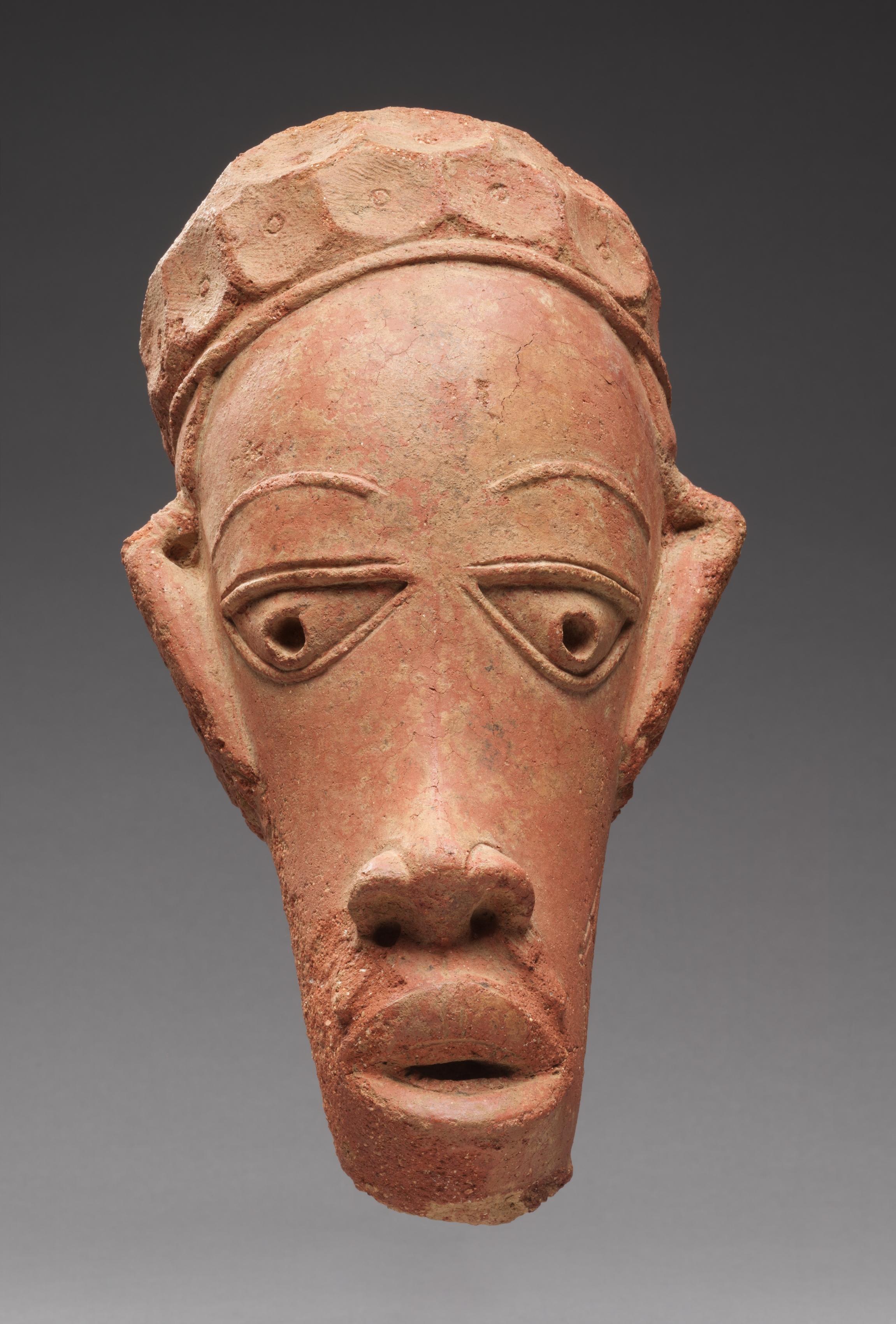
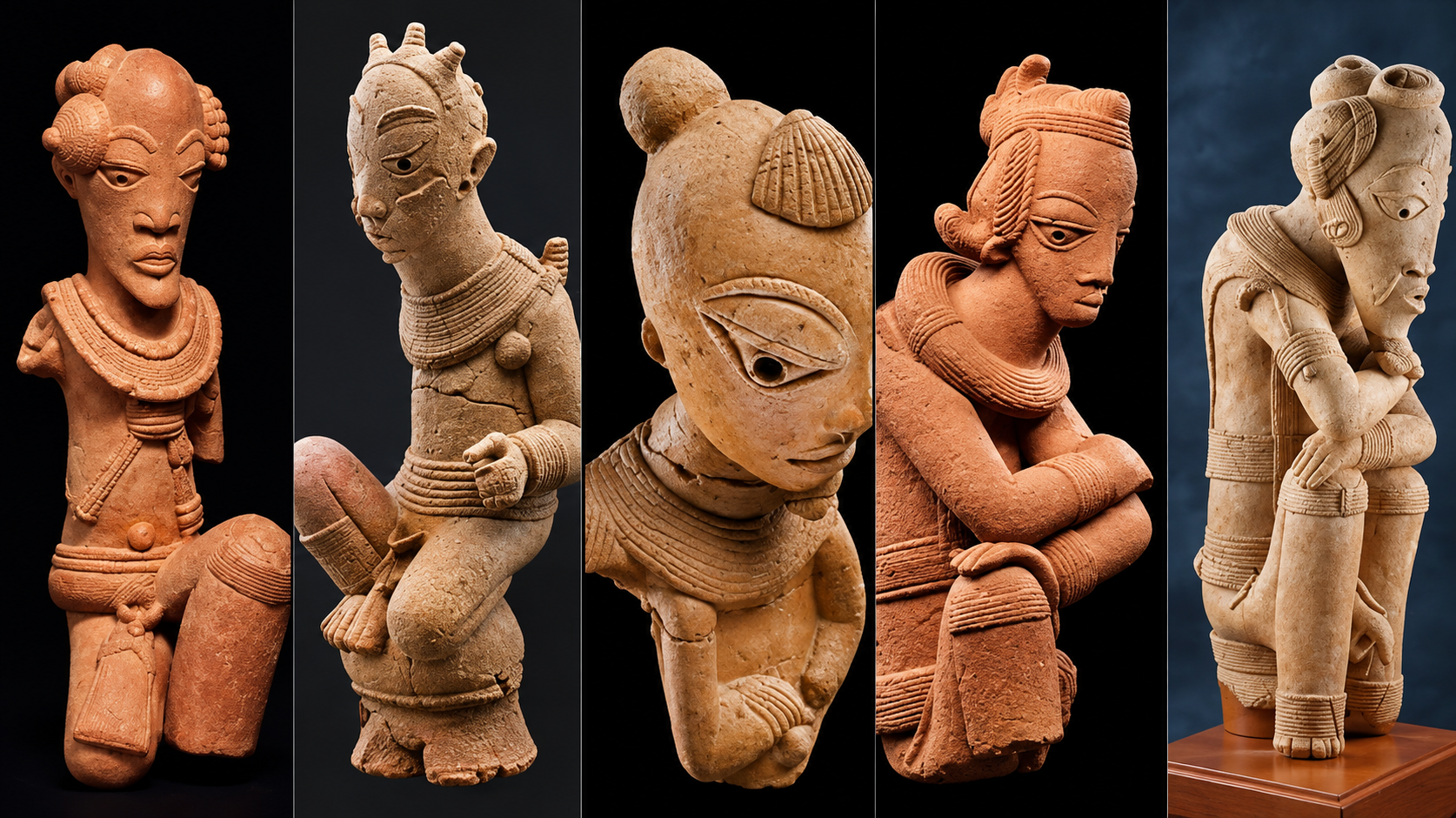
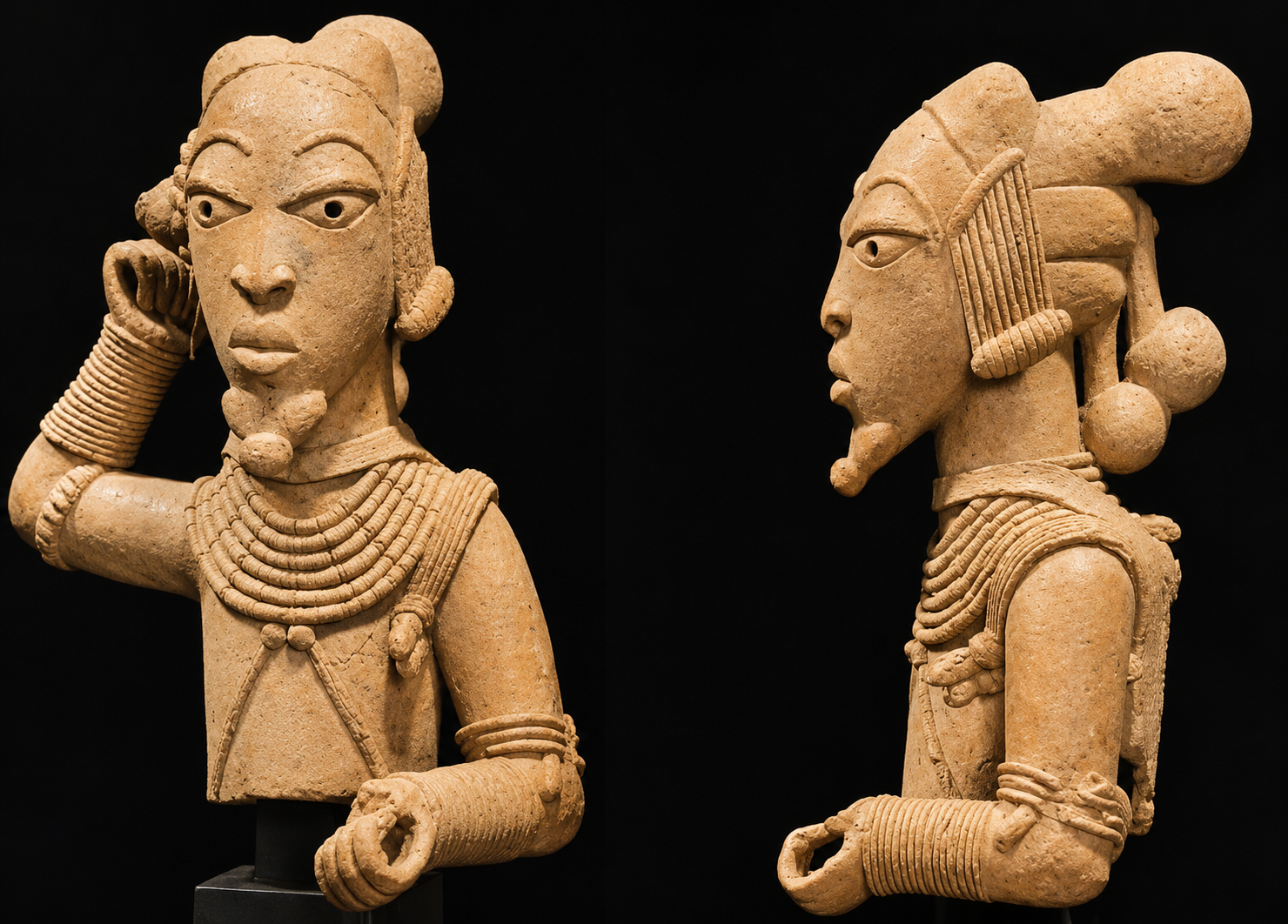
Nok’s sculpture is unmistakable. The first thing that catches the eye is the unconventional proportions. The head plays a primary role in Nok’s sculpture, which is evident from its deliberate enlargement. It takes up about one-third of the entire body. This feature intensifies the identity, as attention is drawn to the face and hairstyle, and it also adds a degree of monumentality and abstraction.
It appears that the head serves as the compositional center. One might hypothesize that for Nok culture, it was important to convey that knowledge was paramount to every individual. Shifting this idea, the large head allowed for the depiction of more detail and the refinement of facial features, which immediately revealed race, distinct characteristics, and social status. Many sculptures feature various hairstyles, differentiated by size, silhouette, and level of detail. I believe this feature played a significant role in representing an individual’s status. «In several later West African traditions, the head is associated with personality, destiny, intellect, or spiritual power. However, directly applying these meanings to Nok without evidence is unwarranted. Met specifically notes that the reason for the disproportionately large heads of the Nok remains unknown.» [6]
Geometric faces and details are also a distinguishing feature of Nok sculpture.
Nok’s eyes often have a triangular, semi-oval, or almond shape. The pupils are indicated by apertures. The triangle is one of the most characteristic geometric forms. This creates a contrast between the soft, rounded mass of the head and the harder shape of the eye.