Развитие искусства витража во французской готической архитектуре XII века
Concept
The art of stained glass in architectural history has traditionally been viewed as a purely decorative element of a church. However, during the emergence of French Gothic in the 12th century, colored glass became a crucial structural factor, transforming the heavy walls of the Romanesque era into a permeable envelope of light. Stained glass is a decorative composition that transmits light, creating images and atmosphere through reflected color. It can also function as an architectural element, such as in a fully glazed facade. This study focuses on the evolution of stained glass in Early Gothic, allowing us to trace how the principles of organizing light, color, and composition changed in key architectural structures of this period.
Working with glass in the Middle Ages was a highly complex craft, passed down through generations. For a long time, stained glass in churches was rare. With the transition to Gothic, walls began to be replaced by pointed windows. The primary challenge was precisely aligning the stained glass forms using architectural instruments and diversifying the tracery through mathematical calculation. During that time, the predominant color palette was high-contrast black and white, with only small accents due to technical limitations. Over this period, the technique evolved, and masters adopted more sophisticated color and symbolic solutions. Stained glass became an integral part of the church—which was the center of every city and a reflection of culture.
Throughout the 12th century, the art of stained glass in French Gothic progressed from strict geometric calculation with a narrow color palette to a narrative architectural canvas filled with vibrant details. The shift in compositional schemes—resulting from the move toward a skeletal interior system, the abandonment of heavy contour divisions, and the reimagining of the role of blue and red pigments—allowed light to become an independent element of the building, mastering the interior space of the church.
For this research, monuments of 12th-century French Gothic were selected—those where the stained glass ensembles are preserved or reconstructed most comprehensively: the stained glass of the Saint-Denis Basilica (Abbot Suger’s reconstruction, 1140–1144). Early stained glass from the Cathedral of Chartres (mid–late 12th century) and the ensemble of the Cathedral of Bourges were also included. The selection of material is driven by the goal of identifying the dynamic shift from monumental narrative compositions to complex systems of light and color.
The study of medieval art often faces the problem of isolating individual genres—painting and applied arts—which are analyzed autonomously. However, the Gothic cathedral represents a synthesis of arts, where stained glass occupies an intermediary, unique position between wall and light, structure and image. The question of how flat colored glass achieved the status of an architectural dominant in the 12th century remains central to understanding the genesis of the Gothic style in France.
Chapter 1: The Philosophy of Light and the Birth of the Gothic Light Environment
The emergence of early French Gothic is inextricably linked to the reconstruction of the Abbey of Saint-Denis, overseen by Abbot Suger in the 1140s. According to Suger’s concept, which derives from the works of Pseudo-Dionysius the Areopagite, material light is a manifestation of the divine essence, capable of elevating the human soul from the material to the immaterial.
In the study by M. S. Yakulskaya and V. I. Ivanovskaya, «The Art of Stained Glass: Principles of Compositional Design, ” it is noted that during this period, „the window ceases to be merely an opening for insolation and transforms into an independent light picture that changes the very density of the air inside the sanctuary.“ The walls of the choir at Saint-Denis were maximally lightened, giving way to expanded window openings filled with colored glass. This led to a radical shift in the spatial experience. The interior was no longer dark and enclosed; it was filled with colored radiance.
Stained Glass as a Theological Text
In the 12th century, stained glass served as a «Biblia pauperum» (Bible for the illiterate), yet its impact fundamentally differed from fresco painting. The light passing through the glass imbued the images with an internal vitality. The figures of saints and biblical narratives seemed to radiate light. This created a unique effect of immersion into a sacred space, where the viewer was surrounded by radiant, luminous imagery.
Chapter 2: Morphology and Compositional Principles of 12th-Century Stained Glass
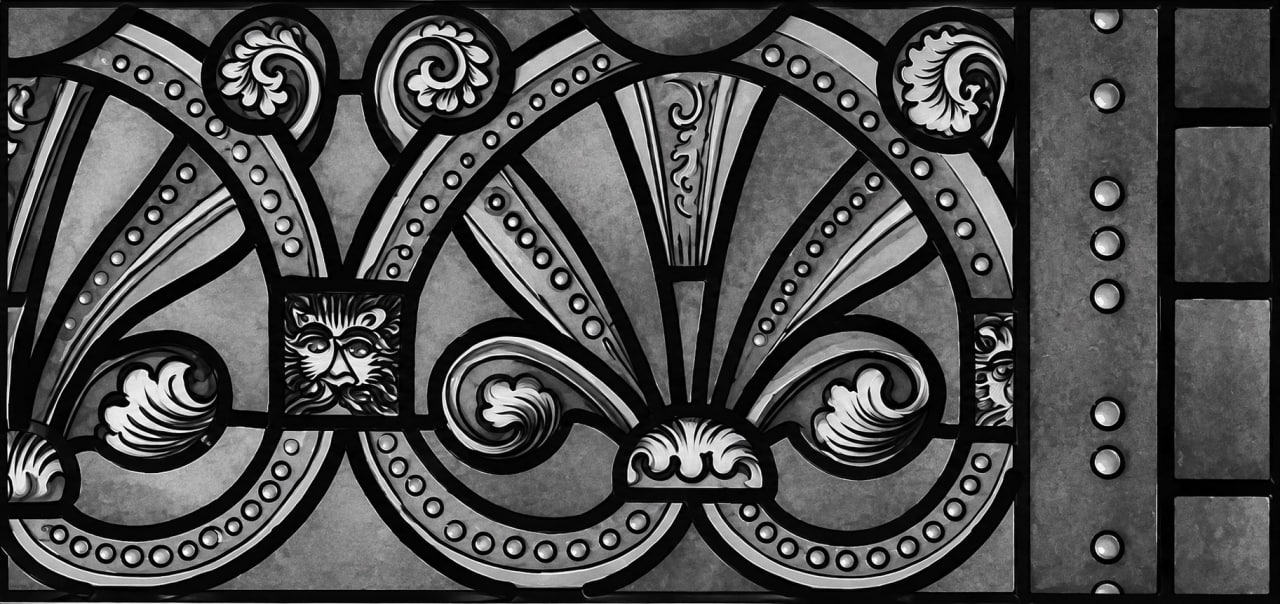
The technological limitations of the 12th century prevented the creation of large sheets of glass; therefore, artisans were compelled to assemble the composition from hundreds of small fragments joined by lead cames (brass or lead strips).
Analysis of the structure of early stained glass indicates that the lead network was not merely a technical necessity. On the contrary, in the practice of 12th-century masters, the heavy black line of the lead played a crucial compositional role, functioning as an outline. The robust linear framework defined the figures' silhouettes, lending them graphic clarity, which allowed the image to be discernible from a distance under illumination.
How was the stained glass created?
At the beginning, the master drew the sketch of the window in natural size using chalk. All the muntins were precisely calculated mathematically. The glass was made in two ways: rolled or blown. After processing in the kiln, it had shape defects but featured a rich color. Next, the glass was cut in the required spot with a hot iron and removed with special tongs. The stained glass gradually took shape; paint, made from crushed glass and metals, was applied to individual pieces to outline silhouettes, fragments, and imagery. After a second firing in the kiln, the composition was assembled according to a predetermined sketch, and the individual pieces were soldered with lead solder. Furthermore, the compositional design was entirely dependent on the bespoke shape of the window, its strict narrative, and the master’s technical capabilities.
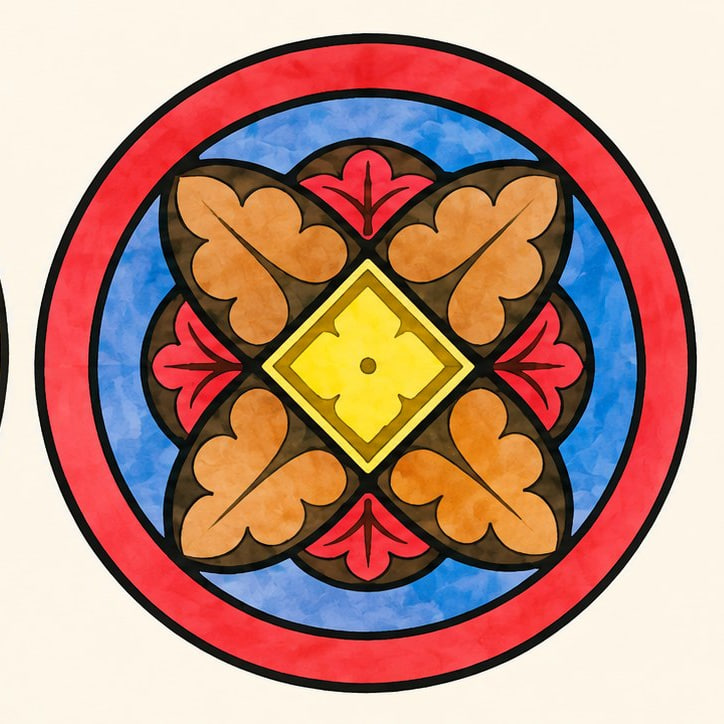
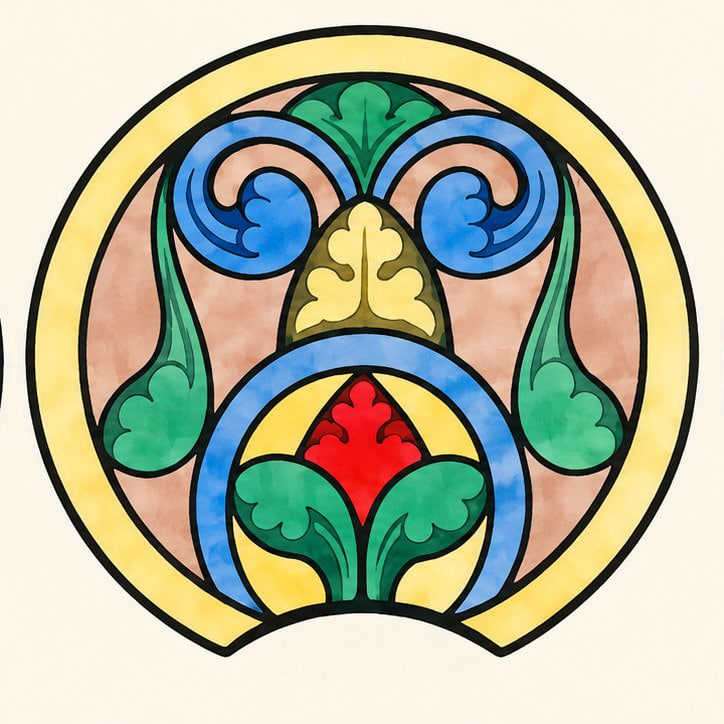
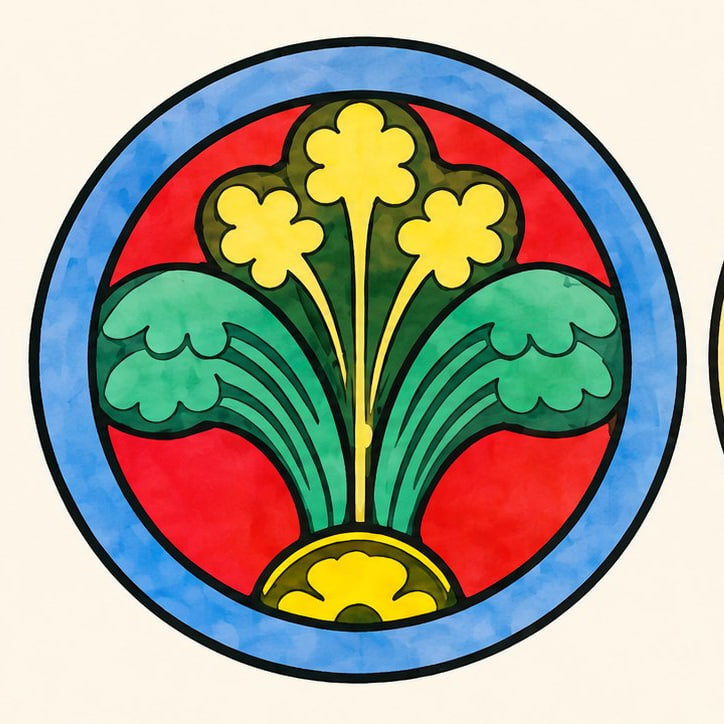
Geometric Grid and Medallion System In the compositional structure of early Gothic stained glass, a rigorous geometric organization dominated. All elements formed a rigid framework within which the narrative unfolded. The most common solution for the internal space of a medallion was a centralized composition. These could be composed of several parts, functioning as an ornamental structural grid.