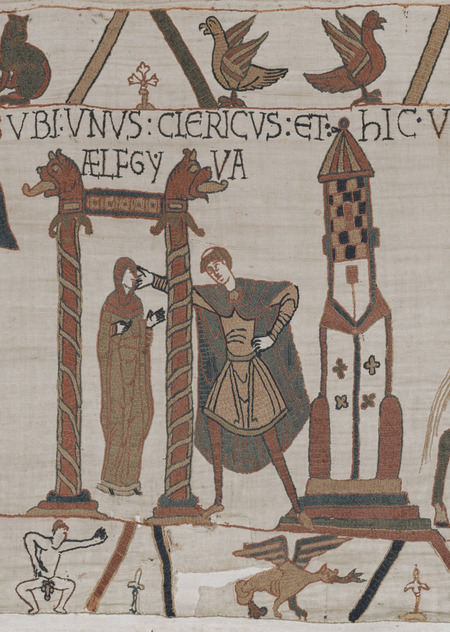
Introduction
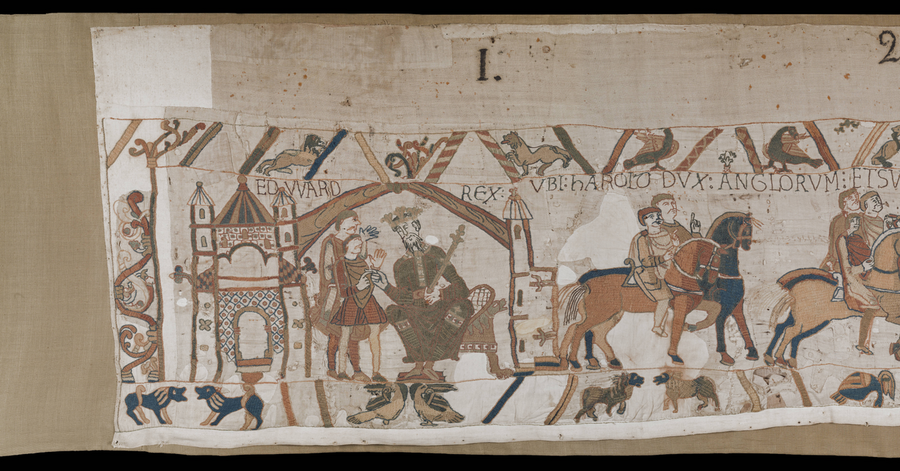
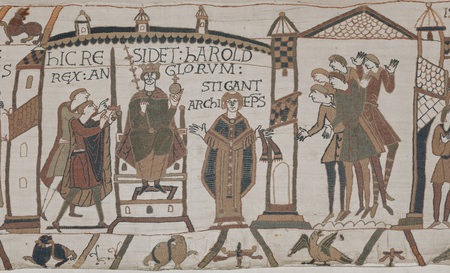
The Bayeux Tapestry, created in the 11th century, is one of the most famous examples of medieval visual storytelling. A story of battle is depicted across a long linen strip through sequential scenes, character movements, and brief captions. Although it is usually called a tapestry, it is not a woven rug but an embroidery executed with wool threads. For this study, the manner in which static images convey motion and connect different events is crucial. The work is fundamentally based on drawing parallels between the tapestry and animation principles.
1. Space and Sequence of Events
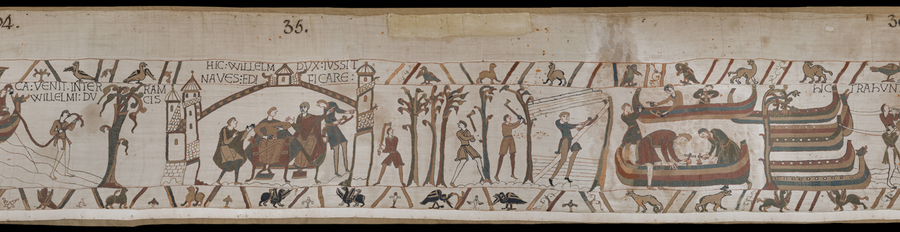
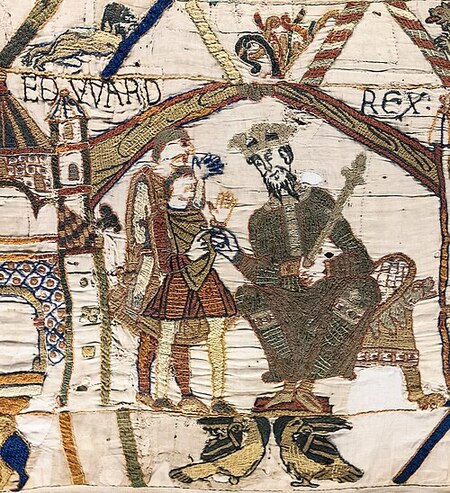
The narrative on the Bayeux Tapestry unfolds horizontally. To grasp its development, the viewer gradually shifts their gaze across the entire surface. Here, space substitutes for time: moving to the next section of the image is perceived as moving to the next event.
The main narrative is situated in the center. The upper and lower borders contain supplementary images that may distract, augment the primary scene, or establish a thematic connection with it. Therefore, the tapestry can be viewed in various ways: reading it sequentially or pausing on details, returning to what has already been seen, and comparing the central and peripheral images.
The connection between parts of the story is maintained through the reappearance of characters. The same individual is depicted in different locations because they participate in multiple events. The viewer recognizes them and connects all these moments into a single narrative. Furthermore, some actions remain outside the frame, and the viewer fills in the gaps between scenes independently.
2. Scene Composition and Transitions Between Them
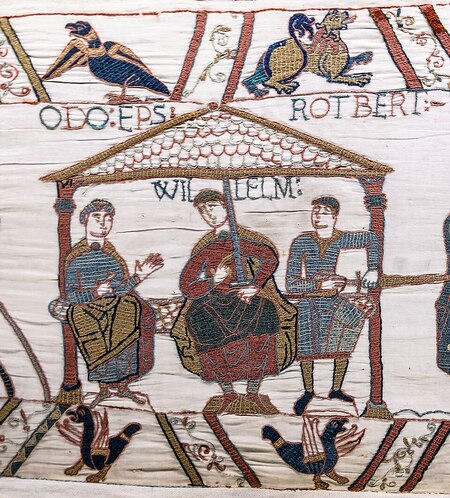
On the Bayeux tapestry, individual scenes are woven into one long image, yet each possesses its own unique details and composition. The placement of the figures, their gestures, and the surrounding objects help the viewer grasp the significance of each scene and the appropriate viewing sequence. In animation, a frame is constructed to capture the viewer’s attention and convey the meaning of the action. On the embroidery, static figures are responsible for this—their postures and arrangement illustrate the progression of events.Transitions between scenes on the tapestry are marked by changes in the background, the appearance of buildings or trees, or the empty spaces separating character groups. These details divide the episodes but do not break the integrity of the entire picture. This is similar to editing in animation, where disparate moments must be linked into a single narrative. However, while animation frames succeed one after the other, the transition on the tapestry occurs through the way the viewer’s eye moves across the image. Moreover, not every background element separates a scene—it is crucial to consider it within the overall composition.
3. Narrative Rhythm and Conveying Movement
Although the image on the rug is static, its different parts can appear more calm or more vibrant. This depends on how densely the figures are clustered, how far apart they are, whether the silhouettes repeat, and the direction of the gestures. When the forms change rhythmically, a sense of rhythm is created; conversely, when figures are placed closely together and their directions intersect, tension emerges.
Movement is primarily conveyed through posture. The lean of the body, the placement of the arms and legs, suggests what may have happened up to that point and what might happen next.
The rug does not dictate how long the viewer should look at it. The composition may feel faster or slower, but each viewer decides for themselves how much time to dedicate to each section. This is one of the key distinctions between embroidery and animation.
4. Character Design and the Role of Color
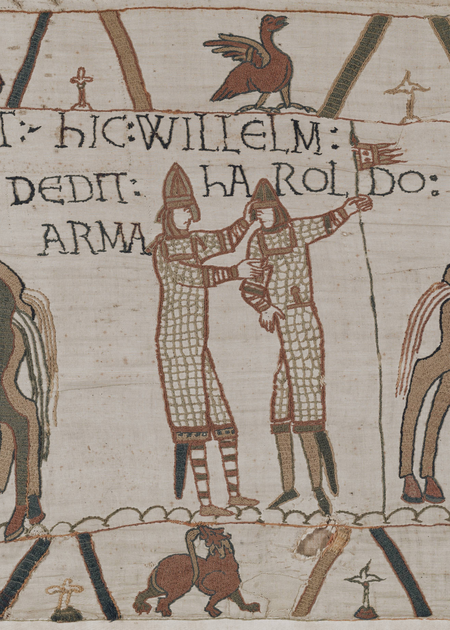
In sequential storytelling, it is important that the viewer immediately recognizes a character upon subsequent appearances. In Bayeux tapestry, this is achieved through clothing, hairstyle, accessories, gestures, and the figure’s placement relative to others. Inscriptions also serve as orientation points. In animation, the character’s appearance serves a similar function: their distinct features allow the audience to identify them across different scenarios. However, on tapestry, recognition relies more heavily on context—the setting, the actions, and the other figures in the scene.
Clothing not only differentiates characters from one another but also helps convey their role in the narrative. A similar concept exists in animation: the character must be comprehensible to the viewer, even if the illustration is simplified. Identifying a hero is not necessarily dependent on facial features; it can be done through a combination of various characteristics.
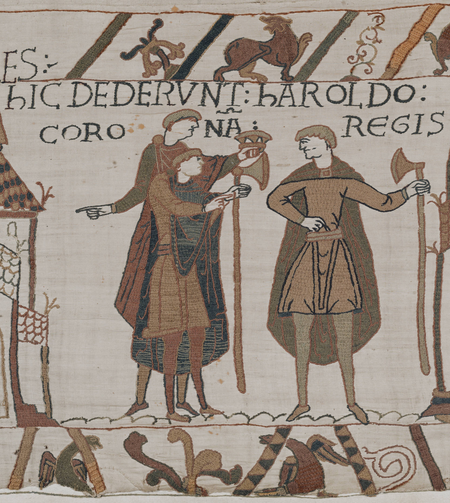
Color also plays a role in scene composition: it separates forms from one another, highlights details, and creates rhythm in visual perception. However, color does not always serve as a constant identifier for a character. In animation, a specific palette is often assigned to a protagonist, and on a rug, this must be verified by comparing different images of the same character. Therefore, it is better to look for the connection with animation not in color as a constant identifying sign, but in its aid to scene perception and guiding the viewer through the action.
5. The Role of Text in Narrative
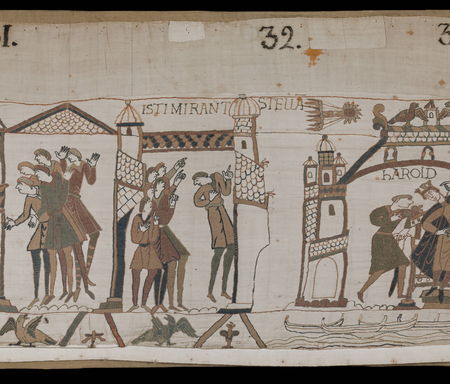
The inscriptions on the Bayeux tapestry help the viewer understand the sequence of events. They name the characters, explain the actions, and clarify the meaning of what is depicted. These texts add information that is difficult to convey solely through poses, gestures, or surroundings. In animation, similar explanatory captions can serve this role, providing necessary details while keeping the image as the primary focus of the narrative.
Functionally, the tapestry inscriptions are closer to intertitles than they are to subtitles. They explain what is happening, rather than conveying the characters' dialogue. However, there is an important difference: intertitles are usually displayed separately from the action, whereas on the tapestry, the text and images are presented together. The viewer sees them simultaneously and can shift their gaze back and forth between the inscriptions and the images multiple times.
The inscriptions also influence how the viewer perceives the scene. Reading holds attention on a specific segment, helping the viewer learn about a character or understand the action before moving on to the next section. In animation, the tapestry connects the use of language with the direction of attention and the explanation of events. Furthermore, the reading time on the tapestry is not fixed—unlike in film, where the author dictates the duration of the caption display, the viewer chooses the pace of viewing on the embroidery themselves.
Conclusion
The interplay between the inscriptions and the imagery allows viewers to see in the Bayeux tapestry techniques that were later developed in animation. The text specifies the action, directs attention, and connects individual episodes, while the image conveys what is happening through poses, gestures, and composition. Together, they make the narrative clear and coherent. Although this does not indicate a direct historical link, it can be argued that the narrative organization employed in the tapestry in some way anticipated modern animation—especially its drive to combine various expressive means to convey action and manage viewer attention.
Sources
Crafton J. M. Hypertext, Hypermedia and the Bayeux Tapestry: A Study of Remediation / J. M. Crafton // Peregrinations: Journal of Medieval Art and Architecture. — 2009. — Vol. 2, no. 4. — P. 97–133. — Accessed: October 30, 2026.
Burt R. Re-embroidering the Bayeux Tapestry in Film and Media: The Flip Side of History in Opening and End Title Sequences / R. Burt // Exemplaria. — 2007. — Vol. 19, no. 2. — P. 327–350. — Accessed: October 30, 2026.
McCloud S. Understanding Comics: The Invisible Art / S. McCloud. — Northampton, Mass. : Kitchen Sink Press, 1993. — Accessed: October 31, 2026.
Thomas F., Johnston O. Disney Animation: The Illusion of Life / F. Thomas, O. Johnston. — New York: Abbeville Press, 1981. — Accessed: November 2, 2026.
Lewis M. J. Intertextuality in the Bayeux Tapestry: The Form and Function of Dress and Clothing / M. J. Lewis // The Bayeux Tapestry: New Interpretations / ed. by M. K. Foys, K. E. Overbey, D. Terkla. — Woodbridge: Boydell Press, 2009. — P. 69–84. — Accessed: November 6, 2026.
Owen-Crocker G. R. The Embroidered Word: Text in the Bayeux Tapestry / G. R. Owen-Crocker // Medieval Clothing and Textiles. — 2006. — Vol. 2. — P. 1–16. — Accessed: November 11, 2026.
Bayeux Tapestry // UNESCO. — Accessed: November 13, 2026.
The Bayeux Tapestry: An Endless Source of Inspiration // Bayeux Museum. — Accessed: November 13, 2026.