Concept
Undoubtedly, the ancient Greeks from the island of Crete borrowed culture from the Egyptians, whom they viewed as experienced neighbors and trading partners. Throughout history, the transition of the islanders from imitation to their own unique vision is quite palpable. Echoes of Egyptian art, focused on the theme of the afterlife, are gradually replaced by a love of life and transition into a belief in immortality. In my research, I will examine how the worldview of the ancient Greeks changed and how that reflected in their art.
Krit’s Connection to Egypt
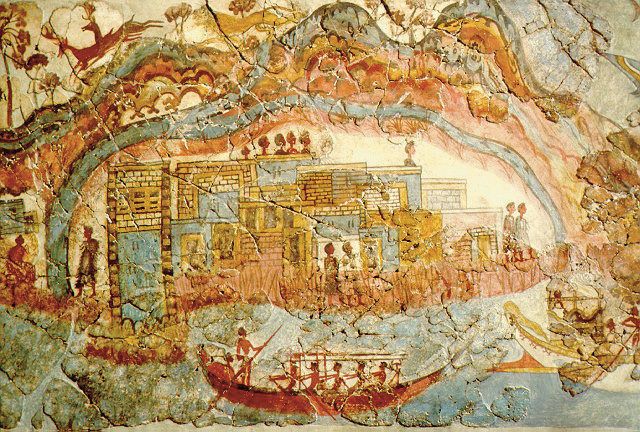
Fresco «Flotilla, ” c. 1600 BCE, Akrotiri (Santorini, Greece)
Early evidence of connections between Ancient Kingdom Egypt and Early Minoan Crete emerges in the 3rd millennium BCE. This is evidenced by references to «ships of the Keftiu lands, ” which is what the Egyptians called the Minoans in papyri. Egypt and Crete maintained trade, economic relationships, and cultural exchange.
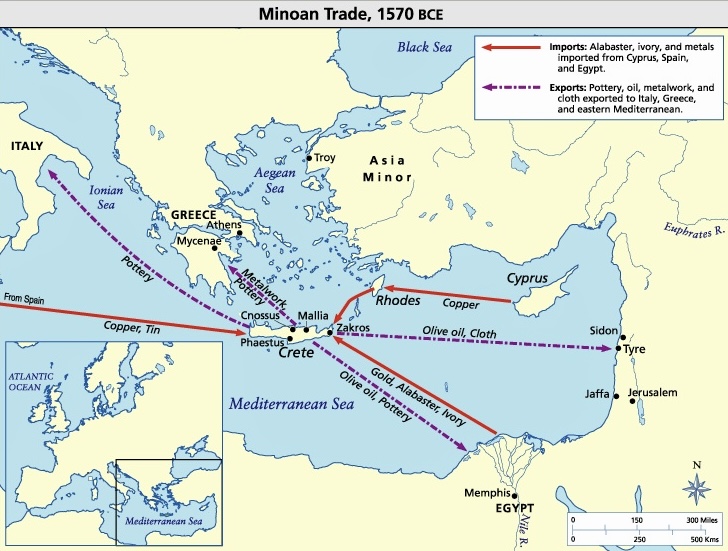
Map of exports and imports between Ancient Egypt and Minoan Crete
Ancient Greek art reflects the psychological and social life of its people. Through it, one can trace the transition from the Egyptian preoccupation with death to the European drive for life.
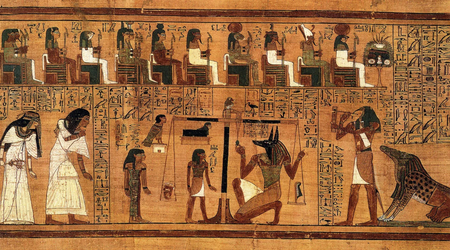
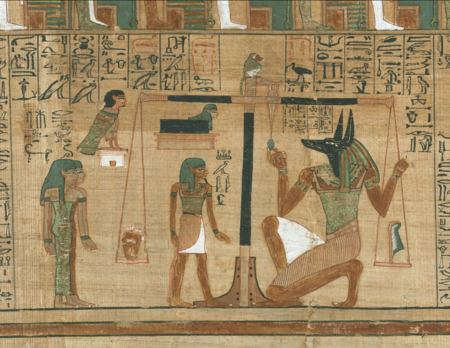
Crete is an island in the Mediterranean Sea, whose art is closely intertwined with its Egyptian neighbors, who brought with them a profound and deeply serious philosophy—the philosophy of death. The Egyptian existed with the singular thought of an afterlife. Death was the central theme of life. After completing their earthly journey, a person returned to the unknown already perfected, if they were of interest to Amun-Ra-Ptah (these are three names for one deity); otherwise, through Osiris, they merged with the deity and continued life in eternity. Otherwise, Osiris cast them into oblivion. The Egyptians feared this second death. This is evidenced by their culture, which was focused entirely on preparing for life after death.
Bull Cult
«Thravoktapsia,» Minoan gold seal
When discussing the art of ancient Crete, one cannot help but mention the legend of Europa’s abduction. Zeus, in the guise of a white bull, took her away to the island of Crete, where she bore him three sons, among whom was Minos, who later became the king of Crete. The entire European civilization that originated on Crete approximately 3,000 years B.C. is descended from the maiden and the God.
Europe and a bull on a Greek vase. Circa 480 BCE.
Krit, which adopted and transformed Egyptian philosophy, undeniably took the cult of the Bull as its foundation. This animal represented the image of the Supreme God, as evidenced by the frescoes and sculptures in the Palace of Knossos.
Fresco at the North Entrance of the Knossos Palace, Crete
Vessel in the shape of a bull’s head. Knossos Palace, mid-16th century BCE./Bulls' horns in the form of crenellations on the walls of Knossos Palace, Crete
Let’s compare the bull cult in Crete with that of Egypt. In Ancient Egypt, the bull was one of the most influential and enduring religious institutions, symbolizing strength, fertility, royal power, and connection to the gods. Several primary sacred bulls were revered in Egypt, each associated with a specific deity and city: Apis—the most famous sacred bull, considered the earthly embodiment (Ka) of the creator god Ptah, and later, the god of the afterlife Osiris. Menes was dedicated to the sun god Ra; it also embodied vitalizing solar energy. Buchis was dedicated to the god of war and the sun, Montu. In both cultures, this animal was associated with royal authority. The title of the Cretan ruler was as inextricably linked to the image of the bull as the title of the Egyptian Pharaoh.
Statue of Apis, 13th Dynasty / Stele with Menes, 12th century BCE
The Cult of the Great Goddess
Crit absorbs the philosophy of Egypt, which manifests itself in the cult of the Great Goddess. At the archaeological museum in Heraklion, the central exhibits are two figures of the Great Goddess Ariadne. They hold a snake in their hands. Snakes are chthonic symbols, emphasizing dominion over the underworld. This is also evidenced by her posture, facial expression, and bare chest. It is generally believed that the bare chest symbolizes the goddess bestowing life. Notably, Ariadne is simultaneously the goddess of the realm of the dead. This creates an interesting contrast between life and death, unified within the goddess.
Minoan goddesses with snakes. Crete. Circa 1600 BCE.
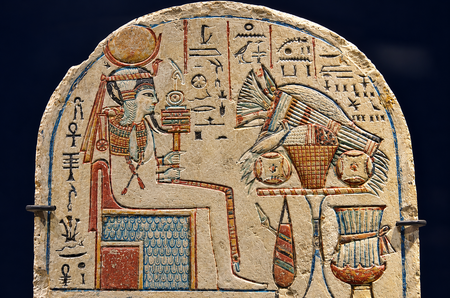
The Cretan Great Goddess embodied a formidable mistress of wild beasts and ruler of mountains and forests, while also serving as a benevolent patron of vegetation, grains, and fruit trees. She was also depicted as a sinister queen of the underworld, holding coiling snakes. The image of this great goddess bears a strong resemblance to two Egyptian deities: Hathor (goddess of love, sky, joy, and fertility) and Isis (great mother, patroness of life and magic).
Statue of the Goddess Hathor, c. 1405–1367 BCE, Luxor Museum (Egypt)/Goddess Isis with Spread Wings, c. 1380–1335 BCE, fresco from the tomb of Seti I, Valley of the Kings, Luxor
Performative Practices
The religious performative practices of ancient Crete—this is where art begins. The first artistic image humanity created is an image formed through the language of action. Here, we see an exhibit from the museum in Heraklion. This person, according to the museum label, is a gymnast. What the young ancient Cretans performed demanded the highest level of skill and rigorous training in devotion to the Great Goddess, so that they might merge with her after death and achieve eternal life. This practice was a form of sacrifice conveyed through strength and beauty, accessible not to everyone.
«Acrobat Jumping Over a Bull, ” c. 1600–1450 BCE, Archaeological Museum of Heraklion (Crete)
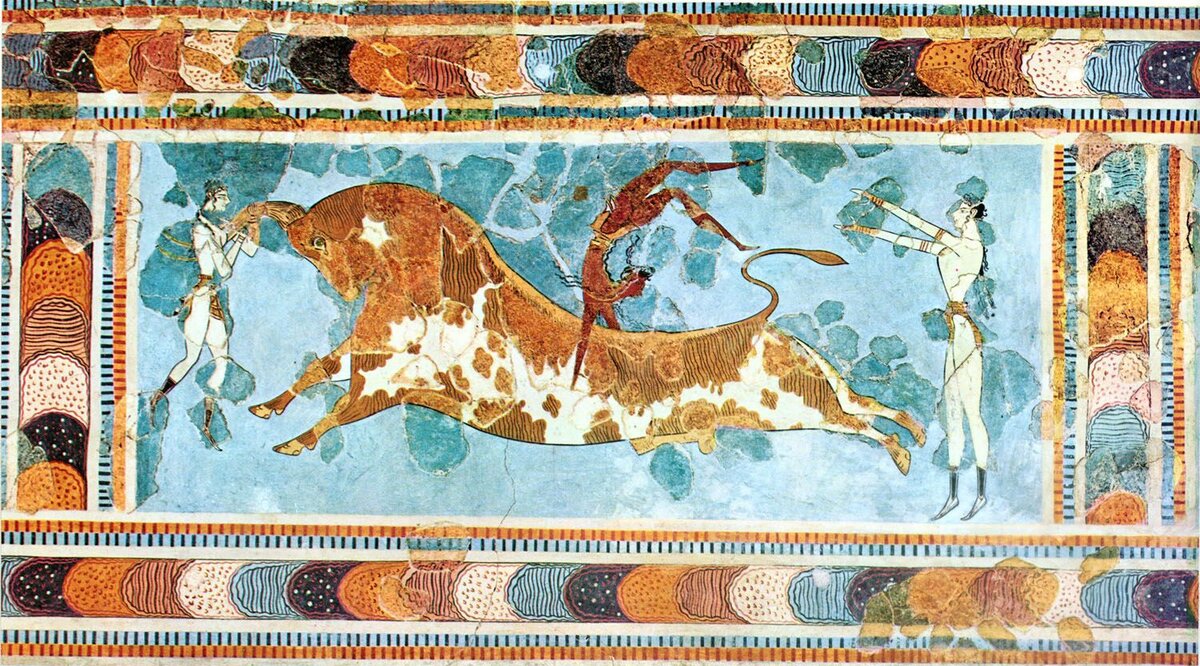
Let us examine the fresco painting from the Knossos Palace on Crete. It depicts bull-leaping games. This performative practice involved young men and women grabbing the animal by its horns, jumping over its back, and completing the trick behind the bull. If death occurred, it was considered a sacrifice to the Goddess Ariadne and the ancestors; however, if the athlete survived, it could be described as a sacrifice of strength, agility, and beauty. This is where the gradual shift away from the idea of inevitable demise on the altar begins to emerge. Sacrifices start to become abstract concepts. This is important to note because the change is tracked for the first time not in art, but specifically in the performative practices immortalized and captured at the Knossos Palace.
Fresco «Thaurocatapxia.» Knossos Palace. c. 15th century BCE.
However, there is also an example of reverse exchange. During excavations at Tell el-Daba (Nile Delta), archaeologists discovered frescoes from the 16th–15th centuries BCE, executed in the Minoan style. These frescoes depict scenes of taurokathapsia. Since the Egyptians did not practice this form of performative art, it is possible to suggest that the fresco was painted by Cretans purely for decorative purposes.
Fragments of Minoan frescoes, Tel el-Daba, 16th–15th centuries BCE.