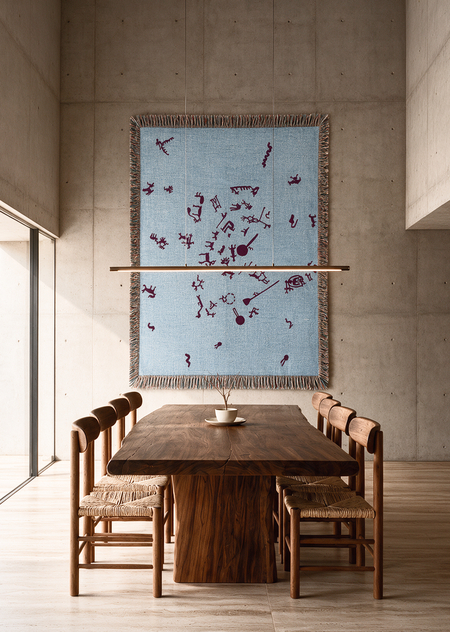
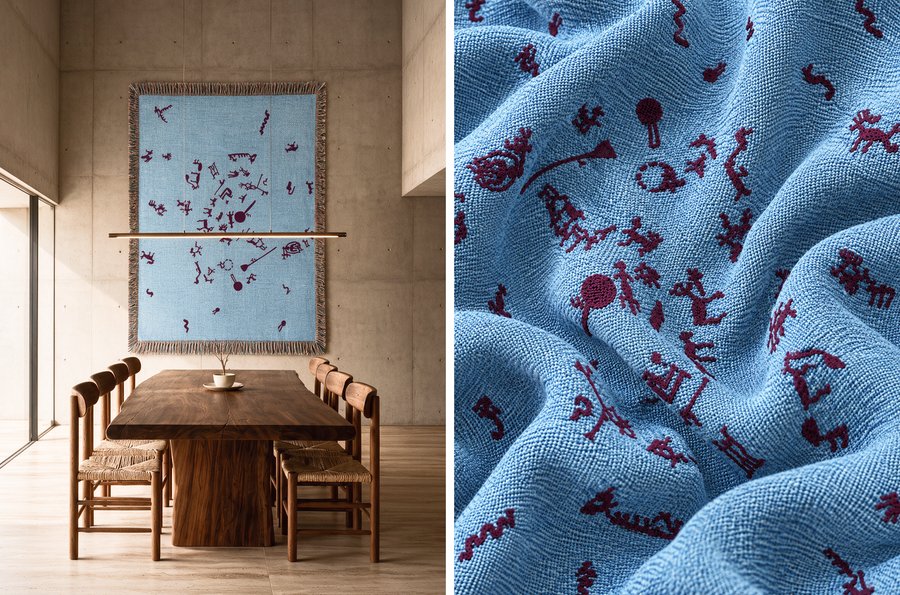
Tapestry «Tracks of Onega» (123 × 142 cm)—a modern interpretation of the petroglyphs from Onega Lake, created by ancient inhabitants of Karelia. The project is based on the Onega petroglyphs—graphic testimonies to human life, worldview, and perception of nature.
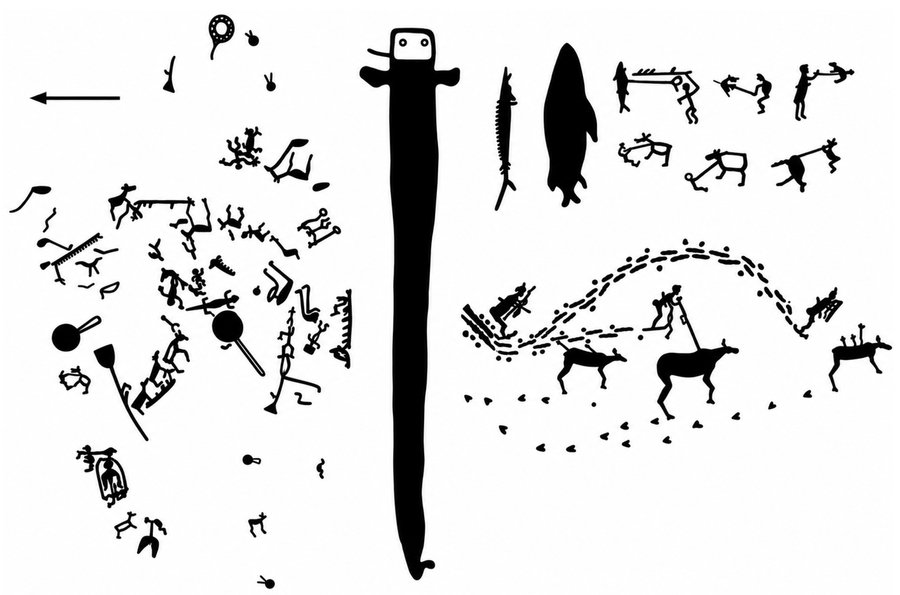
Petroglyphs found on the eastern shore of Lake Onega
In his book, researcher A. M. Lobanov identifies five main typological groups of Onega petroglyphs: «…five basic motifs (narratives): waterfowl (swans), signs with presumed cosmic semantics, humans (anthropomorphic beings), forest animals, and boats.»
BIRD — COSMOS — HUMAN — ANIMAL — BOAT
These five motifs form the semantic foundation of the project. They reflect the relationship between humanity and the surrounding world—the aquatic element, celestial phenomena, and the animal kingdom. The ancient images are examined not as isolated decorative elements, but as an integrated system of signs through which the worldview of the Neolithic era is revealed.
The composition is based on the actual placement of the petroglyphs. The images retain their characteristic outlines and spatial relationships, but they are reinterpreted using contemporary graphic means. The minimalist presentation and the absence of additional decorative elements allow the focus to remain on the symbols themselves.
The color scheme is based on the contrast of two hues: light blue and deep burgundy. The blue is associated with the surface of Lake Onega, while the burgundy references stone color, natural pigments, and ancient depictions. Inverting the colors in the two tapestry variations creates different perceptions of the same composition: the symbols can appear as standalone figures or be perceived as traces emerging on the surface.
Transferring ancient rock paintings into jacquard weaving technique becomes a means of uniting historical heritage with contemporary object design. The tapestry transforms archaeological visual material into an element of everyday life, preserving a connection to the cultural landscape of the Russian North.
The main idea of the project is to transfer the traces of ancient humans from the surface of stone onto the surface of fabric, making cultural memory a part of modern interior design.