The Image of the Cat in Ancient Egyptian Art
Художественные типы и сакральная символика
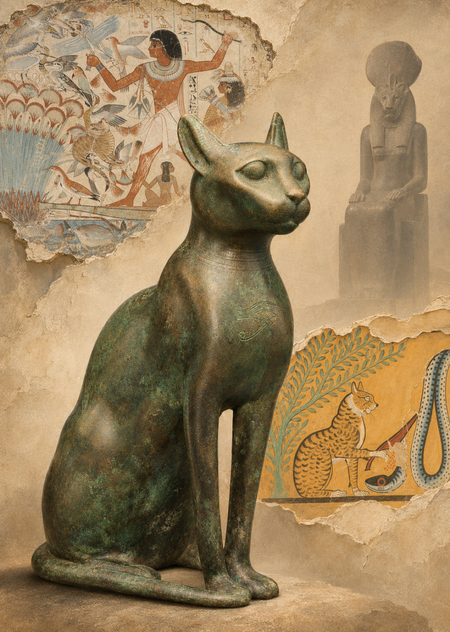
Research Question: What indicators allow us to read a feline figure as an animal near a human, a ritual image, or the form of a deity? The core of the research lies in what is visible within the artifacts themselves: the figure’s placement, the nature of its gesture, its silhouette, and the image’s relationship to the object’s structure.
Concept. Where the question originated: When I started choosing a theme, my cat Keks was lying next to me. I was always surprised by how, just by a slight turn of its head or the positioning of its paws, one could tell what the cat had noticed. In its appearance, there is a blend of closeness to humans and independence. This sensation led me to Egyptian depictions. I wanted to understand what happens to the recognizable body of a cat when an artist places it beneath a human chair, shows it in motion, or imbues it with divine action. My personal observation posed the question, and I will answer it through the comparison of artifacts.
Concept. What defines the role of the cat? I suggest that the significance of the cat image arises at the intersection of composition, gesture, and the monument’s purpose. The position beneath the chair connects the figure to the human scene. The prey in its paws and jaws places the animal at the center of a distinct action. The sculpture’s straight verticality establishes the cat as an autonomous figure, and the hollow body structure allows the image to be related to an internal body. Finally, the knife, snake, or objects held by the goddess provide grounds for a mythological reading. Even a well-recognized silhouette allows for multiple interpretations if it is incorporated into different compositions.
Concept. Three chapters. In the first chapter, I analyze everyday motifs in funerary painting: animals near humans, furniture, and hunting. The word «everyday» here refers to the nature of the depicted action. The location of the paintings within the tomb must also account for their funerary purpose. In the second chapter, I examine the sacred cat through the composition of objects—linen wrappings, the volume of metal figures, and container lids. The third chapter discusses deities who take on feline forms or combine a cat’s head with a human body. Nebamon connects these groups: the artist depicts predatory behavior, and the gilded eye allows us to question an additional solar association.
Concept. Corpus and Boundaries.
The foundation of the comparison comprises Phidian painting, funerary graphics, and the monumental statue of Sekhmet. Ritual plasticity, faience amulets, and mummies expand the study where the question concerns material, scale, or function. The ancient prototypes of the facsimile belong to the New Kingdom, while many cult objects date to the Late and Ptolemaic periods. The broad dating of one mummy encompasses the 1st century CE. The order of the chapters illustrates various possibilities of the image. The comparison does not require presenting them as sequential stages of development. The monuments allow for testing hypotheses with specific examples, while the question of the prevalence of these techniques remains open.
Concept. How to read an image? I begin with the whole and search for what organizes attention: the line of furniture, a scattered group of birds, the curve of a snake, or the axis of a stone figure. Then, I examine the section where the cat’s role becomes clear. For a comparative pair, I ask the same question about both monuments: How is the figure related to its surroundings? Where is the movement directed? Which detail clarifies the attribution? I verify information regarding date, technique, and purpose using museum descriptions. Modern facsimiles allow for the comparison of rendered contours and figure placement, whereas the condition of the ancient surface can only be inferred to a limited extent [2]. In my conclusions, I note where the interpretation relies on the object, where it relies on museum attribution, and where it remains a hypothesis.
How to read the three chapters? The first chapter begins with the depiction of cats alongside humans and concludes with instances where the animal takes on a human role. In the second chapter, we compare real-life constructs where the feline silhouette is linked to the animal’s remains. The third chapter explores which characteristics allow one to identify a divinity and where museum attribution leaves the question open. These chapters can be read sequentially: the figure’s placement in the scene helps us understand its action, and the action and purpose help us judge its significance.
I. Animal in a Human Environment
Общий вопрос первой главы — кто в изображении организует действие
In the royal scene, there are human figures and furniture. In the swamps, the cat takes on its own actions. In the drawing on the ostracon—a small stone shard—it is given a role that would typically be played by a human in the usual scene.
Under the queen’s chair
Amenhotep III and Tiye Under a Canopy. Tomb of Amenan, Thebes (TT 120). Ancient Prototype — circa 1386–1347 BCE. Facsimile by Nina de Gares Davis, 20th century, tempera on paper. The Metropolitan Museum of Art, 33.8.8.
Let’s begin with a complete museum facsimile of the fresco from the tomb of Amenhotep. The backrest, supports, and canopy define the boundaries of the space where Amenhotep III and Tiy are seated. The broad scene draws attention to the royal couple, while the lower zone relies on their furniture. This is a difference in scale and placement: the human figure is visible within the scope of the entire scene, whereas the animal is discovered within a small niche. The overview reveals the meaning of the group’s arrangement, which can then be examined in a separate reproduction [4].
Animals Under the Chair. Ipyu and Anen
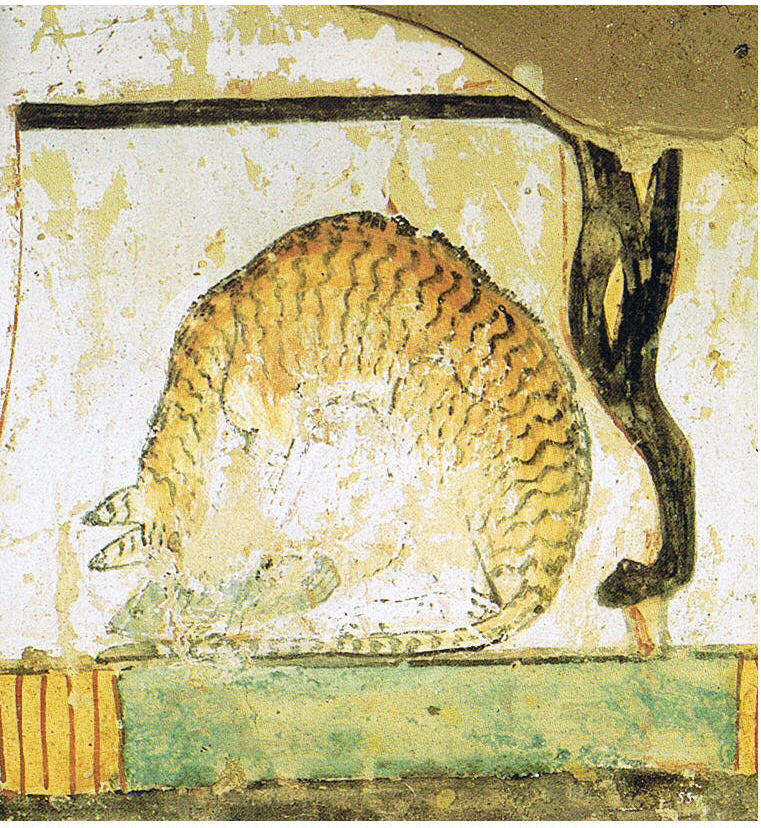
Cat with fish under a seat. Fresco from the funerary chapel of Nakht, Thebes (TT 52), XVIII Dynasty. Fragment. Reproduction from the book by M. Zaydel and A. G. Shedid.
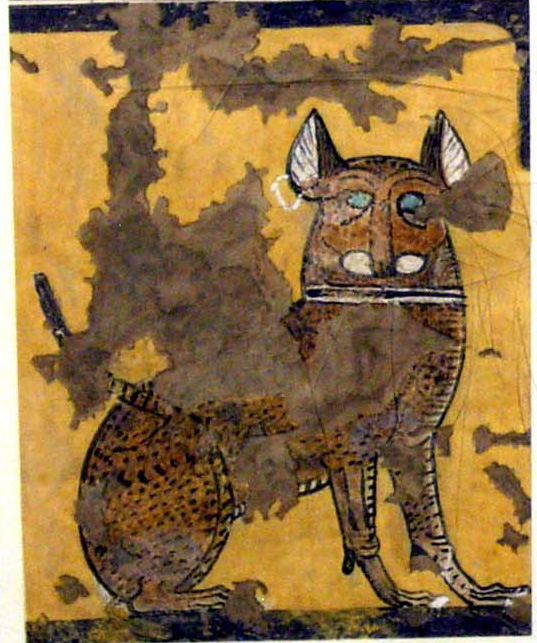
Cat under a chair. Tomb of Ipu, Thebes (TT 217). Ancient prototype — circa 1290–1224 BCE. Facsimile by Norman de Garis Davis, 20th century, tempera on paper. The Met, 30.4.183.
In the facsimile of Ipu, the ear, collar, and the transition from the neck to the front paws outline the cat. In Nakhta, the back rises above the fish, toward which the muzzle is lowered. In both frames, the furniture establishes the upper boundary, but the focus differs. In Ipu, it is concentrated on the animal’s form; in Nakhta, it is on the contact with the prey. In the complete facsimile of Anen, shown above, the same area encompasses several animals.
Neemon’s Hunt. From the Boat to the Thickets
Nebamon hunts in the marshes. Fragment of the fresco from the funerary chapel of Nebamon, Abydos. c. 1350 BCE. Fresco on plaster. British Museum, EA37977. Overall view of the preserved fragment.
In the full fragment, the figure of Nebamon is visible first: a raised arm, a turned torso, and support on a boat. Birds guide the gaze toward the thicket, through which a cat can be found. The large figure of the hunter unifies the scene, while the small feline figure gathers a separate knot of movement. The gilded eye allows for a discussion of the possible solar association proposed by the British Museum. The cat’s position among the birds offers a more immediate observation: it participates in the hunt as a predator. The religious interpretation relies on the funerary context and the material emphasis of the eye.
Nakta Cat. Closed Movement
Let’s compare the two actions shown previously. In Nakhta, the movement is focused around the lowered snout. In Nebamon, the prey is distributed around the body, and the wings continue to move outside the silhouette. The positioning of the prey helps differentiate two ways to construct a hunting scene.
Scale and Visibility
In the funerary frescoes, the cat’s action does not necessarily correlate with its body size. Nebamon is the largest in scale, but it is the cat that forces the viewer to track several flight paths simultaneously. In Ipuya’s work, the cat is small relative to the human, although the isolated frame makes it large for the viewer. These are two different scales: the proportion of figures in the ancient composition versus the size of the image on the page. When laying out the work, it is important to allow these two aspects to be read separately.
Ostraka from Turin. A cat serves food.
Ostracon with a cat covering a table for a mouse with a lotus. 1292–1077 BCE. Limestone, drawing. Museo Egizio, Turin, Suppl. 6296.
In a Turin ostracon, a mouse sits with a lotus flower. A cat stands on its hind legs by the table, serving it. The posture and action create a recognizable social scene: one character receives, the other brings. The change in roles is visible even without assuming who the ancient viewers might have intended. The drawing on the limestone moves the cat from under-furniture to a place where a servant acts in a human depiction.
Brooklyn Ostracon. Who is sitting, who is standing?
Ostracon with a cat attended by a mouse. Circa 1295–1070 BCE. Limestone, pigment. Brooklyn Museum, 37.51E. Photo shooting brooklyn / Wikipedia Loves Art
On the more elongated fragment from the Brooklyn Museum, the mouse’s role is also determined by its posture. The cat is positioned in front of the seated figure and is offering the bird. If viewed as a miniature stage, the distinction between the characters is established by the height of the seating, the pauses between them, and the direction of the gesture. In the Turin version, the servant’s role is conveyed through the action at the table, emphasized here by the direct address to the seated mouse. Repeating the motif in two separate drawings allows one to distinguish what the artists change from what makes the scene recognizable.
Why an inverted stage remains understandable