«Ксенафобия-монстра»
Как неизвестное приобретает рога и клыки
Categories:
- Concept
- «Antiquity—First Strokes» 2.1 «The Monster in the Labyrinth» 2.2 «Bad Weather and Relief» 2.3 «Who Blinded the Elephant?» 2.4 «Strangers in Sicily»
- «Through the Eyes of a European» 3.1 «Guests from Afar» 3.2 «The Sea Calls»
- Conclusion
- Bibliography
Concept:
Throughout human history, people have experienced fear regarding what they could not understand or explain. Unknown natural phenomena, unfamiliar peoples, unusual creatures, and random coincidences often became the source of mystical concepts, myths, and images of monsters. Confronted with the incomprehensible, humans sought to give it form, explain it through the supernatural, and often demonize it. This study traces how this phenomenon manifested in art, culture, and people’s perceptions from antiquity to the 16th century, and examines how the fears formed over centuries continue to influence our modern perception of the unknown.
2. «Antiquity — First Strokes»
2.1 «The Monster in the Maze»
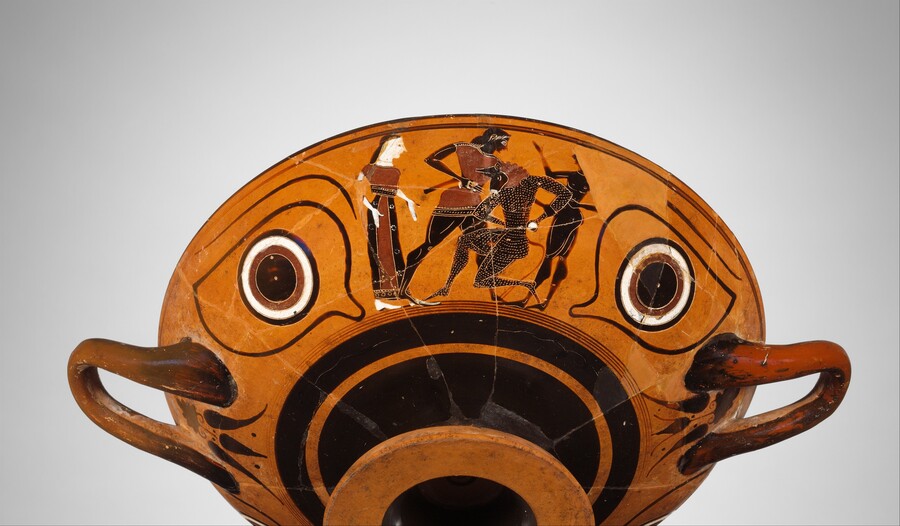
Terracotta kylix: drinking cup c. 530 BCE
According to ancient Greek myth, the Minotaur was a creature with a human body and the head of a bull, born from Pasiphae, the wife of King Minos, and a sacred bull. Minos confined it in the Labyrinth built by Daedalus and regularly sent Athenian youths and maidens as sacrifices. Eventually, the hero Theseus entered the Labyrinth and killed the monster, using Ariadne’s thread to find his way out.
However, if one looks at the myth from another perspective, the proto-figure of the Minotaur might have been an unusual royal heir whose appearance deviated from the acceptable norm and whom the family preferred to keep hidden from the public. Interestingly, ancient sources gave the Minotaur a proper name—Asterius, meaning «starry.» Such a name could indicate his special lineage and high status.
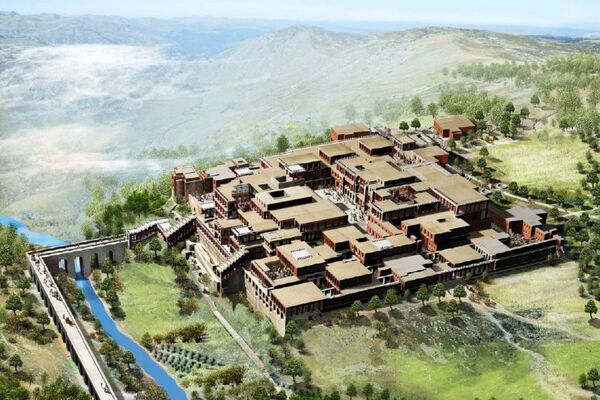
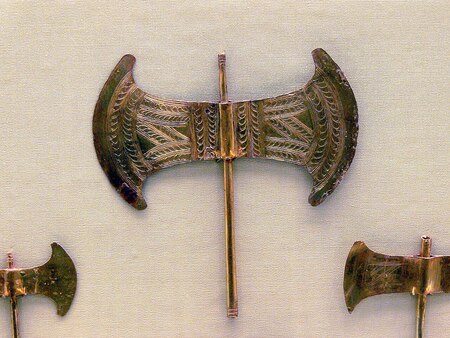
1. Knossos Palace 2. Minoan Labrys
The Labyrinth as a Physical Structure. The Knossos Palace on Crete is considered a possible prototype for the Labyrinth, excavated by archaeologist Arthur Evans in the early 20th century. The complex consisted of about 1,300 rooms connected by numerous corridors, staircases, and internal passages.
To the residents of mainland Greece, accustomed to simpler rectangular structures, such multi-level architecture might have appeared like a genuine trap. There is also a theory that the word «labyrinth» derives from labrys—the double-headed sacred axe found at Knossos Palace. In this case, the original meaning may have been related to the «Palace of the Double Axe.»
2.2 «Bad Weather and Topography»
Terracotta oinochoe (pitcher) c. 590–570 BCE
Harpies, mythical creatures with the body of a bird and the head of a woman, in ancient Greek mythology—particularly in Homer’s «Odyssey"—were associated with sudden, destructive air currents and storms. Their appearance was linked to violent gusts of wind capable of raising waves, derailing ships, and sweeping sailors far from their usual routes. Consequently, harpies were perceived as a unique explanation for unpredictable natural phenomena, such as hurricanes or typhoons, which could either aid ships in navigating the sea or cause perilous voyages.
Scilla. Detail of side A from a red-figure bell crater from Boeotia, 450–425 BCE.
According to ancient Greek mythology, Scylla was a sea monster that inhabited a rocky cave opposite Charybdis. According to Homer’s description, she had six heads on long necks, and each head could snatch a sailor from a passing ship. Scylla and Charybdis were located on opposite sides of a narrow sea strait, meaning that sailors attempting to avoid Charybdis’s whirlpool risked approaching Scylla’s rocks. During Odysseus’s voyage, the monster took six of his companions.
However terrifying the monster may be, by examining the geography of the location, one can confidently hypothesize that the Scylla in Homer is merely an attempt to describe the real dangers of the shoal and rocky terrain Odysseus navigated while attempting to avoid the whirlpool (Charybdis). It is suggested that the creature’s image may have originated from observations of sharp coastal rocks and projections hidden among the waves and swift currents. The name Scylla is traditionally linked to the Ancient Greek verb skyllō ($\sigma\kappa\acute{u}\lambda\lambda\omega$), meaning «to tear» or «to rend,» or to the Phoenician skoula—"rock.» For a wooden ancient ship, the currents in the narrow strait, hurling the vessel against sharp coastal cliffs, literally «tore apart» the hull and destroyed the crew.
2.3 «Who Blinded the Elephant?»
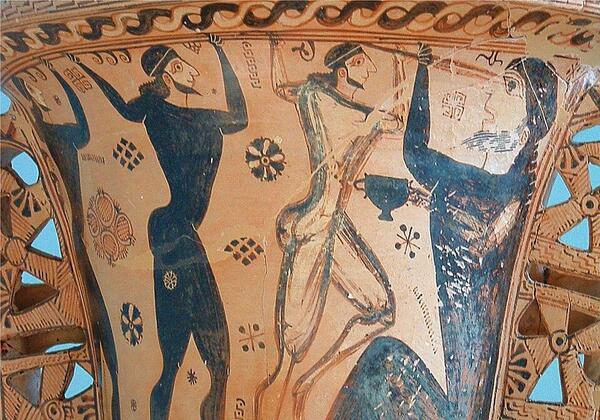
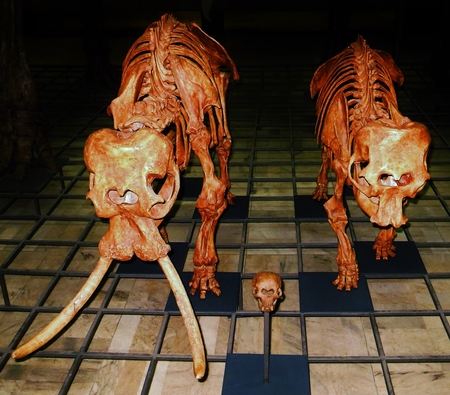
1. Odysseus and his crew blind Polyphemus, detail of a proto-Attic amphora, c. 650 BCE. 2. Skeletons of Palaeoloxodon falconeri
One theory suggests that the possible origin of one-eyed Cyclops was proposed by paleontologist Otinio Abel between 1914 and 1939. Abel hypothesized that the fossilized skulls of Pleistocene pygmy elephants, specifically the Sicilian pygmy elephant Palaeoloxodon falconeri, served as the source for the myth of the Cyclopes.
(This is because, since ancient times, it was believed that the island where the Cyclops Polyphemus lived was located in the Sicily region.)
Abel proposed that the large central nasal cavity (for the trunk) in the skull could have been interpreted as a single, large eye socket. Furthermore, the dimensions of the mammals themselves may have inspired Greek philosophers to create the image of these one-eyed giants, notably the Cyclops Polyphemus from Homer’s Odyssey.
2.4 «Strangers in Sicily»
The fourth panel of the so-called wall painting, «Landscapes of Odyssey,» c. 60–40 BCE
According to ancient Greek mythology, the Lestrigonians were a tribe of giant man-eaters with whom Odysseus encountered during his journey. They lived in the city of Telepylus, surrounded by high cliffs and a narrow harbor. When Odysseus’s ships entered the harbor, the Lestrigonians attacked them, destroying almost the entire fleet and killing many of its crew members. Only Odysseus and his ship managed to escape.
However, if one looks at ancient geographical descriptions, it is possible to hypothesize that the image of the Lestrigons may have arisen from clashes between early Greek seafarers and the indigenous population of Sicily. Thucydides mentions the Lestrigons among the island’s oldest inhabitants and also speaks of the Sicans and Siculi who populated it before the arrival of Greek colonists. Specifically, during the founding of Leontino in eastern Sicily, the Greek settlers encountered an existing population and occupied some of their lands. It is possible that accounts of hostile encounters with local residents defending their territory against foreigners gradually morphed into the myth of brutal giants who destroyed arriving ships.
Review of Antiquity:
As has become clear, behind every myth or monstrous figure there may be a very real explanation that does not require extra horns, fangs, or supernatural abilities. Every legend is rooted in specific historical circumstances, cultural perceptions, and the context of the era in which it arose.
Fantasy creatures often resulted from misinterpreting what was seen, exaggerating real phenomena, or humanity’s attempts to explain the unfamiliar. Therefore, when examining such images, it is important to see not only the creators' imagination but also the real fears, beliefs, and worldviews of the people of their time. Through these depictions, we can better understand how people perceived the world around them and how they sought to explain everything that remained unknown.
3. «Through a European Lens»
3.1 «Guests from Afar»