Данный проект является учебной работой студента Школы дизайна или исследовательской работой преподавателя Школы дизайна. Данный проект не является коммерческим и служит образовательным целям
Проект принимает участие в конкурсе

*Meta is recognized as an extremist organization in the Russian Federation

*Компания Meta признана экстремистской организацией на территории Российской Федерации

INTRODUCTION

Duolingo: The World’s Most Downloaded Education App

Duolingo is the world’s leading mobile learning platform. Founded in 2011 and headquartered in Pittsburgh, USA, the app has been downloaded nearly 960 million times and reached 116.7 million monthly active users by Q4 2024 — a 32% increase year-over-year. Despite being an educational product, Duolingo has become a cultural phenomenon — largely due to a communication strategy that blurs the line between learning and entertainment.

big
Исходный размер 703x265

Duolingo’s App Store page

Brand Overview: Mission, History & Scale

Duolingo was co-founded by Luis von Ahn and Severin Hacker with a clear mission: «to develop the best education in the world and make it universally available.» Today the platform offers 121 courses in 40+ languages, operates in 190+ countries, and has been publicly traded on NASDAQ (DUOL) since 2021. In 2024, Duolingo achieved revenue of $748 million — a 40,8% increase from the previous year. Paid subscribers totalled 9.5 million by Q4 2024, an increase of 43% year-over-year.
big
Исходный размер 1742x897

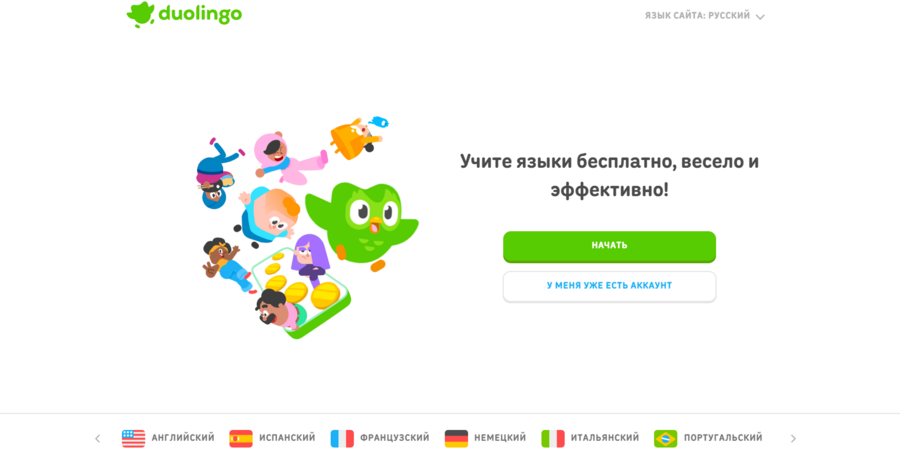
The main page of the website duolingo.com

Core Positioning: Where Education Meets Entertainment

Duolingo occupies a unique strategic position: it is simultaneously an educational tool and an entertainment media brand. The official tagline — «Learn a language for free. Forever.» — communicates accessibility and value. Yet in its public-facing communication, the brand consistently prioritises fun, humour, and emotional engagement over demonstrating learning outcomes. This is not accidental: it is a deliberate and carefully executed strategic choice that sets Duolingo apart from every competitor in the EdTech space.

Target Audience: Who Uses Duolingo?

Duolingo targets two distinct audience segments. The primary audience consists of Gen Z and younger Millennials aged 13–35 — active TikTok and Instagram users who value authenticity, humour, and non-corporate brand behaviour. Duolingo’s own data shows approximately 60% of all US learners are under 30. The secondary audience includes adult learners with specific, goal-driven motivations: relocation, career advancement, or travel. These two groups consume Duolingo’s communication in fundamentally different ways — and the brand deliberately speaks to both through separate channels.

Meet Duo: The Mascot Behind the Brand

Duo  — the green owl  — is  Duolingo’ s mascot since launch and the single most important communication asset the brand owns. Over the past four years, the character has undergone a  radical transformation: from a  friendly, encouraging guide inside the app to  an  absurdist, chaotic, occasionally threatening meme figure in  social media. Rather than fighting the «threatening owl» characterisation that emerged from user memes, Duolingo made the strategic decision to lean into it — officially adopting the persona across their social channels from 2020 onward. This transformation is the foundation of Duolingo’s viral success.

Brand Identity: Visual Language & Tone of Voice

Duolingo’s visual identity is built on a distinctive bright green (#58CC02), rounded typography, and a flat illustration style. The brand’s tone of voice, however, varies dramatically by platform. Inside the app: encouraging, warm, and motivating — celebrating small wins and progress. On TikTok: absurdist, unpredictable, self-aware, and often darkly humorous. On Instagram: playful but slightly more polished. This intentional split-personality approach is a sophisticated communication strategy — the brand maintains visual consistency while adapting its persona to the context and expectations of each platform’s audience.

COMMUNICATION CHANNELS

Duolingo’s Communication Ecosystem

Duolingo operates across two distinct communication layers. The external layer — TikTok, Instagram, Twitter/X, YouTube — functions as an awareness and cultural relevance engine. The internal layer — push notifications, in-app messages, streak mechanics, email — functions as a retention and habit-formation system. These two layers use fundamentally different tones, logics, and persuasion mechanisms. Understanding this architecture is essential to the theoretical analysis that follows.

TikTok Strategy: The Chaos That Works

TikTok is Duolingo’s most important and most studied communication channel. The brand has amassed over 16 million followers, achieving an engagement rate of approximately 11% — far above the 2–3% average for most brands on the platform. Between 2021 and 2025, Duolingo grew its TikTok following from near-zero to 16+ million, while daily active users in the app climbed from 4.9 million to over 80 million — a period that coincided directly with the TikTok strategy. The strategy rests on three pillars: rapid reaction to trending content (within 24–48 hours), the Duo mascot as an unpredictable and self-aware character, and a complete rejection of educational content in favour of pure entertainment.

Исходный размер 832x1280

@duolingo’s TikTok profile (subscriptions visible)

Instagram: A Different Kind of Green

On Instagram, Duolingo adopts a more restrained but still distinctly playful strategy. Content includes illustrated Duo animations, motivational posts, user-generated content reposts, and product update announcements. The tone retains humour but is noticeably softer than TikTok — less chaotic, more aesthetic. Instagram serves primarily as a brand image channel rather than a virality engine. The platform is used to reinforce visual identity and maintain presence with an audience that overlaps with TikTok but skews slightly older and more visually oriented.

Исходный размер 657x934

@duolingo’s Instagram profile (the grid of posts is visible)

In-App Communication: Streaks, Notifications & Gamification

Inside the app, Duolingo builds a separate and sophisticated communication system designed entirely around retention. The streak — a counter of consecutive days of practice — creates habit through fear of loss. Over 10 million Duolingo users now maintain streaks of one year or longer. Push notifications range from friendly encouragement to provocative guilt-tripping. Examples include messages like «Your streak is at risk!», «Go on, keep scrolling social media,» and «Spanish isn’t going to learn itself.» Leaderboards and XP systems introduce social competition. Together, these mechanisms form a retention architecture that operates entirely independently from the entertainment-driven social media strategy.

Исходный размер 2000x2000

Screenshot of Duolingo push notification on your phone

PR & Collaborations: Duo Goes Everywhere

Duolingo actively uses situational PR and cultural collaborations to maintain relevance beyond its core user base. Notable examples: a Squid Game-themed campaign following the show’s global success, Duo appearing in Barbie-themed content during the 2023 film release, the mascot «attending» the Met Gala in celebrity costumes, and a partnership with cleaning product brand Scrub Daddy. Duolingo’s viral campaigns include the famous «Duo vs Google Translate» series, which significantly boosted engagement. These activations reinforce the brand’s identity as a participant in pop culture rather than merely an educational utility.

Исходный размер 1200x675

Screenshot about the collaboration with Squid Game

Key Metrics: Reach & Engagement Across Platforms

The numbers tell a consistent story of extraordinary growth correlating directly with the social media strategy. In Q3 2024, Duolingo reported 37.2 million daily active users — a 54% increase from the prior year — and 113.1 million monthly active users, a 36% increase. On TikTok, the 11% engagement rate is far above the 2–3% industry average. Average reactions per post reach 178,200 likes and 1,700 comments, representing a 4,01% average engagement rate. Crucially, Duolingo’s own shareholder letter credits «unhinged and viral marketing campaigns» as a contributor to user growth — earning the company AdAge’s «Marketer of the Year» award.

THEORETICAL FRAMEWORK

Why Theory? Connecting Academia to Brand Practice

Communication theories are analytical tools — frameworks that allow us to explain why specific strategies produce specific outcomes. Without theory, brand analysis remains descriptive: «Duolingo is funny and popular.» With theory, it becomes explanatory: «Duolingo achieves attitude change through peripheral route processing, while simultaneously satisfying entertainment gratifications that keep audiences engaged.» In this project, we apply two complementary theories from our course as analytical lenses. The Elaboration Likelihood Model (ELM) explains the mechanism of persuasion Duolingo employs. Uses & Gratifications Theory (U&G) explains the motivation that makes the audience receptive to that persuasion.

Theory 1: Elaboration Likelihood Model (ELM)

The Elaboration Likelihood Model was developed by Richard Petty and John Cacioppo in the 1980s. The model explains how persuasive messages change attitudes through cognitive processing. Its central insight is that persuasion does not work the same way for everyone in every context — instead, it occurs along one of two routes depending on the recipient’s motivation and ability to process information. The model has been widely applied in advertising, health communication, and political messaging, making it one of the most empirically tested frameworks in communication research.

ELM: Central vs. Peripheral Route — How It Works

The central route is activated when the audience is motivated and able to engage deeply with content — they think critically about arguments, evaluate evidence, and reach considered conclusions. Attitude change through this route is strong and durable. The peripheral route activates when motivation or cognitive capacity is low — the audience responds to surface-level cues: liking the source, social proof («everyone is doing it»), authority, scarcity, or simple emotional triggers like humour. Attitude change is faster but weaker and less lasting. Critically for our analysis, Cacioppo and Petty identify liking as one of the most powerful peripheral cues — if you like the source, you adopt its message with minimal cognitive effort.

Theory 2: Uses & Gratifications Theory (U&G)

Uses & Gratifications Theory was developed by Elihu Katz, Jay Blumler, and Michael Gurevitch in the early 1970s as a direct challenge to passive-audience media effects theories. Its foundational claim: audiences are active, goal-directed consumers of media who make deliberate choices based on the needs they seek to satisfy. Rather than asking «what does media do to people?», U&G asks «what do people do with media?» Key gratifications identified in the literature include: entertainment (pleasure, relaxation), information (learning, surveillance), social identity (reinforcing personal values and self-image), social integration (belonging, connection with others), and personal utility (practical task completion).This theory is covered in Week 5 of our course, in the context of media effects and audience engagement.

U&G: What Does the Audience Actually Want?

Applying U&G to Duolingo reveals a critical split in audience motivation across channels. Users who follow Duolingo on TikTok are primarily seeking entertainment gratification — the content is funny, unpredictable, and culturally relevant. They are also satisfying social identity needs: following an educational brand signals something positive about oneself («I’m someone who values learning») at zero personal cost. Users who download and actively use the app are seeking informational and utilitarian gratifications — they want to learn a language, track progress, and achieve a concrete goal. These are two distinct need-states, served by two distinct communication strategies. The brand’s sophistication lies in recognising this difference.

How ELM and U&G Work Together: Our Analytical Framework

ELM and U&G are complementary, not competing. ELM describes the mechanism: how Duolingo’s TikTok content changes attitudes without requiring deep cognitive engagement, by leveraging peripheral cues (humour, liking, social proof). U&G describes the context: why the audience is receptive to peripheral-route persuasion in the first place — because they are consuming TikTok to be entertained, not educated, and are therefore not in a state of high cognitive motivation. Together, the two theories map the complete communication cycle: social media content activates the peripheral route to build brand awareness and affinity → the app activates the central route to build learning habit and retention.

ANALYSIS

ELM in Action: Duolingo’s Peripheral Route on TikTok

Duolingo’s TikTok content is almost entirely peripheral-route communication. The brand does not explain why its learning method is effective. It does not cite research on language acquisition. It does not feature testimonials from successful learners. Instead, it deploys a full arsenal of peripheral cues: humour triggers immediate positive affect; Duo as a beloved and recognisable character creates liking; millions of likes and shares constitute powerful social proof; rapid trend-jacking creates a sense of cultural currency. Each of these cues maps directly onto Petty and Cacioppo’s peripheral persuasion mechanisms — and each bypasses the need for the audience to critically evaluate the brand’s educational claims.

Visual Evidence 1: The Threatening Owl — Fear as a Peripheral Cue

Obtain a screenshot of a Duolingo push notification with a guilt-inducing or provocative message — examples include «You said you’d practice. Duo is watching,» «Don’t make me come over there,» or «Spanish isn’t going to learn itself.» These are easy to find by searching «Duolingo notification» on Google Images or Reddit, or by missing a day on the app yourself.

Исходный размер 804x708

Screenshot of TikTok Duo video in a threatening/meme context

The «threatening owl» content category is one of Duolingo’s most strategically important peripheral cues. What began as an organic user-generated meme — with formats like «Duo knows where you live» — was deliberately adopted by Duolingo’s official accounts from 2020 onward. From an ELM perspective, this content operates through two simultaneous peripheral mechanisms: fear (a negative emotional trigger that creates urgency) and humour (which generates liking and reduces resistance). The combination is unusually powerful — the audience does not evaluate whether Duolingo is an effective learning tool; they simply develop warm feelings toward a brand that «gets the joke.»

Visual Evidence 2: Viral Comments — Liking as Persuasion

Find any Duolingo TikTok with 500k+ likes and screenshot the top comments. Look specifically for: comments that engage with Duo’s personality rather than the learning product, users tagging friends, jokes referencing the threatening owl meme, and — crucially — comments like «I follow Duolingo but I haven’t opened the app in forever.»

Исходный размер 720x826

The comment sections beneath Duolingo’s TikTok videos are perhaps the clearest empirical evidence of peripheral-route processing in action. Audiences are not evaluating arguments — they are responding to a character they find entertaining. Duolingo’s engagement rate on individual videos regularly exceeds 21% — 3.5 times greater than the average for other language-learning apps on TikTok. According to ELM, liking is one of the most reliable peripheral cues: when audiences have a positive affective response to the message source, they adopt the associated attitude (Duolingo = good, fun, worth my time) without deeper processing. The comment culture does exactly this — it builds collective positive affect around the brand.

ELM in Action: Central Route Inside the App

Once a user has downloaded the app — motivated by whatever combination of peripheral cues or U&G needs drove that decision — the communication strategy switches. Inside Duolingo, the brand activates the central route. The user is now motivated: they want to learn a language. They have a goal. They are able and willing to process information carefully. Duolingo responds with: a structured onboarding process that asks users to define their learning goal, a transparent progress system, achievement milestones, and logical explanations of how the streak works. These are rational, argument-based communications addressed to an engaged audience — the defining characteristics of central route persuasion.

Visual Evidence 3: Onboarding & Goal-Setting as Rational Persuasion

Screenshot 2–3 screens from the Duolingo onboarding flow: the language selection screen, the «Why are you learning?» screen (showing options: career, travel, brain training, etc.), and the daily goal commitment screen. These are easily obtained by creating a new account or finding them in App Store preview screenshots.

Исходный размер 1276x896

Onboarding screen in the app (selection of the learning goal)

Duolingo’s onboarding process is a textbook example of central route persuasion design. The app asks users to articulate their motivation («Why are you learning this language?») and commit to a specific daily practice time. This activation of conscious goal-setting creates what ELM describes as a strong, durable attitude change — because the user has engaged cognitively with the decision. Petty and Cacioppo’s research shows that attitude changes produced through central route processing are significantly more resistant to counter-persuasion and more predictive of actual behaviour. In practical terms: users who go through the onboarding thoughtfully are more likely to maintain streaks and convert to paid subscribers.

Visual Evidence 4: Streak Mechanics — Consistency as Attitude Change

Screenshot the streak display inside the Duolingo app — showing the flame icon, the current streak number, and the «Streak Freeze» purchase option. Also useful: a screenshot of the streak loss notification («Your streak is at risk!»).

Исходный размер 1200x900

The streak is Duolingo’s most powerful central-route retention mechanism. Over 10 million users maintain streaks of one year or longer — a remarkable behavioural commitment that demonstrates the system’s effectiveness. From an ELM perspective, the streak works through the central route because users understand its logic and engage with it consciously. Users who value their streak have developed a strong, deliberate attitude toward daily practice — not just a vague positive feeling about the brand. This connects directly to the Theory of Planned Behaviour (also covered in Week 4 of the course): the streak creates perceived behavioural control, one of the key predictors of sustained intentional action.

U&G in Action: Why People Follow Duolingo on TikTok

Applying Uses & Gratifications to Duolingo’s TikTok audience reveals three primary gratifications being satisfied. Entertainment gratification: the content is genuinely funny, absurdist, and unpredictable — it delivers pleasure independent of any educational value. Social integration gratification: Duolingo’s meme culture has become a shared language among young social media users — knowing the «threatening owl» meme means being culturally literate. Identity gratification: following an educational brand, even passively, allows users to signal a positive self-image («I’m the kind of person who values learning») at zero cost or effort. Critically, these three gratifications are fully satisfied by following and watching — they do not require opening the app.

Исходный размер 1280x720
Исходный размер 992x600

Visual Evidence 5: Entertainment Over Education in the Comments

Take a screenshot of 8–10 comments from a popular Duolingo TikTok. Use annotation (arrows or coloured boxes) to categorise them: entertainment responses (jokes, laughing emojis), social/tagging responses (tagging friends), identity responses («I should open the app»), and — if present — any actual learning-related comments. The visual imbalance between categories is your proof.

Исходный размер 1800x1999

A qualitative analysis of comment patterns across Duolingo’s most-viewed TikTok content consistently shows the same result: the overwhelming majority of audience responses engage with Duo’s personality, the humour, or the meme culture — not with the language learning product. This is not a failure of the strategy; it is evidence that the strategy is working exactly as designed. U&G theory predicts that audiences seek content that satisfies pre-existing needs — and when entertainment is the dominant need-state on TikTok, entertainment-driven content will generate the highest engagement. Duolingo has correctly identified and served this need-state, achieving extraordinary reach at minimal cost.

U&G in Action: Why People Download the App

The motivations driving app downloads are categorically different from those driving TikTok follows — and U&G theory helps articulate this difference precisely. Users who download Duolingo are primarily satisfying informational gratification: they want to learn a language and see it as a useful, accessible tool. They are also motivated by personal utility gratification: the app offers structure, tracking, and a clear path to a defined goal. A smaller but important segment is motivated by achievement gratification: the gamified system of XP, leagues, and badges satisfies the need for measurable progress and status within a community. These motivations require the brand to deliver substantive value — and the in-app communication system (central route) is designed specifically to serve them.

Исходный размер 1280x720

An example of a user who shares his streak on social media

Visual Evidence 6: Identity Needs — «I’m the Type of Person Who Learns Languages»

Search Twitter/X or Instagram for «Duolingo streak» or «Duolingo 365 days» — you will find numerous users publicly sharing screenshots of their streak milestones. Screenshot 2–3 examples (cropping out usernames for privacy). These posts demonstrate identity gratification in action: users are not just learning, they are performing their learning identity to a social audience.

One of the most interesting U&G phenomena around Duolingo is the organic emergence of achievement-sharing behaviour. Users regularly post screenshots of their streak milestones (100 days, 365 days, even multi-year streaks) to social media — not because the app prompts them to, but because the achievement satisfies a genuine identity need. In Katz and Blumler’s U&G framework, this is identity gratification in its clearest form: the user is not merely learning a language, they are constructing and publicly communicating a self-image as a dedicated, disciplined learner. Duolingo has successfully made personal progress into social content — turning individual utility into communal identity performance.

Where ELM and U&G Converge: Peripheral Route Satisfies Gratifications

The most important theoretical insight of this analysis is the convergence point between the two frameworks. ELM’s peripheral route and U&G's entertainment gratification are describing the same phenomenon from complementary angles. ELM says: Duolingo’s TikTok content persuades through liking, humour, and social proof rather than rational argument — and this generates attitude change without requiring cognitive effort. U&G says: the audience is on TikTok to be entertained, and Duolingo’s content satisfies that need better than competitors. The convergence explains why the peripheral route works so well for Duolingo specifically: the platform context (TikTok, entertainment-seeking) creates the exact audience conditions (low motivation for rational processing, high openness to emotional cues) in which the peripheral route is maximally effective. This alignment between communication strategy and platform audience psychology is the core explanation for Duolingo’s viral success.

Where They Diverge: The Gap Between Following and Learning

The frameworks also reveal a critical structural tension in Duolingo’s communication strategy. ELM predicts that peripheral-route attitude change is weak and short-lived compared to central-route processing. U&G shows that entertainment gratification, while powerful, does not create the motivational conditions necessary for sustained learning behaviour. Together, these theoretical predictions identify a real business problem: a massive social media following does not automatically convert into active, retained app users. The viral TikTok audience may have warm feelings toward Duolingo (peripheral attitude change) and enjoy following the brand (entertainment gratification) without ever being motivated to open the app and study. The gap between «following» and «learning» is the strategic weakness that the brand must address.

The Core Paradox: An Education Brand That Entertains

Duolingo has made a deliberate and consequential strategic choice: to become the most culturally recognised educational brand in the world precisely by not talking about education in its most visible public channel. This is the core paradox — and it is a calculated one. The strategy produced extraordinary business results: daily active users grew from 4.9 million in 2019 to over 80 million by late 2024. The brand gained cultural significance that no EdTech competitor has come close to replicating. Yet the paradox creates a structural tension that both ELM and U&G help to name: the communication strategy that generates awareness is fundamentally different in mechanism and appeal from the one that generates learning. Managing this tension — converting cultural capital into educational engagement — is the central strategic challenge Duolingo faces.

CONCLUSION & RECOMMENDATIONS

How Effective Is Duolingo’s Communication Strategy?

Assessed through the dual lens of ELM and U&G, Duolingo’s communication strategy is highly effective on its own terms — but those terms are predominantly brand-building rather than learning-driving. The peripheral route succeeds spectacularly at generating awareness, affinity, and cultural presence. Entertainment and identity gratifications are well-served for the social media audience. However, ELM’s prediction that peripheral attitude change is weak and unstable, combined with U&G's observation that entertainment gratification does not create learning motivation, suggests that the strategy’s long-term effectiveness depends on successfully bridging the gap between social media engagement and in-app behaviour.

Strengths: What the Brand Does Exceptionally Well

Four strengths stand out from the analysis. First: organic viral reach without proportional advertising spend — Duolingo’s 11% TikTok engagement rate is achieved through content quality rather than paid promotion. Second: deep emotional connection with the primary audience through a mascot, which is extraordinarily rare in EdTech. Third: disciplined channel differentiation — entertainment outside, motivation inside — which respects the different psychological states users bring to different contexts. Fourth: speed and cultural agility — Duolingo responds to trends within 24–48 hours, creating a «live brand» impression that most competitors cannot match.

Исходный размер 934x757

Weaknesses: Where the Strategy Falls Short

Three structural weaknesses emerge from the theoretical analysis. First: weak conversion from social audience to active users — peripheral attitude change (ELM) and entertainment gratification (U&G) do not reliably translate into sustained app engagement. Second: brand perception risk among adult learners — the meme-heavy identity may undermine credibility as a serious learning tool for the secondary audience (goal-driven adult users). Third: the gratification gap — the brand excels at entertainment gratification but has not yet developed a strong social-media-native approach to information or achievement gratifications, which are the needs that actually drive long-term learning commitment.

Recommendation 1: Bridge the Gap Between Social Media and the App

Create a TikTok content format that directly links a viral cultural moment to a specific lesson in the app. Example: a video riffing on a trending Italian meme ends with a direct overlay — «learn this phrase in 5 minutes → link in bio.» This uses the peripheral route (entertaining content) as the entry point, then provides a concrete central-route activation (a specific, low-friction action with immediate utility). According to ELM, combining peripheral engagement with a concrete behavioural invitation is more likely to produce durable attitude and behaviour change than peripheral content alone.

Recommendation 2: Introduce Central Route Content on TikTok

Gradually introduce a content series that demonstrates real learner progress — for example, users speaking their target language after 30, 90, or 365 days of Duolingo practice. This «social proof of learning» format activates the central route for audience members who are in the consideration phase (thinking about downloading the app). It also satisfies informational and achievement gratifications (U&G) that are currently underserved in the TikTok content mix. A suggested content ratio: 70% entertainment-led peripheral content, 30% evidence-led central-route content. This preserves the viral entertainment value while expanding the strategy’s ability to serve different audience need-states.

Recommendation 3: Deepen Community Through Identity Gratification

U&G research consistently shows that identity gratification is one of the strongest drivers of long-term media engagement — stronger than entertainment in the long run because it creates personal investment. Duolingo can deepen this by: building «language community» features inside the app where learners of the same language connect and share progress; creating a structured public challenge format (e.g., a #30DayDuolingo challenge with official brand support) that turns private commitment into public social behaviour; and developing a richer in-app achievement system whose milestones are designed to be shareable, turning individual progress into community content. These changes would shift the gratification structure from primarily entertainment-based to identity-and-community-based — creating a stickier, more motivated user base.

Final Thought: The Owl Knows What It’s Doing

Duolingo has built a communication strategy that breaks every rule in the EdTech playbook: no expert endorsements, no learning outcome claims, no serious brand voice. Instead — chaos, an absurdist owl, and millions of memes. ELM explains why this works: the peripheral route lowers barriers to brand engagement, creating affinity without requiring effort from the audience. U&G explains why the audience accepts it: they are on TikTok to be entertained, and Duolingo delivers that gratification better than any competitor. The question is not whether this strategy works — the growth numbers answer that conclusively. The question is how to translate enormous cultural capital into sustained learning engagement. The owl, it turns out, knows exactly what it’s doing. The next challenge is to make sure the learner does too.

REFERENCES

Note on sources: All screenshots included in this presentation were taken from the official public accounts of Duolingo on Instagram, TikTok, and Twitter (X). The materials are used solely for educational and research purposes within the framework of this academic project, in accordance with the principles of fair use for non-commercial analysis and critique.

Библиография
1.

Petty, R. E., & Cacioppo, J. T. (1986). Communication and Persuasion: Central and Peripheral Routes to Attitude Change. New York: Springer-Verlag.

2.

Katz, E., Blumler, J. G., & Gurevitch, M. (1973). Uses and gratifications research. The Public Opinion Quarterly, 37(4), 509–523.

3.

Petty, R. E., & Wegener, D. T. (1999). The Elaboration Likelihood Model: Current status and controversies. In S. Chaiken & Y. Trope (Eds.), Dual-Process Theories in Social Psychology (pp. 41–72). Guilford Press.

4.

Duolingo, Inc. (2024). Q3 2024 Shareholder Letter. investors.duolingo.com

5.

Duolingo, Inc. (2025). Q4/FY 2024 Shareholder Letter. investors.duolingo.com

6.

Brand24 (2026). Duolingo Social Media Strategy Report. brand24.com

7.

Visibrain (2025). Wisdom from the Owl: How Duolingo Became TikTok’s Standout Brand. visibrain.com

8.

Rival IQ (2023). The Secrets Behind Duolingo’s TikTok Marketing Strategy. rivaliq.com

Источники изображений
1.

All Duolingo app screenshots: captured directly from Duolingo iOS/Android app

2.

All TikTok screenshots: captured from @duolingo TikTok account

3.

All Instagram screenshots: captured from @duolingo Instagram account

4.

Duolingo website screenshots: duolingo.com

5.

AdAge «Marketer of the Year»: adage.com